Showing posts with label peace. Show all posts

Saturday, 24 October 2020

Hey, Mr. ‘Prominent British Jew’: be a mensch and say “I’m sorry!”

 I know, I know: we are way past Yom Kippur.  But who says it’s only on that one day a year that we must say “I’m sorry”?

As yet another Arab country (Sudan) agrees to normalise relations with the Jewish state, quite a few people owe us all (and to themselves) a heartfelt apology.

Journalists

The decay of journalism is one of the greatest challenges to 21st century democracy.  Real journalists (read: people who value objectivity, have respect for facts and are capable of insights) are becoming rare and far between; those depleting ranks are being filled with political activists for whom ‘journalism’ is a weapon, rather than a vocation.  And the saddest thing is that they can get away with not even having to admit they were wrong; mainly, perhaps, because most people did not pay attention to their pathetic screeches – in the first place.

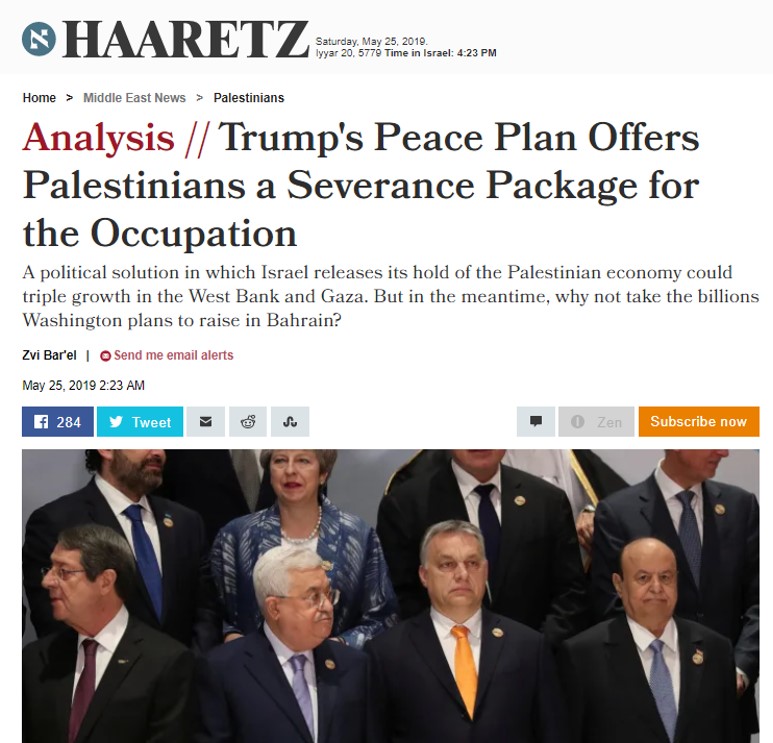
Zvi Bar’el, for instance, would probably describe himself as a senior journalist.  He sports the rather serious-sounding title of Middle East Affairs Analyst for the Israeli newspaper Ha’aretz; he even has a PhD in the History of the Middle East.  One of his ‘analyses’ was published a few weeks ago (after the UAE deal announcement), under the assertive title:

“Israel's Deal With the UAE Spells New Conditions for Ties With Arab States”.

Some may say that’s only stating the obvious – and I couldn’t agree more.  But I’m not complaining about the lack of insight – I’ve come to expect that; the problem is that nowhere in his learned article does Analyst Bar’el utter the words: ‘I got it wrong, folks – I’m sorry!’

Because Mr. Bar’el’s previous ‘analyses’ (i.e. before the UAE announcement) were rather radically different.  For instance, the one he published under the no-less sententious title:

“Without Solution to Palestinian Issue, No Arab State Will Seek Relations With Israel”

Mr. Bar’el began that previous ‘analysis’ by quoting Netanyahu’s statement, delivered at the UN:

“Many have long assumed that an Israeli-Palestinian peace can help facilitate a broader rapprochement between Israel and the Arab World. But these days I think it may work the other way around: Namely that a broader rapprochement between Israel and the Arab world may help facilitate an Israeli-Palestinian peace. And therefore, to achieve that peace, we must look not only to Jerusalem and Ramallah, but also to Cairo, to Amman, Abu Dhabi, Riyadh and elsewhere.”

Ha’aretz’s Middle East Affairs Analyst then proceeded to ridicule Netanyahu for that statement.  No, Arab country, declared our friend Zvi with iron-clad certitude, will “seek relations” with Israel unless the latter first magics up a “Solution to [the] Palestinian Issue”.  Well, the UAE (an Arab country by all accounts, including its name) did.  And two others (so far!) followed.

Hmm… so who looks ridiculous now?  Forgive my French, but I’d say that Zvi Bar’el has made a bit of an ass of himself.  Someone should tell him that, despite the partial homophony, the title of ‘Analyst’ does not derive from the word ‘anal’!

It is a sorry state of affairs when ‘Analysts’ (and journalists in general) are utterly ignorant of what is happening – until the moment it becomes public knowledge.  There were plenty of clues for Mr. Bar’el to pick up.  For years now, Netanyahu has been throwing thick hints about impending peace with the Arab world; so did Trump.  That there was considerable rapprochement was common knowledge.  And, if nothing else, it was clearly spelled out in the latest Coalition Agreement.  No, not the part about ‘annexation’ – leave that one to the hapless ‘analysts’; no, the part that says:

“The Prime Minister and Substitute Prime Minister will act together and in a coordinated fashion to advance peace agreements with all our neighbours and to advance regional cooperation […] all this while aiming to protect the security and strategic interests of the State of Israel, including the need to preserve regional security, uphold existing peace agreements and strive towards future peace agreements.”

The words “peace agreements” feature no less than three times in that one paragraph.  Enough of a clue – you’d think – to pique the curiosity of even a thick, jaded Ha’aretz Analyst.

But ‘journalists’ like Bar’el aren’t attuned to facts or evidence; they are driven by ideology, by beliefs.  According to Mr. Bar’el’s ‘secular religion’, Netanyahu and Trump are perennial liars – never to be believed; Israel’s desire for peace is forever suspect – lip service designed to hide nefarious intentions; and the plight of the Palestinian Arabs is the #1 issue in the whole wide blimming world.  For a certain ilk of pseudo-liberals, the above statements are Gospel – and one does not question scripture!

Now, I don’t wish to be too harsh: valued Middle East Analysts (even those with a PhD and – incredibly, I know – even those writing for Ha’aretz) are of course allowed to make mistakes, just like the rest of us.  But… forgive me if I humbly opine that, besides being a mark of character, admitting one’s mistakes should be a minimum requirement for retaining one’s credibility; if not one’s job.

But let’s stop picking on poor Zvi Bar’el – he is far from the only culprit: pretty much every other ‘Analyst’ (and probably his dog, too) agreed with him.  Until very recently, they all said that, while the Gulf Arab countries did not mind having the political equivalent of furtive sex with the Jewish state, they wouldn’t dreeeeam of formalising that relationship without Palestinian blessing.  And I have yet to hear one of those ‘analysts’ saying the magic words: ‘I was wrong’.

Which brings me to the next category.

The ‘anti-annexation’ activists

Anything involving Israel and the Palestinians is guaranteed to attract a disproportionate amount of attention from ‘activists’ with an axe to grind.  But few things caused such a berserk torrent of unbridled criticism like the ‘annexation’.  Convinced (mainly by their own prejudice) that all Netanyahu ever wanted was to despoil the Palestinians of ‘their’ land, lots and lots of people – from New Israel Fund, Yachad, J-Street and other ‘usual suspects’ to Western European politicians and US Democratic Party senators – came out to ‘express their grave concern’ with ‘the annexation plans’.  After all, as all of them declared (without even bothering to explain why) ‘annexation’ spells the death knell of the two-state solution – doesn’t it?

Even some of the people who are genuinely pro-Israel were baffled.  Why would a previously very cautious Netanyahu suddenly seem so keen to do something ’so radical’?  Well, as many an organisational behaviour consultant will tell you, most people don’t like change: given a choice, they tend to choose the ‘devil they know’; or at least to put off getting acquainted with the new fiend.  To effect a change, sometimes it is necessary to manufacture a crisis…

We know now that the UAE deal has been in the making for many months.  And one does not need a PhD in Middle East History to understand why it ultimately happened.

The threat of ‘annexation’ did that – and more.  In the words of ‘a White House official’ (quoted by Walla and the Times of Israel):

“We have been talking about this [the Israel-UAE normalisation] for over a year, but the issue of annexation created the atmosphere in which a deal became more attainable.”

This only sounds counter-intuitive to clueless ‘analysts’ and green (and I don’t mean just ‘Green Party’) European politicians.  In Middle Eastern politics, the ‘annexation’ was never an impending ‘catastrophe’; no, it was a brilliant gambit: it provided the Emiratis with the opportunity to ‘save the Palestinians’ and ‘to save peace’ – all while doing what they wanted to do anyway.  As for Netanyahu, he ‘reluctantly agreed’ to forgo something he didn’t really want to do in the first place (except under much more propitious circumstances), in return for peace with Arab world’s rising star.  Both sides achieved not just their purpose – but also found a way to sell that outcome to their domestic constituencies.

But was it really a gambit, I hear you asking?  Or was Netanyahu somehow ‘dissuaded’ at the last moment from putting in practice those nefarious ‘annexation plans’?

Well, what plans – pray tell me?  ‘Annexing’ land (i.e. governing it as part of Israel’s sovereign territory) is a rather large logistic operation.  It involves establishing (or at least re-deploying) government offices, security installations, centers of authority.  At a minimum, it involves re-deploying military assets.  Yet no preparations were made – or even sketched; no plans were submitted for approval; no sites were earmarked, not one army unit was moved.  Not just people in the street, but ministers and military commanders were left wondering what – if anything – was going to be annexed: a few symbolic dunams?  The Jordan Valley?  30% of the West Bank?

Plans?  There were no ‘plans’.  And why do you think that is?

The ‘annexation’ was a manufactured crisis, which enabled UAE leaders to present normalisation as the solution.

As for ‘anti-annexation activists’, none – to the best of my knowledge – has so far admitted they were wrong.  In fact, a few saw fit to express their great relief at the ‘suspension of annexation plans’.  Demonstrating either intellectual dishonesty or – more likely – just sheer stupidity.

‘Anti-racists’

There is more to apologise about than merely going over the top about ‘the annexation’.  A couple of years ago, I happened to have a discussion with a leading activist from New Israel Fund – UK.  We were in a small group and she launched into a rant about ‘the blatant racism’ that – in her view – was taking over the Israeli society; she rather aggressively asked me to condemn it.  I replied that I unreservedly condemn it; I added that, unfortunately, there is indeed despicable racism in Israel – just as there is in the UK, USA and elsewhere.  ‘Oh, no,’ she said with something I can only describe as cold anger.  ‘There is much, much more racism in Israel.’  I wanted to ask her for the evidence behind such grave accusation – but she gave every indication that, if I wasn’t going to admit that Israel was more racist than other countries, she wasn’t interested in any further debate with me.

For years now, it has become fashionable in certain circles to accuse not just Netanyahu, not just ‘the Israeli government’, but ‘the Israeli society’ en-bloc of racism, of callousness and lack of desire for peace, of ‘land theft’ and other sins.

The ‘evidence’ typically consists of ‘Israeli behaviour’ (as narrated and interpreted by the accusers), politicised opinion surveys (with questions the like of which are only ever asked of Israelis) and ‘anecdotal evidence’ – all of which demonstrate ‘deeply-entrenched anti-Arab racism’ and other such base attitudes.

These ‘Israeli attitudes’ are then employed to call for international ‘pressure’ on Israelis – who, as racist warmongers, cannot be expected to make peace of their own volition.

Speaking about opinion polls, however, one was performed after the UAE announcement: it seems that nearly 80% of ‘the Israeli society’ supports the agreement with UAE over ‘the annexation’; less than 17% expressed the opposite view.  In fact, since the announcement, the entire country has been in a celebratory mood.  It seems that, despite their engrained anti-Arab racism and their lack of desire for peace – Israelis dream of traveling to the UAE, of doing business there, of having Emirati Arabs visit and do business in the Jewish state.  Hundreds of Israelis were visible on Twitter, seeking to make friends with the Arabs they purportedly despise out of racial prejudice…

And it wasn’t just people in the street: the much maligned ‘right-wing Israeli government’ voted unanimously in favour of the Abraham Accords – as did parliamentarians representing ‘extreme right’ opposition parties.  In fact, the only Israeli party that voted against peaceful relations with the United Arab Emirates was… the Joint (Arab) List!  Needless to say, none of the ‘peace activists’ criticised the Israeli Arab parliamentarians for that stance.  Pseudo-liberals – as we know – only see faults in Jews.

‘Prominent British Jews’

But there’s somebody else who owes the Israeli public – and their own community – an apology.  A few months ago, 40 ‘prominent British Jews’ wrote a letter to Israel’s Ambassador to London, protesting ‘the annexation’.  So what’s wrong with this, you ask?  Surely British Jews – whether ‘prominent’ or not, are entitled to write to the ambassador of the Jewish state?  Of course they are; but they chose a rather weird way to do it.  You see, if I want to send a letter (whether to an ambassador or to the lovely man who sweeps the street in front of the Embassy, it does not matter), I use the good services of the Royal Mail.  Of course, I’m not ‘prominent’; if I were a bit posh, I might use a courier – or send my personal valet to drop the letter at the Embassy.  But that’s not what our ‘Prominent Jews’ did; no, they published their letter in the newspaper.  Which newspaper, you’re asking?  Why, Ha’aretz of course – what else?! 

And what did they write, these ‘prominents’?  Well, they expressed their “unprecedented level of concern”.  As well as the following ‘analysis’:

“We are yet to see an argument that convinces us, committed Zionists and passionately outspoken friends of Israel, that the proposed annexation is a constructive step.  Instead, it would in our view be a pyrrhic victory intensifying Israel’s political, diplomatic and economic challenges without yielding any tangible benefit.”

Needless to say, there were other, even saucier passages, all faithfully and gleefully reproduced by other “friends of Israel” – such as The Guardian and the BBC.

Judging by the above emphatic pronouncement, one would be tempted to think that ‘the Prominents’ are all high-level experts in Middle East politics.  But… no, they’re not.  They’re not even Ha’aretz Middle East Affairs Analysts.  Most of them are politicians and businessmen, a few even political activists masquerading as Rabbis.

What is unclear is: why do these people (who live in Britain, pay taxes in Britain, vote in Britain and do not have to serve in the army in Britain) presume to publicly tell Israelis what to do?  I wonder how would they feel if 40 ‘prominent Israeli Jews’ would have published a letter in The Guardian, declaring something like ‘we are still to see an argument that convinces us that Brexit is a constructive step’?

Why do these arrogant pricks think they understand Israel’s needs and interests better than the elected representatives of the Israeli public?  Why do they see themselves as responsible adults, while viewing Israeli leaders (some of whom have fulfilled for many years positions of vast responsibility in government and/or security forces) as little more than children?

Most believed that Netanyahu – the new Genghis Khan, just as reckless, primitive and bent on destruction as the old one – was about to inflict a huuuge catastrophe upon the Jewish state and on the entire Jewish people.  But a cooler, more sober, more ‘anal’ analysis might have concluded that Netanyahu is anything but reckless.  Sure, like Trump, Netanyahu isn’t everybody’s cup of tea.  Hate the man, if you so wish; despise him for his cigars, his ice-cream, his alleged corruption, his spiteful wife or his undeniable achievements.  But reckless?  No, this guy’s a calculated son of a bitch – if ever there was one.  Netanyahu may play for high stakes – but his game is chess, not backgammon: he does not roll the dice.

By and large, the demarché of the ‘prominents’ was no surprise – most of them have said and done stupid, outrageous things in the past.  Unfortunately, this time their ranks included also people like Howard Jacobson, whom I respect.  What possessed you to add your distinguished name to that shameful list, dear Howard?

I know, I know: we are way past Yom Kippur.  But not past redemption, not yet.  It’s not too late.  Please: would you be a mensch and say “I’m sorry”?

Friday, 29 May 2020

Yachad: “together” with intellectual dishonesty?

The Coalition Agreement which forms the basis of the new Israeli government includes the possibility for Prime Minister Netanyahu to proceed – with US blessing and as part of the new US peace proposal, plus a host of other conditions – with the ‘annexation’ (or ‘application of sovereignty’, however one chooses to call it) of parts of the West Bank/Judea & Samaria.
This has caused controversy both in Israel and among Diaspora Jews – even among staunch Zionists.  Yachad (Hebrew for ‘together’ – a group of hard-left British-Jewish activists who proclaim themselves as ‘pro-Israel’ but rarely, if ever, have anything positive to say about the Jewish state) has been particularly vocal in the campaign against ‘annexation’.  So far – so legitimate; nothing wrong with that.
But legitimacy – along with credibility and respect – evaporates when exposed to crass intellectual dishonesty.
One doesn’t need to lie in order to oppose ‘annexation’; one can campaign – even campaign passionately – without trying to deceive.  Passion is not a licence to cheat.

Yachad’s misleading newsletter
On 28 May 2020, Yachad’s Director sent a newsletter to the group’s list of contacts.  This is what she wrote, among other things:
Netanyahu is right, annexation is not democratic.
In an interview published today, Prime Minister Netanyahu admitted that Israel will not “apply sovereignty” and give citizenship to Palestinians living in West Bank areas which Israel intends to annex. “They will remain Palestinian subjects if you like,” he said. According to the Israeli Prime Minister’s plan, Palestinians living in annexed areas will live “under [Israel’s] security control” but will not be equal citizens.
Now, let’s go to the interview that Yachad refers to.  Here’s the question and Netanyahu’s response, which the newspaper even provides with the subtitle “A Palestinian enclave”:
Q: Nevertheless, several thousand Palestinians live in the Jordan Valley. Does that mean they will receive Israeli citizenship?
[Netanyahu]: “No. They will remain a Palestinian enclave. You’re not annexing Jericho. There’s a cluster or two. You don’t need to apply sovereignty over them, they will remain Palestinian subjects if you will. But security control also applies to these places.”
Clearly, Netanyahu talks about areas (such as the city of Jericho) that will not be annexed by Israel.  The US ‘Peace to Prosperity’ Plan describes such Palestinian enclaves – areas of Palestinian sovereignty connected to the envisaged State of Palestine by access roads.  Since they live in areas earmarked for the future State of Palestine, the inhabitants of these enclaves are Palestinian citizens, not Israeli citizens.  Conversely, there are also Israeli enclaves in the midst of the Palestinian state; these are connected to Israel through access roads and their inhabitants are citizens of Israel.  Here is the exact wording of the Plan:
The Palestinian population located in enclaves that remain inside contiguous Israeli territory but that are part of the State of Palestine shall become citizens of the State of Palestine and shall have the option to remain in place unless they choose otherwise. They will have access routes connecting them to the State of Palestine. They will be subject to Palestinian civilian administration, including zoning and planning, within the interior of such Palestinian enclaves. They will not be discriminated against and will have appropriate security protection. Such enclaves and access routes will be subject to Israeli security responsibility.
The Israeli population located in enclaves that remain inside contiguous Palestinian territory but that are part of the State of Israel shall have the option to remain in place unless they choose otherwise, and maintain their existing Israeli citizenship. They will have access routes connecting them to the State of Israel. They will be subject to Israeli civilian administration, including zoning and planning, within the interior of such Israeli enclaves. They will not be discriminated against and will have appropriate security protection. Such enclaves and access routes will be subject to Israeli security responsibility.
So let’s summarise: Netanyahu said (emphasis mine)
You’re not annexing Jericho. There’s a cluster or two. You don’t need to apply sovereignty over them, they will remain Palestinian subjects if you will.
Yachad says (emphasis mine)
Netanyahu admitted that Israel will not “apply sovereignty” and give citizenship to Palestinians living in West Bank areas which Israel intends to annex.
Netanyahu clearly talks about territory that Israel will not annex; Yachad says he referred to areas that Israel will annex.  This, without the shadow of a doubt, is twisting Netanyahu’s words.  It’s horribly misleading.  But, worse, I believe it is a deliberate misinterpretation, an attempt to deceive.  Here is why:
  1. The Yachad’s Newsletter does in fact include a link to the text of Netanyahu’s interview. But that link is placed at the bottom of the email, where most readers are likely to ignore it.  In addition, the link is to the Hebrew version of the interview.  But it is reasonable to assume that most of Yachad's audience (British Jews) typically do not read modern Hebrew – or not well enough to fully understand the meaning of what was said.  It would have been honest to place a link to the English translation of the interview (published in the same newspaper) in the actual paragraph.  For instance, by making the word 'interview' itself a link, as I did above, which would have allowed readers to easily access that interview and check for themselves.  
  2. Alterntively, Yachad could at least have quoted the short passage from Netanyahu’s interview, in English translation, just as I did above. Instead, they chose to (mis)‘interpret’ it, cutting and pasting small bits in a way that changed the meaning.  The question is – why?
  3. Yachad knows the situation in the West Bank – they’ve been organising ‘educational’ tours (read: indoctrination field trips) there for years. The city of Jericho and its hinterland are Area A – the part of the West Bank that, since the Oslo Accords, is under the complete control of the Palestinian Authority – with Israel allowed to intervene only in cases of severe security breaches.  Yachad knows very well that the ‘annexation’ refers to parts of Area C, the part of the West Bank where Israel was granted complete control.  I’ve heard the same Director of Yachad delivering a presentation on Oslo and Areas A, B and C.  Much as I’d like to, I cannot believe that she missed the reference to Jericho and its significance.
  4. Yachad are neither stupid nor newcomers to the intricacies of the US Peace Plan – they campaigned against it; they are familiar with Israeli politics and with the positions of the main personalities – certainly Netanyahu. They heard, not so long ago, Mark Regev, Israel’s Ambassador to London explaining that Israel will indeed offer citizenship to Palestinians inhabiting areas ‘annexed’ by Israel – just as she did when it ‘annexed’ the Golan Heights and East Jerusalem.  At the very least, that knowledge should have made Yachad circumspect in reading and ‘interpreting’ that part of Netanyahu’s interview.

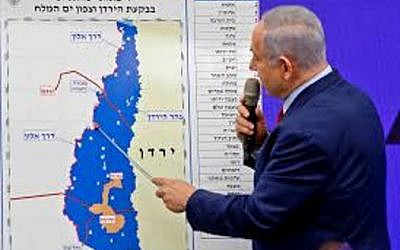
Netanyahu has previously explained the extent of his planned Jordan Valley ‘annexation’. The orange patch in the thicker part of the blue area is the Jericho area. This is part of Area A and is not included in the planned ‘annexation’. {Youtube screen capture}
Yachad may point to some Israeli journalists (notably Ha’aretz) who made the same dishonest claim.  But two liars don’t make a truth.  At least Ha’aretz published the original fragment from Netanyahu’s interview, allowing people to judge for themselves, to spot the spin.
Yachad’s Director now has a last-ditch opportunity to be a mensch: she can write to the group’s contacts, apologising – without reservations, without ‘hochmes’, without trying to squeeze further dishonest propaganda from what she will say is an honest mistake.  She should furthermore publish her apology in the Jewish News and Jewish Chronicle – the same newspapers the group often uses to convey their other messages.  She should apologise in situ for the equally misleading social media posts.
If she chooses not to do all that, then the verdict is inevitable.  This is not about ‘annexation’ or Israel – we can agree or disagree on that.  It’s about ethics; it’s about salvaging a remnant of credibility.
Intellectual dishonesty is always off-putting.  But it is never more appalling than when employed by the self-righteous, by those who seek to cover themselves in the noble mantle of morality.  Lies and deceit make shaky rungs on a ladder leading not to high moral ground – but to the depths of moral turpitude.

Note: a previous version of this article mistakenly stated that no link to the interview was provided in Yachad's email.  It was – though the link was to the text in Hebrew (a language most British Jews do not speak) and it was included in the 'Read more' section at the bottom of the message, where most people would probably ignore it, as I did initially.

Saturday, 31 August 2019

Israelis, Palestinians and ‘Love Island’

I have a confession to make: I am one of those few weirdos who never bothered to watch an episode of Love Island.  Which is why my knowledge of this TV show is second-hand at best; and why using this metaphor is – I have to admit – a bit of a cheap trick to get you hooked, dear reader.

I understand the attractions of love – but why on an island?  Perhaps because islands have that strange allure: they are constrained geographies suggestive of enforced isolation from without and imposed intimacy within.

From Gauguin to Attenborough, from Defoe to Swift, we’re all fascinated by islands.  They are world’s quintessential test tubes: riveting experiments in natural and social eccentricity.


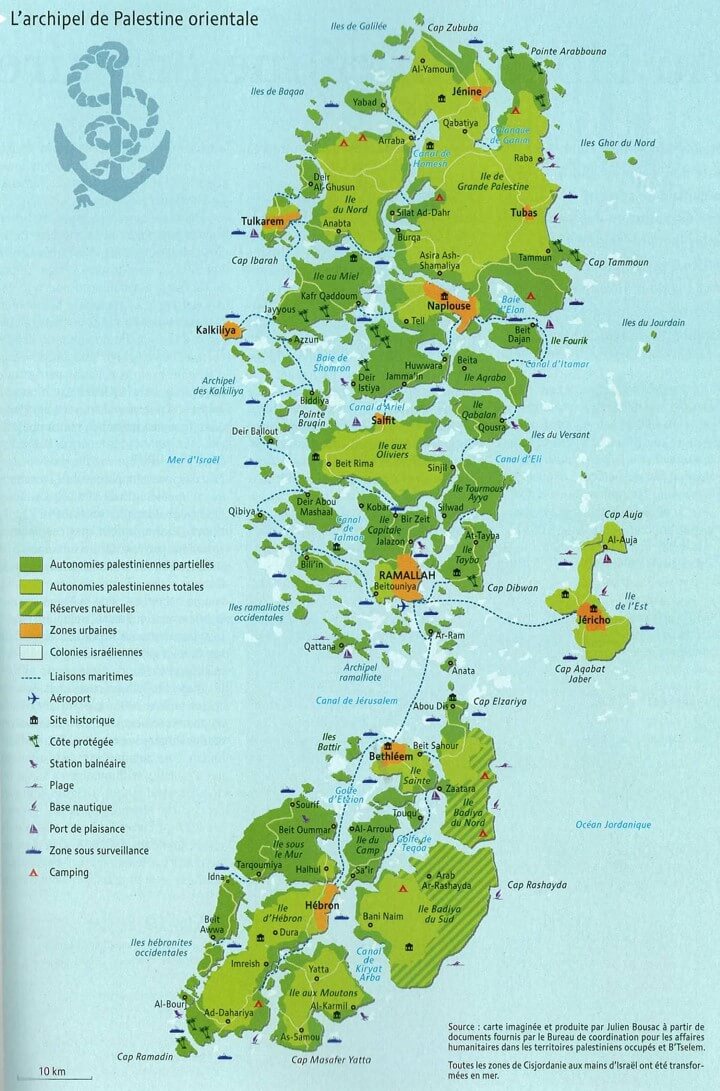
With their rich, often over-the-top imagination, ‘pro-Palestinian’ activists could not possibly have missed the metaphoric potential of islands.  They harnessed that potential ‘for the cause’ by portraying the Palestinian Authority-governed areas of the West Bank (defined in the Oslo Accords) as an ‘archipelago’ of small islands in a ‘sea’ of Israeli ‘settlements’.  Such allegoric maps travel far and reach wide; their message is clear: a patchwork of Palestinian ‘islands’ cannot be turned into a viable state.


Not satisfied with the mere allegory, some activists are shouting that message in full-throated, indignant, moralising voice: it is too late for the two state solution.  Often, they blame Netanyahu and ‘his settlements’; but Seumas Milne (a former journalist and currently top courtier to Labour Party leader Jeremy Corbyn) suggested, even 15 years ago, that the two-state solution was no longer achievable.

Among certain ‘pro-Israel’ activists (and even among some Israelis), such suggestions are a source of dread and despair.  In the absence of a Palestinian state, they say, Israel’s choices are grim: either ‘one-state’ in which Jews will be (or will quickly become) a minority; or else an apartheid state – in which the Palestinians won’t possess full political rights.

A recent Jewish Chronicle article quotes Tal Keinan, an American-Israeli businessman and former Israeli fighter pilot, who argues that there are “only three possible endgames” for Israel:
"The first is that Israel could annex the West Bank and give its Arab residents citizenship – which would mean Israel ‘opening itself to the prospect of demographic suicide’. […]
The second option would be to annex the Palestinian territories without granting the Palestinians citizenship – imposing sovereignty on a large number of people without representation. […]
The final option […] is for Israel to withdraw from most of the territories, with or without an agreement with the Palestinians. If the Palestinians build a state, there will be a state, but if not, the West Bank ‘will likely become another rocket base’."


So there you are: the options are oblivion, apartheid or being bombed to smithereens.  As the current British Prime Minister would put it, doom or gloom!

There’s a debate to be had on whether it is indeed too late for the ‘two state solution’; and whether lack of ‘full political rights’ equals ‘apartheid’.  But I do not wish to go there now.  My question is: are those ‘3 choices’ really the only possible ‘endgames’?  Or are the prophets of doom merely demonstrating their own stale thought processes, their own lack of imagination and creativity?

I am fascinated by islands.  They are such interesting places!  Let’s let our minds travel to a few islands – and see what we can learn.

A ‘Great’ Britain with some little ‘dependencies’

To start with, I won’t have to travel too far: I live on the island of Britain, which some (both on and outside it) still sometimes call ‘England’.  But it isn’t ‘England’ – the island of Britain is part of a sovereign state called the United Kingdom of Great Britain and Northern Ireland.  Although it is not formally called a federation, this is in fact a federal state made up of four ‘countries’: England, Scotland, Wales and Northern Ireland – each of them endowed with a great deal of political, economic and cultural autonomy.  Nonetheless, there are nationalist movements in each of these ‘countries’, aspiring to more autonomy and even to outright secession from the federation. 

I have recently travelled to Scotland, where great efforts are being made to revive and expand the use of Scottish Gaelic.  Upon return to London, I discovered that I still had a pocketful of Scottish banknotes.  The ‘Scottish pound sterling’ is worth exactly as much as the ‘British (not English!) pound sterling’; but the banknotes are underwritten by the Royal Bank of Scotland and bear different images from their ‘British’ counterparts.  Those strange-looking banknotes may be legal tender throughout the UK; but they are, let me tell you, viewed with suspicion by London retailers, many of whom seem to see them for the first time.

Another ‘country’ – Wales – occupies a peninsula in the West of Britain.  Wales is very similar in size to Israel, but it is less densely populated.  The vast majority of its inhabitants speak English and only one in five has Welsh as their mother tongue.  Still, Welsh is an official language in Wales, on a par with English; no expenses are spared – everything (from road signs to court summons) is written in both languages.  And children have to study Welsh in school, whether they have any use for it or not.

But ‘Great’ Britain is not as interesting as some of the smaller islands off its coast.  Take for instance the Isle of Man, a territory just one-and-a-half times the size of Gaza Strip.  The Isle isn’t part of the United Kingdom; nor is it a sovereign, independent state.  It is, instead, defined as a ‘British Crown Dependency’.  If you think that this means ‘owned by the Queen’ – think again: Queen Elizabeth the Second could not sell off that piece of real estate to – say – Donald Trump; even if he was interested and however much Her Majesty wanted to oblige!

Most Isle of Man inhabitants have the status of ‘Manxmen’ (and Manxwomen?)  Manxmen are ‘in principle’ British citizens; in principle only, because they cannot, for instance, vote in UK national elections and are hence not represented in the UK Parliament.  Although decisions made in that Parliament can have a huge impact upon their lives.  For instance, Manxmen could not vote in the 2016 Brexit referendum.  But, although the island is not part of the United Kingdom – and also not part of the European Union – its economy is strongly affected by the trade between the two…

Manxmen do elect the 24 members of the House of Keys – the lower chamber of the local ‘Parliament’, which deals with most internal matters.  Issues pertaining to defence, international relations, as well as the final say on matters of ‘good governance’, however, are the competence of the UK government and parliament.

Fiercely dependent:
Manxmen are proud citizens of a British Crown 'Dependency'
Upon application, Manxmen are issued with specially printed  British passports.  But instead of ‘United Kingdom’, those passports declare their bearers citizens of a strange entity called ‘British Islands – the Isle of Man’.  Such passports allow Manxmen to travel to – for instance – EU countries; but, unlike ‘regular’ British citizens, they are not entitled to work there.  Nor are EU nationals entitled to work on the Isle of Man, although they (still) can work in the UK.


The British Crown possesses also other ‘Dependencies’ – including several islands in the English Channel/La Manche: Jersey, Guernsey, Alderney and Sark.  Each island is governed separately, according to its own traditional system, mostly originating in the early Middle Ages.  Their combined population is estimated at around 165,000.  None of the Channel Islands is represented in the UK Parliament and, as a rule, their ‘citizens’ cannot vote in UK national elections and referenda.  Their status is, roughly speaking, similar to that of Manxmen.

Something is rotten in the state of Denmark


If we let our mind fly north-west of Britain, across the North Atlantic ocean, we come across Donald Trump’s latest real-estate project: Greenland.  It is the world’s most sparsely populated ‘country’ – with just one inhabitant on average per 10 square miles of territory; but it is also the world’s largest island: circa 10 times larger than Great Britain and 100 times larger than Tiny Israel.

Politically, Greenland is defined as an ‘autonomous region’ of the Kingdom of Denmark – a ‘region’ 50 times larger than Denmark-proper.  Some call it a ‘constituent country’ – similar in principle to the status of Scotland or Wales within the UK.

Happy Greenlanders

The majority of Greenland’s population (circa 88%) belongs to the indigenous Inuit (a.k.a. Eskimo) ethnicity, akin to the natives of North Canada and Alaska.  They speak their own language.  The balance consists of Danish settlers.

Greenlanders elect 2 representatives to Denmark’s parliament, out of a total of 179.  They also elect the 31 members of Greenland’s own parliament, which in turn elects a local government with a high degree of internal autonomy.  However, the Danish government sitting in Copenhagen is responsible for decisions pertaining to defence and international relations; even for those that directly affect the inhabitants of the ‘constituent country’ of Greenland – such as the permission to locate nuclear weapons on the island.

In 1973, the Kingdom of Denmark (including Greenland) became a member state of the European Community – precursor to the European Union.  But, using its greater autonomy achieved in 1979, Greenland voted in 1982 to leave the economic block – and completed that exit by 1985.  It is no longer part of the European Union; but it is still part of the Kingdom of Denmark, a member state of the European Union…

Economically, Greenland has long been highly dependent on Denmark.  However, for the past decade or so, the Greenlandic government has worked steadily to gradually reduce the economic dependence, with the ultimate goal of attaining political independence.

The Kingdom of Denmark ‘owns’ also another ‘constituent country’: the Faroe Islands.  Their status is roughly similar to that of Greenland: the Faroese elect 2 members of the Danish Parliament, as well as all 33 members of the local parliament.  Just like in Greenland, there is a local government, led by a Prime Minister; there is also a strong movement demanding political independence.  A separate Faroese Constitution drafted in 2011 has been rejected by the Danish government of the time, as ‘incompatible’ and ‘cannot co-exist’ with the Danish Constitution.

The poor ‘rich harbour’

By now, you probably think that ‘special status’ islands are but vestiges of medieval kingdoms, bizarre anachronisms somehow preserved into modernity.  Well, not exactly: some of them are part of relatively young republics.

One such island is Puerto Rico.  ‘Discovered’ by Columbus, it was incorporated into the Spanish Empire and colonised by (mainly) Spanish settlers, who wiped out the indigenous population and culture.  But in 1898, it was conquered by the United States.

The term ‘colony’ is not en-vogue any more; but Puerto Rico is not a federal US state, nor is it part of a state.  It is, therefore, defined these days as a ‘United States unincorporated territory’.  In this context, ‘unincorporated’ means that the US Constitution does not apply in full: only ‘fundamental rights’ are protected, other constitutional rights are not.  As a consequence, although the Puerto Ricans are ‘in principle’ US citizens (since 1917), they cannot vote in US presidential elections and do not have senators or voting representatives in the US Congress.  Instead, the 3.2 million Puerto Ricans elect a local Governor and a bi-cameral parliament.  However, the head of state is the President of the United States.  The jurisdiction and sovereignty belongs to the United States of America and the ultimate power is vested in the US Congress.  Laws adopted by the latter apply to Puerto Rico by default.  Many US federal agencies (notably the FBI) are active in Puerto Rico.


A very lonely star...
Puerto Rico calls itself Estado Libre (Free State). But it is neither an independent state, nor a US state.

As US citizens, Puerto Ricans can serve in the US military – in fact they were historically forced to serve whenever the US adopted compulsory military draft.  However, Puerto Rico also has its own National Guard, distinct from the US National Guard.  The commander-in-chief of the Puerto Rican National Guard is… the President of the United States.

On average, Puerto Ricans are significantly poorer than the citizens of the State of Mississippi – the poorest of US states.

US controls a few other ‘unincorporated territories’ with roughly similar regimes – and they happen to also be islands: Guam, Northern Mariana Islands, U.S. Virgin Islands and American Samoa.

And a ‘fragrant’ harbour

I never noticed any particularly pleasant smell when I visited Hong Kong, but many believe that ‘Fragrant Harbour’ (hēung gong in Cantonese) is the origin of the modern name.
Hong Kong consists of the eponymous island, plus an archipelago of some 200 other islands and two small pieces of territory on the coast of Southern China.  In total, it is not much larger than the Gaza Strip – but it is more densely populated: more than 17,500 inhabitants per square mile, compared to Gaza’s 13,000.


How to live on an archipelago:
one can travel among the main islands of Hong Kong by underground train.

In theory, Hong Kong is part and parcel of the sovereign territory of the People’s Republic of China.  But it certainly does not feel that way.  And it’s not just a matter of a different flag, state symbols and anthem.

The official language of China is Mandarin – written with simplified Chinese characters.  In Hong Kong, it is Cantonese, inscribed with traditional characters.  Which render anything spoken or written in Hong Kong unintelligible to most people in China.

Cars cling to the left side of the road in Hong Kong, still following the British tradition; but they are driven on the right in China.

Five years ago, I travelled to China via Hong Kong.  To start with, I had to apply for a Chinese visa; but when I finally got it, was told that it’s not valid in Hong Kong – where one needs a separate visa; or, in the case of my Israeli passport, no visa for Hong Kong, yes visa for China.

Flights from Hong Kong to Beijing are expensive, as they are considered international flights.  I was advised, instead, to buy a seat on one of the many cars and coaches ferrying passengers from Hong Kong Airport to Shenzhen Airport just across the border with China.  I do not use the term ‘border’ lightly: en-route to Shenzhen, my passport was checked twice, within a 50 yards stretch of road: first by the border police of Hong Kong, then by Chinese border officials.

Once at Shenzhen Airport, I boarded a much cheaper, probably subsidised ‘domestic’ flight to Beijing.

I paid for the transfer from Hong Kong to Shenzhen with Hong Kong dollars, but they’re not legal tender in China; so I had to buy the flight ticket Beijing with Chinese ‘renmimbi’, not accepted in Hong Kong.

All this may sound and feel strange, given that Hong Kong is not an independent state.  Officially, Hong Kong is called a ‘Special Administrative Region of the People's Republic of China’.  But in this case, ‘special’ is an understatement.

As I am writing this, there are widespread protests in Hong Kong against Chinese ‘interference’ – protests triggered by a change in law allowing certain offenders to be ‘extradited’ from Hong Kong to... another part of China’s ‘sovereign territory’.  Go figure!

So what?

By now, I can hear quite a few of you grumbling: what do all these islands have to do with anything?  Israel has occasionally been called ‘an island’ – as in ‘an island of freedom in a sea of tyranny’; but geographically it certainly is no island.

Well, I’m afraid I used the ‘islands’ allegory only as a crafty rhetorical device.  This isn’t just about islands, there are many other, ‘continental’ examples.

The point is that the ‘sovereign state/no state’ paradigm is based on a false dichotomy.  Reality is much more complex than that; there are almost-states, states-within-states, incorporated ‘unincorporated territories’, ‘constituent countries’, ‘special administrative regions’ and a myriad other ‘unconventional’ political constructs.

It may be that none of the existing models described above precisely fits the requirements of a future Israel-Palestinian Arabs accommodation.  But what these ‘islands’ prove is that there’s a huge breadth of possibilities – rather than a binary option.

Human beings are endowed with imagination, creativity and problem-solving abilities.  They are also ‘tribal’ and seek self-determination: the right to control their destiny, while organising themselves along ‘tribal’ identities that both unite and divide.  And, as a result of all that, human communities have evolved and are evolving in many complex, unusual, original ways.  Because no man is an island; not even on the Isle of Man.


The conflict between Jews and Arabs – or between ‘Israelis’ and ‘Palestinians’ – is a conflict between right and right.  Not a dilemma, or even a multiple-choice question; but an art project, a piece of blank canvas.

We live in a world of endless possibilities.  There are no slim choices, just narrow minds; mankind doesn't inhabit rigid, tidy little boxes – only some men do.

Saturday, 25 May 2019

Give peace a chance!


Trump’s ‘Deal of the Century’ between Israelis and Palestinians may yet prove to be the Flop of the Century.  But its architects have been amazingly successful at keeping mum: I can’t remember any other political programme that has been kept so secret for so long, in the face of such keen curiosity from journalists, pundits and political adversaries.  Nobody knows what the plan is; no details have leaked, no positions have transpired.  Unheard of!

No wonder, then, that everybody is jittery: Israelis and Palestinians, Jews and Arabs, left-wingers and right-wingers… Kept in the dark, they are reduced to… well… guessing.

One understands this; it’s human nature.  Guessing is one way to try and gain some control in a world plagued by uncertainty.  But assuming the worst when knowing the least is not mere guessing – it’s something else.

It may be distressing to see the Palestinian Authority rejecting the new peace plan before even knowing what it contains; but a surprise it ain’t: after all, that Authority is made up of people who make a nice living out of the status-quo; from their point of view, any change (whether led by Trump, Obama or Clinton) risks being a change for the worse.

Waaay more surprising is the deluge of negative reactions from the ranks of the self-proclaimed 'progressive', 'pro-peace' camp.  Granted, these people don’t like Trump (I’m being a bit British here: they hate his guts, actually).  But hey: God (or the forces of Dialectical Materialism) moves in mysterious ways.  After all, those same self-proclaimed 'progressive', 'pro-peace' activists like the Egypt-Israel Peace Treaty; which was signed not by doves, but by right-wingers Menachem Begin and Anwar Sadat.  So why not wait until a few details have been revealed about the Trump plan?  It’s likely to happen in a matter of weeks, if not days.

I find it disturbing to see so many 'pro-peace' activists ranting against a peace plan – any peace plan.  And in particular one that they (along with everybody else) know nothing about.
"Pro-peace" – but only if it's the "correct" peace.
Writing in the Times of Israel, former Knesset Member Ksenia Svetlova attacks the ‘Deal of the Century’ for trying to offer economic benefits, rather than political solutions:
“So what is left of Trump’s peace plan if we take out the whole matter of an independent Palestinian state? Only the ‘economic peace’ that Prime Minister Benjamin Netanyahu has been talking about for so many years."
Following a well-known activist’s gambit (when your argument is thin or dishonest, bring up a ‘human story’ to stir up readers’ emotions), Ms. Svetlova goes on to describe the plight of… Palestinian ice-cream manufacturers.  Apparently, Israel does not allow one such manufacturer in Gaza to export its products, claiming that “it [i.e. Israel] has not yet set up the required supervisory [i.e. security] mechanisms”.  An excuse that Mr. Svetlova derides:
“The State of Israel, which has pioneered advanced technological and human capabilities to detect whether the mother of an American Jewish tourist has friends in B’tselem, has no technological solutions to enable it to inspect goods from Gaza.”
In fairness, I tend to agree with her: I’m sure a technological solution can be developed, which would allow soldiers to detect explosive material, weaponry or parts thereof frozen inside a box of ice-cream.  What is, however, less clear to me is: why would Israel use its taxpayers’ money to develop and implement such a solution in order to enable exports from a hostile territory – when the most likely outcome would be that the resulting profits (or parts thereof, at least) would end up financing Hamas’s rocket capabilities, tunnels, attempts to break into Israel and other such goals?
But it’s not just Gaza – there are apparently also ice-cream manufacturers in the West Bank.  And, while Israel in principle allows the West Bank to export its products, Ms. Svetlova tells us that in practice
“The owners of the Al-Araz ice cream plant in Nablus would also be happy to reap the economic benefits of peace. But ice cream is a delicate and fragile product, and long waits at the checkpoints do it no good."
Upon reaching that passage, I’m sure that some of Ms. Svetlova’s readers will be wiping a tear: despite their occupation-induced misery, the poor-but-brave Palestinians manage to produce a bit of ice-cream – enough to export even!  But those nasty Israelis make them wait at the checkpoints, causing the ice-cream to melt, along with the readers’ tender hearts.

Except that, in the very next sentence, we learn that the same Palestinian ice-cream manufacturer
“whose ice cream is every bit as good as its Israeli counterparts, markets to the West Bank and to Jordan, and a bit to Dubai."
Now, that’s surprising.  Because, to sell in the West Bank and Jordan, the Palestinian ice-cream has to cross checkpoints manned by the same nasty Israelis.  As for shipping to Dubai (about 1,500 miles away from Nablus), surely that takes longer than crossing even the most vicious Israeli checkpoint?
When the tears are wiped off and the brain gears engaged, one finds more than a hint of dishonesty in Ms. Svetlova’s story: ice-cream is indeed a “delicate and fragile product”; which is why it is always moved around (even in frigid Scandinavia, let alone in the torrid Middle East!) in frigorific road trucks, railway cars and shipping containers – designed to keep that product from melting, whether en-route to Dubai, Jordan, Israel  or South Patagonia.  So, whatever it is that’s preventing Al-Araz from exporting ice-cream to Israel, it is not “long waits at the checkpoints”.

But a closer look at the primary thrust of Ms. Svetlova’s article reveals that it, too, is fatally tainted by dishonesty.  After all, she describes the – yet unpublished and unknown – “Trump’s peace plan” as merely an attempt to bribe the Palestinians:
“It’s supposedly a simple idea. We’ll give the Palestinians financial incentives so that they can develop their economy, create factories and jobs, and in exchange they will cease their military and political struggle and stop dreaming of freedom and sovereignty. In exchange, the economic flourishing will bring stability and quiet to the entire region."
Having ‘established’ that, she goes on to teach us how “real life” works:
“The problem is that in real life, the economic, the military, and the political cannot be separated from one another.”
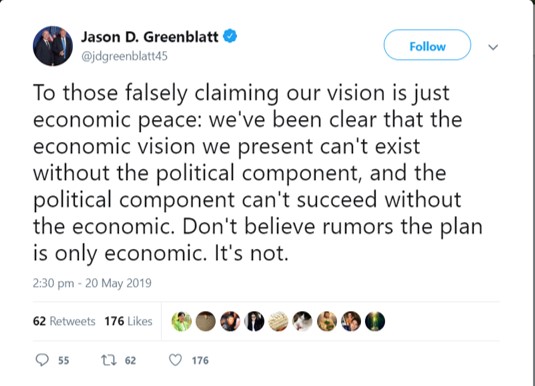
That’s a cogent argument – if one ignores the fact that it’s based on a lie.  In fact, the new peace plan’s architects have been very clear that, while the plan included economic incentives, those are designed to come alongside – not instead of – political solutions.  In fact, Jason Greenblatt – one of the plan’s main architects and, in consequence, one of the very few people who really know what it contains – made that clear repeatedly; including on 20 May, two days before Ms. Svetlova penned her diatribe.

One can argue against the ‘Trump plan’ (if one is inclined to argue against anything ‘Trump’) without resorting to dishonesty.  It would be more than legitimate to doubt, for instance, whether either economic incentives or political solutions can be delivered in practice, given that both the Palestinian Authority and Hamas have already rejected them out of hand.  One can argue that, in the face of that rejection, the ‘Trump plan’ is doomed to fail.

But then, decades of two-state-solution negotiations – including those led by Ms. Svetlova’s own party – have also failed.  It is difficult to see why the same approach that failed umpteen times in the past would succeed this (umpteen + 1) time.  And it is difficult to understand what's to be gained by rejecting a new approach out of hand – before even learning what that approach actually is.

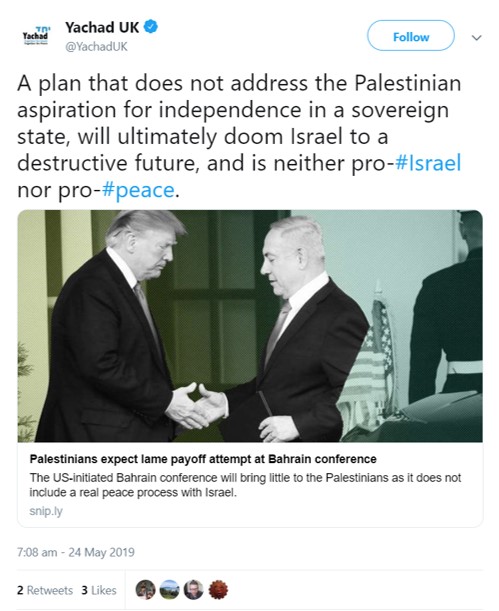
Among the cohort of critics of the yet-unpublished peace plan is the British-Jewish organisation Yachad, which describes itself as “pro-Israel, pro-peace”.  The group is so keen to attack that peace plan, that it even promoted an article from Al-Monitor, a ‘news’ website accused of being a mouthpiece for the Assad regime.

Yachad added their own view:


Once I got over my awe at the stentorian tone, I asked myself: how do Yachad activists know what the “Palestinian aspiration“ is?  Beyond the rather neo-colonialist tendency of attributing to other cultures our own ‘way of doing things’?  Of course, the Palestinian Authority/PLO/Fatah screams that aspiration to the entire world.  But what does that count for?  The last (and only) time Palestinians in West Bank, Gaza and E. Jerusalem had something remotely resembling free elections, a plurality voted for Hamas – whose declared goal is certainly not a sovereign state living in peace alongside Israel.

Yachad activists have visited the West Bank and met Palestinians – typically those that are themselves activists on behalf of the same Palestinian Authority/PLO/Fatah.  I have no doubt that, when queried by some starry-eyed Yachad activist, those Palestinians delivered the ‘correct message’.  But, again, what does that count for?

The 'peace activists' will tell you a tale of across-the-board Palestinian rejection of
Trump's plan.  But, as usual, the picture is more nuanced...

As I wrote elsewhere, the Palestinians are certainly entitled to their aspirations.  But what these aspirations actually are, it’s hard to know.  If anything, the more trustworthy opinion polls show them as ambivalent at best on the issue of ‘two-states’.

In fact, I would suggest that, leaving aside the corrupt political class, the Palestinian Arab masses are yet to make up their collective mind as to how their future should look like.  And why would it be any different?  The same can be said about Arab masses at large.  The fact is that Palestinians (like other Arabs) live under dictatorial regimes, with no freedom of speech and political debate.  It does not help that they also live in an ultra-conservative society rife with taboos, in which dissent is frowned upon and worse.

Unlike certain 'peace activists', I do not think Palestinians are stupid.  Why would they 'aspire' to a "sovereign state", if that just means exchanging Israeli occupation for the local brand of corruption-cum-tyranny?  For decades, foreigners and their local allies have tried to tell Palestinian Arabs what they should 'aspire' to: pan-Arabism, Islamism, or perhaps Western-style nationalism...  The one voice we have not heard is that of the Palestinians themselves.  But that does not seem to bother self-proclaimed ‘progressives’ who feel that they know what’s good for ‘the natives’.

Doesn’t it make sense, that, in order to formulate their collective “aspiration”, Palestinian Arab masses (and Arab masses in general) need to have the tools of free expression and the economic wherewithal that would allow them to think beyond tomorrow’s meal?

***
For decades now, ‘peace activists’ have been yelling at me: “Give peace a chance”.  Well, I listened.  And I did: I supported the two-state solution; the Oslo Accords; the withdrawal from Lebanon; the ‘disengagement’ from Gaza.  I rooted for Barak’s proposal, for Clinton’s parameters, for Olmert’s offer.

“You failed”, I tell the ‘peace activists’.  “But no matter, I will still give peace a chance.”
“Not this one”, they respond.  “This one’s different.  It’s wrong.”
“How the hell do you know?” I blurt, befuddled.  “And what’s ‘wrong’ with ‘different’, anyway?”
“Don’t you understand?” they yell, exasperation growing into shrill hysteria.  “This is coming from TRUMP!!!”
I shrug.

Sunday, 6 May 2018

Iran: leapfrogging to The Bomb

Nuclear weapons for dummies

Development of nuclear weaponry involves putting together 3 basic components: know-how, explosive and vehicle.

Component A: know-how

This includes the basic science and the applied technology needed to design and build a nuclear bomb that can be transported and detonated at the desired place and time.

Since the very nature of this hyper-destructive weapon precludes a trial and error approach, a huge volume of research, calculations, modelling and indirect experimentation is required to achieve the required bomb architecture, a working triggering mechanism, etc.

Component B: explosive

The most common ‘nuclear explosive’ is an isotope called uranium 235.  It is found in nature, but only in very small concentrations.  Natural uranium (which is mined) contains circa 0.7% uranium-235, with the bulk being uranium-238 – which cannot be used as ‘nuclear explosive’.

To produce a workable bomb, uranium-235 needs to be separated from uranium-238 up to a purity of at least 80-90%.  Since the two isotopes are very similar – they only differ slightly in the weight of their nuclei – the separation process (dubbed ‘enrichment’) is extremely complex and laborious.  It necessitates the design, building and operation of a large number of very sophisticated centrifuges.  The process can take many years, but it can be shortened to just weeks or days by designing more efficient centrifuges and increasing their number.  In essence, it’s like filling a grain silo with a spoon.  It can be sped up by using more people and larger spoons.

Component C: vehicle

To be used as weapons, nuclear bombs need to be transported to the target.  This can be achieved by using a bomber aircraft – as was done in 1945 at Hiroshima and Nagasaki.  But bomber planes are easy to detect and can be destroyed in the air, before the bomb is dropped.  The ‘modern’ delivery vehicle is the missile.  And its simplest embodiment is the ballistic missile.  A ballistic missile is very similar to the rockets used to launch satellites and other spacecraft, but it is fired at lower velocity, so that it returns to Earth, rather than escaping its gravitational field into the outer space.

Ballistic missiles are not simple projectiles; they need to carry a sensitive payload (a satellite or a nuclear bomb), which needs to be protected during flight, as well as deployed and triggered at precise moment in time.

Designing and building such missiles (especially long-range missiles that can accurately hit targets hundreds and thousands of miles away) involves huge research and development efforts, as well as lots of testing and experimentation.

If a country (or a rogue regime) wants to produce nuclear weapons, it needs to develop the 3 components above, in whatever order.  In the case of a rogue regime, it needs to achieve all that before being stopped by other countries.

This is difficult, because some of the processes involved cannot be hidden forever: installing large numbers of centrifuges involves building a suitable, large-scale facility; even if that facility is hidden underground, the logistics needed to build it can hardly escape the attention of intelligence agencies.  Similarly, testing missiles and nuclear devices is relatively easy to detect.

But hiding is not the only tactic at the disposal of a rogue regime intent on developing nuclear weapons; obfuscation is another.  Many of the activities necessary to obtain nuclear bombs are similar to the ones practiced in the pursue of civilian applications.  Up to a point, Component A activities can be disguised as benign academic research; enrichment can produce explosive material, but also fuel for nuclear energy production, as well as medical isotopes; missiles can be developed as ‘legitimate’ conventional weapons before being equipped with nuclear warheads.  This ‘dual purpose’ ambiguity can be exploited to mask the true purpose of a nuclear programme, especially given a media and a public eager to avoid tensions and war.  Debates related to the true nature of the North Korean nuclear programme were only really dispelled by that country’s first nuclear test, conducted in 2006.

Military tactics for dummies

One of the most basic military combat manoeuvres is ‘leapfrogging’.  In its simplest embodiment, the tactic can be employed by a small unit of – say – 3 soldiers.  Let’s call them A, B and C.  All 3 march forward from a set position.  Upon locating the enemy, the 3 take cover and fire.  Then Soldier A leaps forward 10 or 20 yards, while Soldiers B and C maintain their covered positions and fire on the enemy.  Once Soldier A has leaped and taken cover again in a more advanced position, Soldier B leaps forward, while A and C maintain their cover and fire…  And so on, until the unit closes down on the enemy and gets near enough to begin the final assault.

This is a basic offensive manoeuvre, meant to overwhelm the enemy while minimising the risk to one’s own forces.  Experience has taught that, when the force is relatively far away from its objective, this tactic is preferable to the alternative: the 3 soldiers running towards the enemy at the same time.  In the latter alternative, after a few seconds the enemy is able to anticipate the route of each of the soldiers and to take aim.  In leapfrogging, provided the leaps are short enough, the enemy has too little time to take effective aim; however, their attention becomes focused on Soldier A (the leaping soldier), so they are surprised by the next leap (Soldier B); and so on.  The tactic works because the successive movements distract the enemy’s attention, making it difficult for him to learn and react in a timely and effective manner.  By the time the enemy figures out the pattern and learns to react, it is usually too late: the attacking force is again achieving surprise by switching to the final assault.

The tactic remains effective, although it has been used countless times, at various command levels.  Just replace mentally the 3 soldiers with 3 platoons, companies, battalions or divisions.  Or indeed with 5, 7 or 10 divisions!

The same type of logic applies to non-military confrontations – think of business or politics.  The principle remains the same: distract attention; deny the enemy the time to read your intentions and prepare a suitable reaction.

How does one say ‘leapfrogging’ in Farsi?

So let’s now turn our inquisitive eye towards the Islamic Republic of Iran and its nuclear programme.  Thanks to the recent Israeli intelligence coup, we now know for sure that before 2003 Iran was working hard on Component A: know-how.

I say ‘we now know for sure’, because everybody but the terminally naïve was already harbouring very serious suspicions.

For instance, in a report dated 15 December 2015, the International Atomic Energy Agency (IAEA, the international nuclear watchdog) stated:
“The Agency assesses that a range of activities relevant to the development of a nuclear explosive device were conducted in Iran prior to the end of 2003 as a coordinated effort, and some activities took place after 2003. The Agency also assesses that these activities did not advance beyond feasibility and scientific studies, and the acquisition of certain relevant technical competences and capabilities. The Agency has no credible indications of activities in Iran relevant to the development of a nuclear explosive device after 2009.”
In plain talk, Iran was learning how to design and trigger a nuclear bomb.  But sometime in 2003, that effort was scaled back or practically terminated. But why?  What’s so special about 2003?

Soldier A leaps

For a while before 2003, Iran’s Islamic regime could pursue its nuclear ambitions at very low risk.  Not that those ambitions were unknown – information about Iran’s nuclear programme was leaked to the Western intelligence agencies, including through Iranian defectors.  But those agencies had at the time – in the aftermath of 9/11 – other priorities.  The war in Afghanistan and the mounting tension with Iraq provided additional distraction.

But in March 2003 a multinational coalition led by USA invaded Iraq.  The attack was motivated by suspicions that Saddam Hussein’s regime was developing nuclear weapons.  The immediate outcome was that Iraq’s Ba’athist regime was toppled; Saddam Hussein was captured and executed.

Now put yourself in the shoes of regime bosses in Tehran – on the other side of a long border with Iraq.  Unlike Saddam, you have a relatively advanced nuclear weapons development programme – but are still years away from being able to actually build a bomb.  Would you want to continue that programme and provide the coalition with the motivation to deal with you in the same way it did with Saddam?  Or would you rather abruptly terminate the programme and hide all evidence that it had ever existed?

The leap is over, then.  Soldier A takes cover.

The files were hidden, therefore, but not destroyed.  Quite the opposite: they were carefully archived and stored, because they contained the precious Component A: know-how.  The files stolen by the Mossad will tell us now how good is the Iranian grasp of Component A; but in all probability, the research was very advanced, as it had been going on for years, with the full support of key regime figures and unimpeded by an ‘international community’ whose attention was focused elsewhere.

Soldier B leaps

But what was scaled down was further work on Component A; the march towards the bomb continued.  After 2003, the regime simply prioritised work on Component B: explosive.

In 2006, Iran had hundreds of centrifuges working on enriching uranium; by 2012, it had 10,000.  And another 8-9,000 were installed in 2013.  Moreover, Iran had developed more efficient, higher capacity centrifuges.

Uranium enrichment as such is not prohibited under the Non-Proliferation Treaty, because of the ‘dual-purpose’ conundrum.  Nuclear reactors designed for energy generation use uranium enriched to 3-5%.  Enrichment above that limit can be claimed to be conducted ‘for research purposes’; and if one wishes to enrich to 20% and above, one can always claim to produce medical isotopes.  That’s exactly what Iran claimed.  Using guile, staling tactics and intimidation, it limited the access of IAEA inspectors and thus maintained deniability.

One technical detail needs to be understood: the enrichment process is not linear; it actually accelerates at higher concentrations.  It takes longer to enrich natural uranium from natural ore (0.7% uranium-235) to 10%, compared to further enriching the 10% to 20%.  That’s because, as the concentration increases, the amount that needs to be processed decreases and the processes become faster.  Which means that, given a large enough volume of uranium enriched to 20%, the time needed to produce enough explosive material to build several bombs can be compressed to months, weeks or even days, depending on the number and efficiency of available centrifuges.

The ‘international community’ finally sprang into action, spooked by the prospect of a nuclear armed Islamist regime in the most volatile region on earth.  Economic sanctions were tightened; UN Security Council resolutions were issued; even hints of military intervention were uttered.

But did the Islamic Republic really want to enrich enough uranium for a bomb?  I doubt it.  The time was not ripe yet.  Iran had learned to build, install and operate thousands of centrifuges.  But it was not ready for the final assault.

Rather, the regime judged that, for the moment, it had made enough progress regarding Component B: explosive; to push any further was to risk a crippling military attack.  End of leap.  Soldier B takes cover.

So the regime signalled a willingness to concede.  Exploiting to the full the West’s reluctance to engage in yet another military conflict in the Middle East, Iranian negotiators drove a tough, tough deal – the bombastically named Joint Comprehensive Plan of Action (JCPOA), signed in 2015.

Soldier C leaps

Meanwhile, the Islamic Republic switched its focus to Component C: vehicle.  The JCPOA placed no limits on missile development.  The UN Security Council Resolution 2231 (2015), which endorsed the JCPOA, contained the following loose clause:
“Iran is called upon not to undertake any activity related to ballistic missiles designed to be capable of delivering nuclear weapons, including launches using such ballistic missile technology, until the date eight years after the JCPOA Adoption Day or until the date on which the IAEA submits a report confirming the Broader Conclusion, whichever is earlier.”
But, since Iran does not have to open its missile programme to any international scrutiny, who’s to say what missiles are “designed to be capable” and which are not?  What does “called upon” mean and what happens if Iran, is “called” but does not answer??

Iran’s missile programme did not begin in 2012 or 2015, of course.  It started much earlier, with North Korean help.  But the pace of missile development now becomes frenetic: in 2015, Iran test-launches at least 3 different ‘brands’ of missiles, with ranges reported as ‘up to 3,000 km’.  (This would make them capable of reaching Berlin and Rome.  Jerusalem is just 1,000 km away from Iran, as the crow (or indeed the missile flies); Riyadh is just 600 km away.)

The tests accelerate in 2016: in just two days of military exercises in March, Iran test-fires no less than 5 different types of missiles – the Qiam-1, Shahab-1, Shahab-32, Ghadr-H, and Ghadr-F.  In September, a new model (dubbed Zolfaghar).  A Shahab-3 missile is test-fired in December, as part of a broader military exercise.

In February 2017, Iran test-fires a cruise (guided, rather than ballistic) missile, with a range of between 2,000 and 3,000 km.

In June 2017, 6 Zolfaghar missiles are combat-fired at a target in Deir ez-Zor, Syria, which Iran claims was ‘an ISIS command centre’.

And so on…

And lastly…

In short, the Iranian regime employs a variant of the ‘leapfrogging’ tactic: each component of the nuclear programme is advanced in turn, while the other two are maintained on the slow burner.  The latest ‘leaps’ can be dated, as shown, around 2003 and 2015.  And we know what ‘leapfrogging’ leads to: the final assault.  Or, in this case, the speedy, all-out dash towards achieving operational, deployable, deliverable nuclear weapons.  That ‘assault’ will take place when the Iranian regime feels that it has closed down on that target; close enough to be able to achieve it in weeks, rather than months; i.e. before ‘the enemy’ is able to muster a response.  The regime may also wait for the right moment in a broader international context.  Perhaps a conflagration in a different place; a significant event that further distracts the fickle attention of the much vaunted ‘international community’.

Nobody really knows when that might happen, though of course every ‘expert’ will have an opinion.  But the current focus on Component C may well represent Iran’s final ‘leap’.

The time for counter-attack is now.
 
;