Showing posts with label USA. Show all posts

Wednesday, 20 April 2022

Russia & Ukraine: the smartened-up story – Chapter III

As mentioned in the previous chapters of this series, we are witnessing a worrying phenomenon: a type of groupthink – engendered by Western politicians and mainstream media who promote a simplistic, monochromatic version of reality.  The fact that in the current conflagration Russia (and only Russia) is the aggressor should not be used to cover up grave errors committed by other parties (in particular Ukrainian and Western leaders), which paved the way to the present situation.  These errors need to be teased out and analysed – not in order to justify Russia’s invasion, but to learn and derive conclusions for the future.

In this series of articles, I attempt to do just that: expose the dumbed-down narrative; and present a smartened-up account, in all its polychromatic intricacy.

In this episode, we will have a hard look at the Western response to Russia’s aggression: what was that response in practice (that is, beneath the layers of demagoguery and verbal ornaments)?  How does that response measure in relation to the West’s moral and legal obligations?

‘Not engaged in the conflict’

On 7 December 2021, when Russian troops were being marshalled on Ukraine’s borders, US President Biden had a video call with Putin.  The subsequent White House communiqué makes for some interesting reading:

"President Biden voiced the deep concerns of the United States and our European Allies about Russia’s escalation of forces surrounding Ukraine and made clear that the U.S. and our Allies would respond with strong economic and other measures in the event of military escalation."

What the docile mainstream media heard (and reported) was a threat of ‘extreme’ sanctions.  In reality, however, Putin would have interpreted Biden’s ‘threat’ of “economic and other measures” as a pledge not to intervene militarily.  That Russia would have to deal with economic sanctions was already obvious – and repeating that threat was a sign of weakness, not strength.  From Putin’s point of view, the ‘threat of sanctions’ was nothing but green light to proceed, with no fear of direct military confrontation with the US or with NATO.

Yet on 22 February (i.e., two days before the Russian invasion began) Biden made this crystal-clear, as if to remove the last shred of a doubt in Putin’s mind:

"Our forces are not and will not be engaged in the conflict."

Biden wasn’t the only one that provided Putin with all the reassurance he needed.  European and NATO leaders went out of their way to let Putin know that they won’t intervene militarily.  For instance, on 4 February 2022, NATO Deputy Secretary General Mircea Geoana declared:

"NATO will not get involved militarily in Ukraine.

And why wouldn’t it?  As politicians and the servile media hastened to explain, that’s because Ukraine wasn’t a member of NATO.

"The North Atlantic Treaty Organisation (Nato) said it condemned ‘in the strongest possible terms’ Russia’s attack on Ukraine, but it has not sent any troops to Ukraine.

This is because Ukraine is not a member of the Nato alliance, meaning it is not obligated to launch an armed attack against Russia to protect Ukraine.”

This was, to put it mildly, sand thrown in the public’s eyes, as well as turning the reality upside-down: after all, the only reason why Ukraine was not a NATO member was because NATO did not accept her membership – so that it wouldn’t have to defend her in the event of attack.  And, as already mentioned, NATO has in the past intervened militarily in non-member countries (like Afghanistan and the former Yugoslavia).

In reality, it wasn’t the West ‘threatening’ Putin.  It was Putin threatening the West: he ominously warned unspecified countries not to interfere in Ukraine:

"If you do, you will face consequences greater than any you have faced in history."

So, while our media was dutifully reporting the Western threats of ‘extreme sanctions’, it was the West that backed off, frightened of a possible clash with Russia.

Technically (or ‘legally’) NATO was not obliged to intervene.  Morally… now that’s a different story.  What is the point of talking about ‘rules-based international order’, if those rules are not enforced (or are not consistently enforced)?  The phrase is then not just emptied of any meaning; it becomes a fraud, a way to ‘trick’ countries like Ukraine with false pretences – and then abandon them to their bitter fate.

But if NATO can at least hide its cowardice behind technicalities, that meagre excuse isn’t available to the US (nor, arguably, to the UK).  Let me explain why:

In 1991, when Ukraine won its independence, it was hosting on its territory the third largest nuclear arsenal in the world.  These were nuclear bombs and missiles, which had been placed there as part of the Soviet Army’s ‘nuclear deterrent’.  Ukraine (already traumatised by the Chernobyl nuclear disaster) did not want those weapons; Russia did.

So, through a series of trilateral agreements signed between 1994 and 2009, USA and Russia jointly guaranteed Ukraine’s security, territorial integrity and political independence – in return for the country’s renunciation to nuclear weapons, all of which were ‘returned’ to Russia.  Let there be no doubt: these were international agreements (a.k.a. ‘legal obligations’ to those who believe in ‘international law’).  And at least one of those agreements was also signed by the UK.

Russia has, of course, cynically violated those guarantees.  But USA (and, arguably, the UK as well) also failed to fulfil their side of the bargain.  They did not defend Ukraine’s security, territorial integrity and political independence – as they had committed to.

Hold on, I hear you saying – but we enacted ‘extreme sanctions’ against Russia!  Didn’t we?

Well, firstly sanctions (however ‘extreme’) are not what the term ‘guarantee’ is supposed to mean.  Guarantees are meant to provide defence against aggression, not to punish the aggressor post-factum.  But no one expected sanctions – or the threat thereof – to stop Putin’s aggression.  In fact, sanctions (much, much harsher than those imposed on Russia) failed to deter the likes of North Korea, Iran and Syria – countries considerably smaller and poorer than Russia.

And how ‘extreme’ are the sanctions imposed on Russia, anyway?  Take for instance the expulsion of seven Russian banks from the SWIFT international payment system – which was ‘sold’ to us as a harsh form of economic punishment.  Sure, such ban could have caused Russian companies a few headaches; but the key word in that announcement is ‘seven’.  There are no fewer than 330 banks operating in Russia.  Now imagine that several large British banks were thrown out of SWIFT.  Rather than transferring money via Barclays (banned from SWIFT), I’d have to open an account with – say – Starling or Metro Bank (still in SWIFT).  I’d use that account for the international transfers, then execute a domestic transfer to Barclays.  Sure, I might be paying a bit more in bank fees, to account for that domestic transfer and for maintaining an additional account…  But this is really a mild inconvenience – not an ‘extreme sanction’.

So why weren’t all Russian banks sanctioned?  To answer this, we need to look at the recent trajectory of the Russian currency – the Rouble.

Back in February and the beginning of March, the Western media was gleefully announcing the fast depreciation of Russia’s currency.  On 16 February (i.e. before the invasion), 1 Euro was worth circa 85 roubles; on 15 March (after sanctions were imposed), it was 145 roubles.  But what we were not told is that, since then, the Russian currency has recovered: by 8 April, it had bounced back to pre-sanctions levels: 86 roubles per Euro.

The Russian rouble bounced back, despite all those 'extreme sanctions'.

So what caused this swift recovery?  On 31 March, Putin issued a decree, requiring ‘unfriendly countries’ (no prizes for guessing which countries he meant) to pay… in Russian roubles, if they wish to buy Russian gas.

And they do wish to!  Russian natural gas accounts for one third of the EU consumption – but that’s an average across the entire Union; in countries like Germany and Italy, it is a considerably higher proportion.  And it’s not just gas: Russia is the source of 34% of Germany’s crude oil and 53% of hard coal (used in power generation, but also to make steel).

Also on 31 March, Western mainstream media carried statements by Europe’s political leaders, rejecting the Russian demand:

"Germany and France rejected Vladimir Putin's demand that foreign purchasers of Russian gas pay in roubles as an unacceptable breach of contract, adding that the manoeuver amounted to ‘blackmail’."

But, interestingly, the whole issue has since disappeared from the news.  We are not being told what actually happened: are we still paying in Euros?  Or has Europe accepted the “blackmail” and now pays in Russian roubles?  The latter would result in a rise in the parity of the Russian currency versus the euro.  So which is it?  Well, have a look at the rouble’s ‘miraculous’ recovery and take a guess!

I don’t know whether to laugh or to cry: whatever the currency, we know that, while talking of ‘extreme sanctions’, Europe continues to buy Russian coal, oil and (especially) gas, to the tune of hundreds of millions of Euros a day.  It has no choice, as our ‘wise’ leaders failed to find alternative sources – even after Russia’s annexation of Crimea, even after the Donbas war.

This, of course, makes a mockery of the ‘extreme sanctions’; what’s more, paying in roubles would force Europe to deal with Russia’s Central Bank – in contravention of their own sanctions!

Of course, the West has sanctioned Putin personally – as well as several of his close associates, such as Foreign Minister Sergey Lavrov.  Any assets that Putin may hold in the West (for instance, money in Western banks) have been confiscated.  Yay!  Except that… we are not told what those confiscated assets are.  We aren’t even told what is their total worth.  I suggest that may be because… their total worth is zero.  Come on!  Putin may be many things – but dumb he ain’t.  Why would he keep money in Western banks (or any other assets in the West), when he’s been told many times that there will be sanctions?

‘Collective punishment’ and ‘the sins of the fathers’

But at least we grabbed some assets from the ‘Russian oligarchs’: a yacht here, a private jet there, a mansion in London…

Well, I’m sure the oligarchs themselves do not like that.  But I’m also pretty sure Putin does not give a damn.  But, hold on: the Independent informs us that

"The drastic sanctions on Russian oligarchs are designed to put maximum pressure on Putin."

Seldom have I heard something so blatantly stupid.  It is not Putin who is beholden to the oligarchs – but the other way around.  Those oligarchs made their money (or so we are told) because of favours bestowed on them by Putin and members of his regime.  And, however many yachts, planes and mansions we grab in the West, the bulk of their assets (such as shares in Oil & Gas, petrochemical and metallurgic companies) are in Russia.  Their families are typically there, as well.  In Russia – read: subject to Putin’s decrees; which, let me tell you, are ‘a bit’ more effective than Western sanctions!

And I don’t just question the effectiveness of sanctioning oligarchs – I doubt its morality, as well.  Sure, it may be that these oligarchs are indeed awful people.  BBC’s Panorama programme implied that much, when talking about Roman Abramovich and accusing him of making his money through bribes, Mafia-style threats and other unpleasant methods.  That may indeed be so.  But I thought we in the West enjoyed something wonderful called ‘Rule of Law’?  According to which people are not punished unless/until proven guilty?  And, furthermore, according to which that guilt (or lack thereof) is determined in a court of law – read: not by the government, not by the public and not even by the BBC?  Any ‘oligarch’ (indeed, any person) suspected of committing an offence should stand trial.

As for whether these ‘oligarchs’ are moral people – isn’t it a bit late to question their ethics, years after they (and their billions) were welcomed with open arms by the UK and other European countries?  Isn’t it a bit strange that Western leaders only developed such exacting moral standards once Putin attacked Ukraine?

In addition to his Israeli citizenship, Abramovich is also a national of Portugal  a EU member country.  It is that latter citizenship that allowed him to continue to live in the UK, even after Brexit.  He obtained by claiming some Sephardic ancestry, in accordance with the Portuguese laws, which offer naturalisation to descendants of Sephardi Jews.  The law requires those claims to be assessed by experts (who are, of course, themselves Jews).  And so, on 12 March, the BBC gleefully reported that one such expert – Rabbi Daniel Litvak (rabbi of the Jewish community in the Portuguese city of Porto)

"was detained on Thursday as part of an investigation into how citizenship had been granted."

Nobody thought of questioning Abramovich's Portuguese-ness before.  It is surely a mere coincidence that a challenge was mounted in March 2022, soon after Russia started its invasion of Ukraine!

Rabbi Litvak (and the leaders of his community) deny any wrongdoing and claim that Abramovich’s ancestry was assessed in the usual way, according to criteria

"accepted by successive [Portuguese] governments."

Interestingly enough, we were never told what came out of that inquiry.  But we know that Abramovich has not been stripped of his Portuguese nationality.  Instead, the Portuguese law has been ‘tightened’: instead of just showing Sephardi ancestry, applicants will now have to prove ‘effective connection to Portugal’.  Which (in passing be said) may be a bit difficult, given the more than 500 years that passed since the expulsion of Jews from that country!

Of course, I am not inclined to shed many tears for ‘oligarchs’ – I’m sure they’ll be fine.  But will we?  I am rather concerned that the campaign to ‘persecute’ (but not prosecute) the ‘oligarchs’ is nothing but a set of populist measures designed not to help Ukraine, but to appeal to base instincts such as envy and – in the case of certain ‘oligarchs’ with Jewish names and Premier League associations – antisemitism.

There are also immediate practical consequences – in addition to the moral concerns: the rule of law doesn’t just protect our freedoms; it also attracts investment into the West.  Investors from places like China, South America, Africa and the Middle East have traditionally been happy to spend money in the UK, in the knowledge that their property will not be confiscated willy-nilly, without due process.  That money, which creates jobs and fuels our prosperity, may now dry out.

But if sanctioning ‘oligarchs’ on the basis of suspicions and allegations is ethically and pragmatically problematic, it is the sanctioning of Russian leaders’ families that really reeks of moral bankruptcy.

A BBC article dated 6 April 2022 announces the sanctioning of Putin’s two daughters and of the daughter of Russian Foreign Minister Lavrov.  The article merits a bit of analysis, as it is, in my humble opinion, nothing short of disgusting.  It says that

"[t]he measures follow new revelations of atrocities by Russian troops in Ukraine, including images of bodies of civilians scattered on the streets of Bucha, near the capital Kyiv.

[…]

“Referring to the Bucha murders, US President Joe Biden said on Wednesday: ‘There's nothing less happening than major war crimes.’

‘Responsible nations have to come together to hold these perpetrators accountable,’ Mr Biden added.

The US said that Mr Putin's daughters, Katerina Vladimirovna Tikhonova and Maria Vladimirovna Vorontsova, were being put under sanctions ‘for being the adult children of Putin, a person whose property and interests in property are blocked’."

So how are Putin’s daughters linked to the Bucha massacre?  They are not in any way, of course; it is incredibly, outrageously misleading for BBC to play with words and string sentences in a way designed to imply that they are.  This kind of subliminal manipulation should be repugnant when perpetrated by any media outlet; let alone one that is funded by the public and – as such – is expected to inform the public with due accuracy and impartiality.

But, unethical journalism aside, how about the ‘explanation’ that Putin’s daughters are sanctioned “for being the adult children of Putin”?  I always thought that children don’t get to choose their parents – has someone in the US discovered that they do??

Later in the article, the BBC again quotes official US sources listing the ‘crimes’ of Putin’s daughters:

"The [US] announcement described Ms Tikhonova as ‘a tech executive whose work supports the GoR [Russian government] and defense industry’."

Her sister, Ms Vorontsova, it went on, ‘leads state-funded programs that have received billions of dollars from the Kremlin toward genetics research and are personally overseen by Putin’".

Katerina Vladimirovna Tikhonova (Putin’s elder daughter, aged 37) is a mathematician.  How exactly her work “supports the GoR [Russian government] and defense industry” is unclear – especially since no other scientists (not even those working in Russia’s extensive nuclear programme) have been sanctioned.

As for Maria Vladimirovna Vorontsova (36), she is a doctor and medical researcher, specialising in genetics and endocrinology.  It may well be that Putin takes special interest in her research and that, as part of that interest, her programmes are abundantly funded.  But there is nothing to indicate that those programmes have any sort of military dimension.

In fact, the next part of the article presents yet another ‘reason’ for the sanctions:

"Asked why the US was targeting Mr Putin's daughters, a senior Biden administration official said the US thought they could be in control of some of their father's assets.

‘We have reason to believe that Putin, and many of his cronies, and the oligarchs, hide their wealth, hide their assets, with family members that place their assets and their wealth in the US financial system, and also many other parts of the world,’ the official said.

‘We believe that many of Putin's assets are hidden with family members, and that's why we're targeting them’."

“The US thought…”“We have reason to believe…”?  Since when have we taken to sanctioning individuals on the basis of ‘beliefs’ and mere suspicions??

Not to mention that the article presents – in the space of just a few sentences – three different ‘reasons’ for the sanctions.  The ‘journalists’ who wrote it seem totally unconcerned and not inclined to challenge the contradictory character of those US announcements.

And just as unquestionably, the UK joined in those ‘family’ sanctions – just a couple of days later.

As I was writing this, the All-England Club (organiser of the Wimbledon tennis tournament) announced that it will ban Russian and Belarusian players.  The AEC justified discriminating against sportsmen and sportswomen on the sole basis of their nationality by stating that

"in the circumstances of such unjustified and unprecedented military aggression, it would be unacceptable for the Russian regime to derive any benefits from the involvement of Russian or Belarusian players with the Championships."

That sounds very assertive.  But just what "benefits" is Putin going to get from World #2 Daniil Medvedev playing at Wimbledon?  Is he going to get credit for the latter's famously accurate serve??

The oh-so-wise Sports Minister Nigel Huddleston wanted Russian players to denounce Putin's regime as a pre-condition for participation.  And, just in case you didn't get it, this is the Sports Minister of the United Kingdom – not of Russia, China or Burma!

We must start telling our dear leaders that this is patently wrong.  Individuals should not be discriminated because of their country of origin, or because of their opinions.  There is no such thing as 'crime of opinion'.  Mr. Huddleston may think he fights the Putins of this world: in fact, he is becoming one.

No-fly and what might fly

One of the keenest Ukrainian demands was the institution of a no-fly zone over Ukraine (or parts thereof).  NATO (and the various Western leaders) flatly refused that Ukrainian request.  As British Prime Minister Boris Johnson explained:

"When it comes to a no-fly zone in the skies above Ukraine, we have to accept the reality of that involves shooting down Russian planes…it’s simply not on the agenda of any Nato country."

That much is true, especially if the putative no-fly zone covered the entire Ukrainian territory or a considerable portion thereof.  In fact, the ‘official’ Ukrainian demand (as expressed by President Zelenskyy and some of his entourage) had precisely that purpose: to draw NATO into the conflict via the creation of ‘incidents’ between Russian and NATO combat planes.

But who says that the no-fly zone has to be extensive?  And who said it needed to be enforced by NATO planes?  Why not designate a relatively small area in Western Ukraine (say from Chernivtsi to Lviv) as a refuge area, policed from the air and on the ground by contingents from neutral countries?  Closed to the movement of military equipment and personnel (with the exception of those belonging to the Neutral Police Force) but provided with international humanitarian aid the Refuge Area should be designed as a safe haven for refugees fleeing the ravages of war in Ukraine’s other regions.  After all, what is a point of (to use that worn-out slogan) ‘opening our borders to Ukrainian refugees’?  Why expect war-battered, fleeing refugees (or those who are willing and able to) to cross borders and potentially travel as far as the UK – rather than secure a safe area for them and provide them with a decent life in their own country, amongst a population they feel connected to?

Of course, Putin might not agree to all this – though I don’t see much downside from his point of view.  But why not try?  If you’re US President Biden, UK Prime Minister Johnson, French President Macron or German Kanzler Scholz, why not make a formal proposal to that effect?  Is it perhaps that building up public hostility by exposing Russian war crimes is politically more useful than actually helping civilians survive?

Avoiding World War III

But let’s come back to the initial response – to the repeated Western statements that NATO won’t get involved.

‘It’s easy to criticise,’ I hear you saying.  ‘But what do you want us to do – start World War III?’

No, I don’t really want that.  But excessive Western timidity does nothing to avoid that terrible outcome; it made it more likely.  Showing fear never appeases a bully – it emboldens him.  Those who are not streetwise enough to understand that fact, should at least learn it from history:

In a bid to create a ‘buffer zone’ against future German aggression, the Treaty of Versailles (which formally ended World War I) declared Germany’s western-most region – the Rhineland – a demilitarised zone.  German military equipment and personnel were banned from that area.  Yet on 8 March 1936, Hitler ordered 20,000 German soldiers to march into the Rheinland.  This was a blatant violation of the peace treaty.  Documents from the Nazi archives clearly show that at the time the Wehrmacht was still unprepared for war.  Warned by his generals, Hitler was apprehensive – he very nearly ordered the German soldiers to pull back from the Rheinland when it was reported that the French soldiers were gathering at the border with Germany.

But it soon became clear that the French and British governments had no intention to enforce the Versailles treaty, they meekly acquiesced in its violation.  Had they confronted Hitler at that point, they might have prevented the war that was to start three and a half years later.  In the words of American author William L. Shirer:

"... in March 1936 the two Western democracies, were given their last chance to halt, without the risk of a serious war, the rise of a militarized, aggressive, totalitarian Germany and, in fact – as we have seen Hitler admitting – bring the Nazi dictator and his regime tumbling down. They let the chance slip."

Almost exactly two years after the remilitarisation of Rhineland, Hitler manoeuvred Austria into ‘joining’ Nazi Germany.  Again, France and Britain did not react, because (as British Prime Minister Neville Chamberlain declared):

"The hard fact is that nothing could have arrested what has actually happened [in Austria] unless this country and other countries had been prepared to use force."

Which, they clearly were not prepared to do.  What wonderful reassurance for the ever-more-confident Führer!

No wonder that the next crisis arrived just a few months later – in September the same year (1938)!  Rather than defending Czechoslovakia, as they had committed to do, the British and French leaders gave Hitler green light (through the Munich Agreement) to take over a significant portion of that country.  He, of course, went on and occupied the whole lot.  Many historians agree that, had Britain and France stood firm at that point – Hitler might not have attacked Czechoslovakia or may have been defeated if he did: the German army was still not fully prepared for war, while the Czechs’ smaller but well-equipped army was ready for combat and entrenched in fortified positions.  The Nazi Germany (which at the time still did not yet have access to the resources of an entire continent) would have had to fight on two fronts.

Instead, upon arrival back to England, Chamberlain infamously waved the Munich Agreement as an achievement and boasted that he had attained “peace for our time”.  But “our time” was to last exactly 11 months: on 1 September 1939, Hitler (this time in cahoots with Stalin) attacked Poland.  What followed was 6 years of devastating war.  Even then, Nazi Germany and its allies were defeated only at the cost of huge human and material sacrifices.

Despite their good intentions, appeasers like Chamberlain did not avoid the war.  All they achieved was to make war more likely – and ultimately conduct it from a less favourable position.

As mentioned before, Putin is no Hitler.  But that does not mean that we cannot draw some conclusions from the events that preceded World War II.  Those who do not learn from historical errors, tend to repeat them.

The West has already stood by when Russia attacked Georgia; it allowed Putin to grab Georgian territory (via the old tactic of creating the ‘independent republics’ of Abkhazia and South Ossetia), as well as subvert Georgia’s political trajectory.

The West once again stood by (with only the economic and political equivalent of frowning) while Russia gobbled up Crimea and parts of the Donbas.

It should be remembered that Russia also supports militarily the ‘independent republic’ of Transnistria – which all other countries view as part of the territory of Moldova.

And now, ‘extreme sanctions’ and political posturing notwithstanding, the West is standing by once more, in practical terms allowing Putin freedom of action in Ukraine.

So one needs to ask: what next?  At which point do we draw the line?  And will we be in a better or worse position – when we finally are forced to confront the bully?

US and NATO should never have provided Putin with reassurance that they will not intervene militarily in Ukraine.  Quite the opposite: they should have stressed the US (and by extension NATO’s) legal status as guarantor of Ukraine’s territorial integrity and political independence – while at the same time admitting that there are issues related to borders and the status of minorities, which need to be resolved through negotiations and accommodation.  Rather than insisting that joining NATO is ‘ultimately a Ukrainian decision’ (it is not, otherwise the country would already be a member of the alliance) the West should have indicated that this is one more issue to be included in the negotiations.

And, of course, the West should show (and not just to Russia) better preparedness to defend itself and its values.  Reasonable military budgets being a simple but effective way to demonstrate such preparedness.  If two thirds of NATO member states can’t be bothered to spend 2% of their GDP on self-defence – what does that tell a potential aggressor?

The Romans had a saying: 'Si vis pacem, para bellum'.  There is only one way to avoid war: by showing willingness to fight it and capacity to win it – alongside desire for peaceful solutions and flexibility to find them.  This isn’t a game for the faint-hearted – but it’s the only game in town.

***

In the next instalment of our saga, we will focus on probable outcomes and consequences (direct and indirect, immediate and remote) of this conflict.


Sunday, 10 January 2021

Trumping common sense

On Wednesday, there was a riot on the Capitol Hill.  A violent mob broke their way inside the building, causing elected legislators to scatter and hide.

It was a shameful, disgusting event.  Sure, people are free to protest and demonstrate, though such tools are best employed by those who are not in power.  It is pathetic – to say the least – to see the US President calling for a demonstration; and it is irresponsible for him to use language that sounds like dog whistle for mischief.

There is a fundamental guarantee for our safety and freedom: the rule of law.  And the rule of law is based on one key principle: that the state has the absolute monopoly on the use of coercive force.

I can condone the use of violence (certain levels of violence, directed at certain targets, in certain limited circumstances) against tyrannical regimes opposed to the rule of law.  I recognise the right to resort to violence in legitimate defence situations, where the rule of law does not provide effective protection.  But – outside these exceptions – violence is a crime, not a form of protest.  And a crime is a crime is a crime, irrespective of who commits it – whether supporters of Donald Trump, whether activists of Antifa or ‘Extinction Rebellion’ militants.  ‘Protesting’ means carrying placards, waving flags and shouting slogans – not breaking windows and smashing furniture; and most certainly not threatening or hurting people.

What happened at the Capitol in Washington DC was a violent riot, not a ‘protest’.  And whoever incited it – let alone participated in it – committed a crime.  They should be apprehended, investigated, tried in a court of law and, if found guilty, punished in accordance with the law.  And that goes for everybody – from the President of the United States to the most humble janitor.  The rule of law is only the rule of law if applied equally to everybody.


Blind Justice

Keep cool and believe in democracy

Violence is always disgusting – even more so when committed in the name of perceived ‘justice’.  It’s even more appalling when this occurs in the very home of democracy.

But while we uphold the rule of law and decry violations thereof, we must also – to use a rather irreverential American phrase – keep our pants on.  Responding to violence with hysteria is not smart, not helpful – and often not honest, either.  We should keep things in proportion.  That’s more than the mainstream media did, on this occasion.

Writing in the Guardian, for instance, columnist Rebecca Solnit lamented:

“On Wednesday, a coup attempt was led by the president of the United States.”

A similarly hysterical tone was stricken by some politicians.  Here’s Sen. Elizabeth Warren:

“The violence at the Capitol today was an attempted coup and act of insurrection egged on by a corrupt President to overthrow our democracy.”

That’s ‘a bit’ of an exaggeration, I’d say.  A coup is an organised, deliberate attempt to seize power.  It typically involves military units or other security forces, who intend to take control of the centres of power in the state: the government, legislature, courts and means of communication.  An insurrection is a mass uprising.  Neither nouns accurately (or honestly) describe what happened on Capitol Hill.  Anyone viewing the footage with an open mind will see it for what it was :a riot; a mob of a few hundred people, with neither leadership nor clear intentions or purpose.  A riot which – were it not for the lax security and the unpreparedness of the police – would have ended in an hour or so, with a few minor injuries at most.

Compare Wednesday’s events with a real attempted coup – even one poorly organised and executed: in 1981, a Spanish general (and supporter of the former militarist dictator Franco) rebelled against the country’s fledgling democracy.  The rebels started by declaring a state of emergency in one of the provinces.  Tanks were brought into the streets; the radio and TV stations were taken over by rebel army detachments; and a group of 200 soldiers stormed the country’s parliament, taking about 350 MPs hostage.  The rebels eventually surrendered, but only when confronted by loyalist army units.


Coup d'etat in South Korea, 1961


On Wednesday in Washington DC, lives (perhaps even the lives of elected parliamentarians) were recklessly put at risk; but, histrionic statements notwithstanding, democracy was never in danger.  Let us remember that, more than once in the country’s history, US democracy easily survived even the assassination of a President.

In fact, if the riot (and its dismal outcome) proved anything – it demonstrated the strength of that democracy: once the violence became apparent, hardly anyone of any consequence expressed support for it; Republican governors, senators and representatives condemned it; a few members of the cabinet resigned in protest; and ultimately Trump himself called to “remain peaceful […] respect the Law and our great men and women in Blue”.

The riot deserves unreserved condemnation; but I’m afraid that those turning their eyes to the skies and decrying it as a ‘direct attack on democracy’ do so mostly out of dishonest political interest, rather than genuine concern.

While the media and a rather phoney-sounding chorus of Western leaders were focused on the annoying, but ultimately inconsequential events in Washington DC, a real and much more significant attack on democracy was taking place unhindered and largely un-condemned: the Hong Kong police conducted mass arrests of former -pro-democracy lawmakers and other political activists critical of the People’s Republic and its increasingly oppressive rule over Hong Kong.  These individuals are accused of ‘subverting state power’ and – in accordance with the latest ‘security’ legislation, may be extradited to the famously tender love and care of the government in Beijing.

Let’s get things straight, folks: the USA will remain a democracy – I promise you; as for Hong Kong…


Something is rotten in the state of Denmark

That’s not to say that all is well in USA – far from it.  What we see is a divided, polarised society.  And, contrary to what some pundits would want us to believe, this is not all Trump’s doing.  In fact, the processes that gradually led to this situation have been at work for decades.  And – like in most broken up families – both sides are equally to blame.

I am a liberal at heart.  I crave a kinder, juster society; one that encourages competition, but does not allow the powerful to ride roughshod upon the weak.  A place that offers everybody equal opportunities – though not necessarily equal outcomes.

But let me make a confession: I am 100% in favour of evolution and 0% for revolution.  Sure, we need to change things; but not every change is for the better.  That’s why the ‘progressives’ who call for change are no more and no less legitimate than the ‘conservatives’ who challenge it.  In my view, to make real, genuine progress, a society needs to balance the two impulses.  Checks and balances are essential for a democracy not just to function, but also to evolve.

Most people are political moderates.  But, increasingly, it feels like the agenda has been hijacked by the political extremes: on one side the supremacists who would take us back to a dark, best forgotten past; on the other, a wokeocracy intent on dragging us, volens-nolens, to a weird, undesirable future.

The extremes are, by definition, militant.  But we, the ponderous, mostly silent and often apathetic majority, do ourselves no favours when we get caught up in their immoderate polemic.


Let’s watch our language – it is important.  Let’s handle carefully our social fabric – lest we tear it apart.  The language of political campaigns is one thing; but we, who aren’t politicians, should disagree without delegitimising.

I watched – with concern – the riot at the Capitol.  But I experienced real heartbreak when the unthinking, sheep-like media called the rioters ‘Trump supporters’.  What a mistake!  Beyond dishonest spin, the US has had fair, free elections.  More than 74 million people have voted for Donald Trump; but how many of them broke into the Capitol?  Describing criminal offenders as ‘Trump supporters’ is delegitimising language; it generates (or entrenches and exacerbates) a sense of alienation, of being held in contempt and dismissed.  Intolerance breeds intolerance; bigotry creates more bigotry.

Contrary to the cliché, 74 million people can be wrong (so can 81 million).  But dismissing them en-masse as Neanderthals is the real threat to democracy.  Beyond a thin layer of extremists, their concerns are legitimate; their intentions untainted.  No, they do not wish to kneel on any black neck; nor do they want to be called rednecks, or ‘white nationalists’.  Let’s take colours out of our political lexicon, shall we?  Let’s be colour-blind.

Democracy works by debate and persuasion; it’s the dictatorship that uses dictates and coercion.

By all means disagree with them, if you wish; but listen with respect and empathy.  Don’t treat them with disdain: overconfidence is the mark of the stupid.

By all means persuade them, if you can; but don’t try to bully them into compliance with your own views; don’t attempt to impose your own political correctness on them – that shows weakness, not strength.

Joe Biden, congratulations: you’ve won the elections; come 20 January, you will be the new (and the only) President of the United States.  You’re even likely to have a sympathetic, relatively supportive Congress.  But you and your administration would do well to seek to understand the 74 million.  On 3 November 2020, they were still ‘Trump supporters’; on 20 January 2021, they should be nothing but fellow Americans.  Accept them and they will accept you.

Friday, 10 April 2020

Epidem-ideology: how political dogma affected the response to Covid-19

According to an opinion poll published on 15 March by NBC/Wall Street Journal

I just looked up the data: worldwide, the number of deaths caused by Covid-19 is fast approaching 100,000.  It will probably run past that heart-breaking milestone, by the time I finish writing this.

Italy is (still) the country most affected: with a population of 60 million, it registered more than 18,000 Coronavirus deaths – that’s 300 per million inhabitants.  Italians have already spent weeks in lockdown.  The Italian economy – not very healthy to start with – is in intensive care and may never completely recover.

South Korea has a somewhat smaller population: 51 million.  But its death toll currently stands at just 208 – 4 deaths per million inhabitants.

Why this huge difference – no less than two orders of magnitude in mortality rates?  I could tell you that there are many reasons, that they are complex, that we are studying them carefully…  But I’m not a politician and – even more so under the current circumstances – am disinclined to muddy the waters.

We find a hint about the reasons for the Italian-Korean disparity in a recent interview with Italy’s Prime Minister Giuseppe Conte.  Asked whether his government’s response had not been ‘too little, too late’, Mr. Conte doubled down:
"We have a completely different system to China. For us to severely limit constitutional freedoms was a critical decision that we had to consider very carefully.  If I had suggested a lockdown or limits on constitutional rights at the start, when there were the first clusters, people would have taken me for a madman."
Mr. Conte is probably right: some people, perhaps many people, would have taken him for a power-grabbing madman, had he imposed “limits on constitutional rights” too early in the process.  But then, isn’t this what a leader is expected to do – make unpopular, but timely and efficacious decisions in an emergency?  Spot the iceberg ahead before it becomes obvious to the naked eye – and veer hard to avoid it, even if it rocks the boat and nauseates the passengers?  Otherwise, Mr. Conte, nobody needs you: let’s have governance by opinion poll!

The cruel, brutal, heart-wrenching irony is that Giuseppe Conte has not protected constitutional rights: his government ended up imposing a tougher, longer and more painful lockdown than the South Koreans ever experienced.  In the process, he trampled the most important constitutional right of all: the right to live.

In South Korea, legislation allows the government – in times of emergency only – to access essential information, such as the telemeter data from mobile phones, the location of credit card transactions, etc.  Some may see it as a ‘Big Brother’ invasion of privacy.  But that information is collected anyway – in the databanks of telecom companies and financial firms.  And access to it is crucial to containing the pandemics, by locating and isolating early people who came in contact with already identified virus carriers.  In Israel, there is even an app for that: one can register on that app and check for him/herself whether they have been in the immediate proximity of a known virus carrier.

Of course, this does not provide full-proof (or even fool-proof) protection; it does not kill the infection – but it prevents it from killing too many people.  Would you suspend for a while – just for a while – your oh-so-dear right to perfect privacy, if you knew it may save one life?  Or 10?  Or thousands?  I know I would!

Of course, I know the dangers: ‘it’s a slippery slope…’, ‘once there’s a precedent…’, ‘ give them one finger…’, etc. etc.  But hey: as Mr. Conte said, we do not live in China.  We are lucky enough to live in countries with a tradition of democracy, with governments that are elected and accountable.  The risks are there, yes, but so are the solutions; we can deal with those risks after we save those old and vulnerable (or just unlucky) among us.  Denying ourselves the means to save people’s lives in an emergency, just because those means may be misused later?  That’s like not calling armed officers during a terrorist attack – to pre-empt the risk of future police brutality against peaceful protesters.

But it’s not just about accessing data – there is more misplaced ideological ballast that should have been thrown overboard, once that iceberg first appeared onto the radar screens.

Italian Prime Minister Giuseppe Conte and
President of the European Commission Ursula von der Leyen.
No, they do not congratulate each other for their response to Covid-19. 
For a certain tinge of politicians, political activists and just loud-mouthed scatter-brains, ‘freedom of movement’ has morphed from a desideratum to be considered and adopted where beneficial – into the be-all and end-all of ‘progressiveness’ and political correctness.  To the point where they now see it as an immovable principle – circumstances be damned.

As early as 24 January 2020, France had identified three cases of Covid-19 on its territory – all three imported from China.  A month later, Italy had announced its third Covid-19 death.  Yet on 29 February, as the infection was expanding like fire in a pile of dead wood, the pompously named – but poorly led – World Health Organisation was issuing the following ‘wise’ recommendation:
“WHO continues to advise against the application of travel or trade restrictions to countries experiencing COVID-19 outbreaks.”
Needless to say, the European Union bureaucrats were only too happy to comply with – and reinforce – that mind-boggling advice.  As late as 2 March 2020, as no less than 66 countries were reporting Covid-19 cases, the European Centre for Disease Prevention and Control was serenely assessing:
“The risk of acquiring the disease for people from the EU/EEA and the UK travelling/resident in areas with no cases, or multiple imported cases, or limited local transmission, is currently considered low to moderate.”
In blissful accordance with the EU ‘multilateral’ and legalistic approach, ECDC also advised that
“Travel and trade restrictions during a public health event of international concern (PHEIC) are regulated under the International Health Regulations (IHR), part III.”
Well, this is what ‘the experts’ said, but what about the politicians?  The ones elected to keep us all safe?  The captains charged with steering us away from death and misery?

On 22 January 2020, the annual World Economic Forum was taking place, as usual, in the beautiful, tranquil ski resort of Davos.  Defying that tranquility, some experts chose that posh gathering of international figures to ring the alarm bells about a strange pandemic that was already devastating Wuhan.  A former US disease control czar named Dr. Richard Hatchett was among the first to spot the approaching iceberg:
“China was unfortunate in that that’s where the epidemic started, but it is now a global problem.”
Few of the politicians paid attention.  The newly-elected (appointed?) European Commission President Ursula von der Leyen did not even mention the pandemics in her hour-long speech.  The address was, instead, laden with all the formulaic niceties politicians use when they have nothing particularly interesting to say.

Of course, European politicians are not stupid enough to rely on EU Commission’s clairvoyance at the best of times – let alone when flying excrement hits the proverbial fan.  Give it a bit of strain (let alone a global pandemic) and the ‘Union’ dis-unites into national governments driven by the good ol’ ‘each man for himself’ attitude.

So on 31 January, the Italian government banned flights to and from China.  Of course, to describe this as ‘closing the stable door after the horse has bolted’ would be charitable.  In fact, while people could no longer fly directly from Beijing to Milan, they could still fly there via Berlin, Paris or Vienna; they could even drive or train it across the beautiful Alps – and the Schengen Area’s non-borders.  No, this was definitely a case of closing the door of a stable that had no walls.  If you, dear reader, think that this is particularly stupid… well… I can’t really blame you.  But then, you must remember that the Italian prime minister’s main concern was not keeping his people healthy – but keeping them from doubting his own mental health.  He needed to accomplish that difficult task – while also being seen as ‘doing something’.

On 25 February, a gaggle of European health ministers met in… Rome.  Where they sagely decided that imposing a travel ban within the EU would be “disproportionate and ineffective”.

It’s not that the EU Commission was oblivious; no, they were widely awake to the danger posed by Covid-19… to Africa’s weak healthcare facilities.  On 13 February, they attended a presentation by World Health Organisation officials, who warned that the entire African continent had only two laboratories able to test for Coronavirus.  Consequently, on 24 February, EU commissioners announced a donation of 114 million to WHO and €15 million earmarked for African lab facilities.  An ample Commission delegation flew to Addis Ababa on 26 February, for a series of meetings with African Union officials.  (The only thing that the European Union and the African Union have in common is the word ‘Union’; but hey: it’s such a powerful word!)

At the time (and still today) Africa was the least affected continent.  No, not because of the abundance of testing labs and ventilators – far from it; just because… most Africans don’t travel that much, and not that many people travel to Africa.

Why, then, you may ask – the focus on Africa?  Well, it’s just another instance of ideological – rather than logical – decision-making: a large part of the European political class is constantly on the look for ‘weak and oppressed’ to save; even when they don’t particularly need saving.  That admirable attitude comes with quite a pinch of racism: Africans are seen as the eternal victims, the world’s quintessential ‘weak and oppressed’.  It’s the new ‘white man’s burden’; but also a well-tried way for a ‘privileged white person’ to feel good about him/herself.

And it’s not just career politicians – the same frame of mind has infected the layer of professional political activists who like to – rather pompously – refer to themselves as ‘civil society’ or ‘human rights organisations’.  By the beginning of April, the number of Covid-19 deaths in the UK was edging towards 3,000; the country had already spent a week under lockdown.  An even tougher (and earlier) lockdown had been declared in Israel, where there were already dozens of deaths.

Yet two ‘pro-Israel’ outfits decided to convene a (virtual, because of the lockdown) ‘emergency briefing’ on… the dire Coronavirus situation in the Gaza Strip (which, ironically thanks to the Israeli-Egyptian blockade, had 9 already isolated cases and – fortunately – no deaths).  I read their advert twice, to make sure this was no April Fools joke.


It wasn’t – it was dead serious.  Yachad UK and New Israel Fund UK had entrusted the ‘emergency briefing’ to a couple of ‘civil society’ representatives from Israel and Gaza, chaired by Donald Mcintyre – a journalist/political activist with The Independent with a history of very harsh anti-Israel ‘criticism’.  Mr. Mcintyre had also in the past blamed the failures of British foreign policy (revoltingly pro-Israel in his opinion) on “Jewish party donors”.  But hey: why should valiant builders of the ‘New Israel’ disqualify someone for chairing their briefing, merely because he is suspect of harbouring antisemitic prejudice?

Anyway, I was interested to learn from that most absorbing briefing that, according to international law, Israel is responsible for everything that happens (or might happen, or could conceivably happen) in Gaza.  I must admit that my knowledge of international law cannot compete with the expertise of those civil society luminaries.  Still, I was wondering how exactly was Israel supposed to discharge that clear responsibility – given that any Israeli who ventures onto the Strip is imprisoned – if not immediately killed?

By the way, I tend to focus on the failures of European leaders and ‘civil society’ simply because I happen to live in what is – only arguably by now – Europe.

Not that the US administration – which comes from a rather different ideological neck of the woods – did much better.  Trump started by dismissing the whole thing as leftist exaggeration – if not outright fake news designed to hurt the great American economy and his own chances of re-election as President.  After all, no sensible virus would take on the might of the United States – now would it?  

But, by 12 March, with South-Western Europe claiming a rather inglorious leadership in Coronavirus pandemics, the US imposed a 30-day travel ban on the entire European Schengen Area.  With hindsight, this was a modest and very, very belated step in the right direction.  But one that immediately attracted the bitter ire of European freedom-of-movement ideologues.  Indeed, EU officials condemned the new Trumpian heresy in the strongest terms.  A prominent Belgian MEP (from the Green Party) called Trump’s decision “irresponsible”.  A physician by training, she delivered that sage verdict in a TV studio, while sitting face-to-face with her interviewer.  Then she turned her attention to more burning issues: the (harsh, in her opinion) EU asylum policy; and the bloc’s far-from-sufficient cuts in carbon emissions.

But only 5 days later (17 March) the EU chiefs were imposing a ban on travel into the Schengen Area.  By then, however, they were just desperately trying to board a train that was already moving away – as several Schengen countries had already re-instituted border checks…

On 23 March, Italy reported 602 Coronavirus deaths in just 24 hours; the total number had exceeded 6,000.  On the same day, EU foreign policy chief Josep Borell announced that the bloc would send 20 million in humanitarian aid to I… no, not I-taly, but I-ran!  Which had just announced 127 new deaths in 24 hours, bringing the official count to 1,812.

No doubt, the Italian prime minister (whose mental sanity must by now be well-established with his co-nationals) had that little Iran detail in mind when he bitterly declared, in a recent interview, that the “European project” might fail over its response to the pandemic.  But I’m positive Mr. Borell will reassure him that it’s nothing personal: helping Iran, rather than Italy, is just deep-seated EU ideological impulse.

As for myself, I'd like to reassure Mr. Giuseppe Conte that he is not alone: I, too, am most concerned about our “constitutional rights”.  I think we have the right to be led by people endowed with leadership qualities and a sense of civic responsibility.  We have the right to demand that those leaders (politicians, civil servants and ‘experts’) wean themselves from the intoxicating political dogma; that they check their ideological baggage in at the gate – before they start making decisions about our life and death.  Because, if they keep betraying their oaths of office; if they get it wrong by placing ideology before epidemiology – I say we have the right to demand a reckoning.

Saturday, 31 August 2019

Israelis, Palestinians and ‘Love Island’

I have a confession to make: I am one of those few weirdos who never bothered to watch an episode of Love Island.  Which is why my knowledge of this TV show is second-hand at best; and why using this metaphor is – I have to admit – a bit of a cheap trick to get you hooked, dear reader.

I understand the attractions of love – but why on an island?  Perhaps because islands have that strange allure: they are constrained geographies suggestive of enforced isolation from without and imposed intimacy within.

From Gauguin to Attenborough, from Defoe to Swift, we’re all fascinated by islands.  They are world’s quintessential test tubes: riveting experiments in natural and social eccentricity.


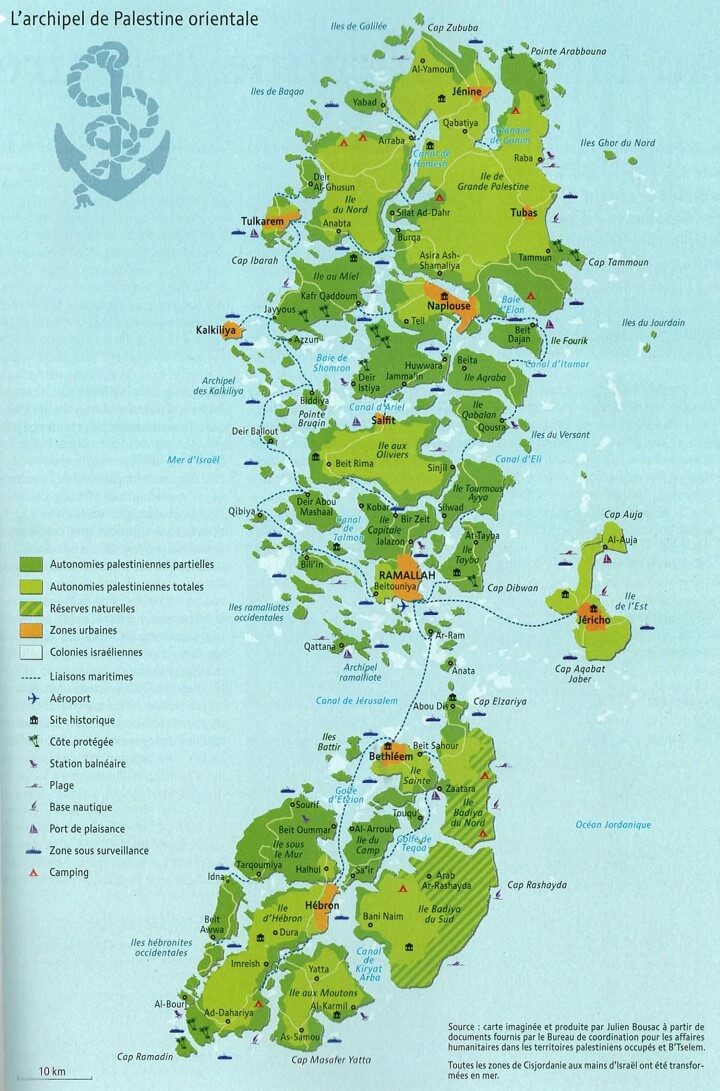
With their rich, often over-the-top imagination, ‘pro-Palestinian’ activists could not possibly have missed the metaphoric potential of islands.  They harnessed that potential ‘for the cause’ by portraying the Palestinian Authority-governed areas of the West Bank (defined in the Oslo Accords) as an ‘archipelago’ of small islands in a ‘sea’ of Israeli ‘settlements’.  Such allegoric maps travel far and reach wide; their message is clear: a patchwork of Palestinian ‘islands’ cannot be turned into a viable state.


Not satisfied with the mere allegory, some activists are shouting that message in full-throated, indignant, moralising voice: it is too late for the two state solution.  Often, they blame Netanyahu and ‘his settlements’; but Seumas Milne (a former journalist and currently top courtier to Labour Party leader Jeremy Corbyn) suggested, even 15 years ago, that the two-state solution was no longer achievable.

Among certain ‘pro-Israel’ activists (and even among some Israelis), such suggestions are a source of dread and despair.  In the absence of a Palestinian state, they say, Israel’s choices are grim: either ‘one-state’ in which Jews will be (or will quickly become) a minority; or else an apartheid state – in which the Palestinians won’t possess full political rights.

A recent Jewish Chronicle article quotes Tal Keinan, an American-Israeli businessman and former Israeli fighter pilot, who argues that there are “only three possible endgames” for Israel:
"The first is that Israel could annex the West Bank and give its Arab residents citizenship – which would mean Israel ‘opening itself to the prospect of demographic suicide’. […]
The second option would be to annex the Palestinian territories without granting the Palestinians citizenship – imposing sovereignty on a large number of people without representation. […]
The final option […] is for Israel to withdraw from most of the territories, with or without an agreement with the Palestinians. If the Palestinians build a state, there will be a state, but if not, the West Bank ‘will likely become another rocket base’."


So there you are: the options are oblivion, apartheid or being bombed to smithereens.  As the current British Prime Minister would put it, doom or gloom!

There’s a debate to be had on whether it is indeed too late for the ‘two state solution’; and whether lack of ‘full political rights’ equals ‘apartheid’.  But I do not wish to go there now.  My question is: are those ‘3 choices’ really the only possible ‘endgames’?  Or are the prophets of doom merely demonstrating their own stale thought processes, their own lack of imagination and creativity?

I am fascinated by islands.  They are such interesting places!  Let’s let our minds travel to a few islands – and see what we can learn.

A ‘Great’ Britain with some little ‘dependencies’

To start with, I won’t have to travel too far: I live on the island of Britain, which some (both on and outside it) still sometimes call ‘England’.  But it isn’t ‘England’ – the island of Britain is part of a sovereign state called the United Kingdom of Great Britain and Northern Ireland.  Although it is not formally called a federation, this is in fact a federal state made up of four ‘countries’: England, Scotland, Wales and Northern Ireland – each of them endowed with a great deal of political, economic and cultural autonomy.  Nonetheless, there are nationalist movements in each of these ‘countries’, aspiring to more autonomy and even to outright secession from the federation. 

I have recently travelled to Scotland, where great efforts are being made to revive and expand the use of Scottish Gaelic.  Upon return to London, I discovered that I still had a pocketful of Scottish banknotes.  The ‘Scottish pound sterling’ is worth exactly as much as the ‘British (not English!) pound sterling’; but the banknotes are underwritten by the Royal Bank of Scotland and bear different images from their ‘British’ counterparts.  Those strange-looking banknotes may be legal tender throughout the UK; but they are, let me tell you, viewed with suspicion by London retailers, many of whom seem to see them for the first time.

Another ‘country’ – Wales – occupies a peninsula in the West of Britain.  Wales is very similar in size to Israel, but it is less densely populated.  The vast majority of its inhabitants speak English and only one in five has Welsh as their mother tongue.  Still, Welsh is an official language in Wales, on a par with English; no expenses are spared – everything (from road signs to court summons) is written in both languages.  And children have to study Welsh in school, whether they have any use for it or not.

But ‘Great’ Britain is not as interesting as some of the smaller islands off its coast.  Take for instance the Isle of Man, a territory just one-and-a-half times the size of Gaza Strip.  The Isle isn’t part of the United Kingdom; nor is it a sovereign, independent state.  It is, instead, defined as a ‘British Crown Dependency’.  If you think that this means ‘owned by the Queen’ – think again: Queen Elizabeth the Second could not sell off that piece of real estate to – say – Donald Trump; even if he was interested and however much Her Majesty wanted to oblige!

Most Isle of Man inhabitants have the status of ‘Manxmen’ (and Manxwomen?)  Manxmen are ‘in principle’ British citizens; in principle only, because they cannot, for instance, vote in UK national elections and are hence not represented in the UK Parliament.  Although decisions made in that Parliament can have a huge impact upon their lives.  For instance, Manxmen could not vote in the 2016 Brexit referendum.  But, although the island is not part of the United Kingdom – and also not part of the European Union – its economy is strongly affected by the trade between the two…

Manxmen do elect the 24 members of the House of Keys – the lower chamber of the local ‘Parliament’, which deals with most internal matters.  Issues pertaining to defence, international relations, as well as the final say on matters of ‘good governance’, however, are the competence of the UK government and parliament.

Fiercely dependent:
Manxmen are proud citizens of a British Crown 'Dependency'
Upon application, Manxmen are issued with specially printed  British passports.  But instead of ‘United Kingdom’, those passports declare their bearers citizens of a strange entity called ‘British Islands – the Isle of Man’.  Such passports allow Manxmen to travel to – for instance – EU countries; but, unlike ‘regular’ British citizens, they are not entitled to work there.  Nor are EU nationals entitled to work on the Isle of Man, although they (still) can work in the UK.


The British Crown possesses also other ‘Dependencies’ – including several islands in the English Channel/La Manche: Jersey, Guernsey, Alderney and Sark.  Each island is governed separately, according to its own traditional system, mostly originating in the early Middle Ages.  Their combined population is estimated at around 165,000.  None of the Channel Islands is represented in the UK Parliament and, as a rule, their ‘citizens’ cannot vote in UK national elections and referenda.  Their status is, roughly speaking, similar to that of Manxmen.

Something is rotten in the state of Denmark


If we let our mind fly north-west of Britain, across the North Atlantic ocean, we come across Donald Trump’s latest real-estate project: Greenland.  It is the world’s most sparsely populated ‘country’ – with just one inhabitant on average per 10 square miles of territory; but it is also the world’s largest island: circa 10 times larger than Great Britain and 100 times larger than Tiny Israel.

Politically, Greenland is defined as an ‘autonomous region’ of the Kingdom of Denmark – a ‘region’ 50 times larger than Denmark-proper.  Some call it a ‘constituent country’ – similar in principle to the status of Scotland or Wales within the UK.

Happy Greenlanders

The majority of Greenland’s population (circa 88%) belongs to the indigenous Inuit (a.k.a. Eskimo) ethnicity, akin to the natives of North Canada and Alaska.  They speak their own language.  The balance consists of Danish settlers.

Greenlanders elect 2 representatives to Denmark’s parliament, out of a total of 179.  They also elect the 31 members of Greenland’s own parliament, which in turn elects a local government with a high degree of internal autonomy.  However, the Danish government sitting in Copenhagen is responsible for decisions pertaining to defence and international relations; even for those that directly affect the inhabitants of the ‘constituent country’ of Greenland – such as the permission to locate nuclear weapons on the island.

In 1973, the Kingdom of Denmark (including Greenland) became a member state of the European Community – precursor to the European Union.  But, using its greater autonomy achieved in 1979, Greenland voted in 1982 to leave the economic block – and completed that exit by 1985.  It is no longer part of the European Union; but it is still part of the Kingdom of Denmark, a member state of the European Union…

Economically, Greenland has long been highly dependent on Denmark.  However, for the past decade or so, the Greenlandic government has worked steadily to gradually reduce the economic dependence, with the ultimate goal of attaining political independence.

The Kingdom of Denmark ‘owns’ also another ‘constituent country’: the Faroe Islands.  Their status is roughly similar to that of Greenland: the Faroese elect 2 members of the Danish Parliament, as well as all 33 members of the local parliament.  Just like in Greenland, there is a local government, led by a Prime Minister; there is also a strong movement demanding political independence.  A separate Faroese Constitution drafted in 2011 has been rejected by the Danish government of the time, as ‘incompatible’ and ‘cannot co-exist’ with the Danish Constitution.

The poor ‘rich harbour’

By now, you probably think that ‘special status’ islands are but vestiges of medieval kingdoms, bizarre anachronisms somehow preserved into modernity.  Well, not exactly: some of them are part of relatively young republics.

One such island is Puerto Rico.  ‘Discovered’ by Columbus, it was incorporated into the Spanish Empire and colonised by (mainly) Spanish settlers, who wiped out the indigenous population and culture.  But in 1898, it was conquered by the United States.

The term ‘colony’ is not en-vogue any more; but Puerto Rico is not a federal US state, nor is it part of a state.  It is, therefore, defined these days as a ‘United States unincorporated territory’.  In this context, ‘unincorporated’ means that the US Constitution does not apply in full: only ‘fundamental rights’ are protected, other constitutional rights are not.  As a consequence, although the Puerto Ricans are ‘in principle’ US citizens (since 1917), they cannot vote in US presidential elections and do not have senators or voting representatives in the US Congress.  Instead, the 3.2 million Puerto Ricans elect a local Governor and a bi-cameral parliament.  However, the head of state is the President of the United States.  The jurisdiction and sovereignty belongs to the United States of America and the ultimate power is vested in the US Congress.  Laws adopted by the latter apply to Puerto Rico by default.  Many US federal agencies (notably the FBI) are active in Puerto Rico.


A very lonely star...
Puerto Rico calls itself Estado Libre (Free State). But it is neither an independent state, nor a US state.

As US citizens, Puerto Ricans can serve in the US military – in fact they were historically forced to serve whenever the US adopted compulsory military draft.  However, Puerto Rico also has its own National Guard, distinct from the US National Guard.  The commander-in-chief of the Puerto Rican National Guard is… the President of the United States.

On average, Puerto Ricans are significantly poorer than the citizens of the State of Mississippi – the poorest of US states.

US controls a few other ‘unincorporated territories’ with roughly similar regimes – and they happen to also be islands: Guam, Northern Mariana Islands, U.S. Virgin Islands and American Samoa.

And a ‘fragrant’ harbour

I never noticed any particularly pleasant smell when I visited Hong Kong, but many believe that ‘Fragrant Harbour’ (hēung gong in Cantonese) is the origin of the modern name.
Hong Kong consists of the eponymous island, plus an archipelago of some 200 other islands and two small pieces of territory on the coast of Southern China.  In total, it is not much larger than the Gaza Strip – but it is more densely populated: more than 17,500 inhabitants per square mile, compared to Gaza’s 13,000.


How to live on an archipelago:
one can travel among the main islands of Hong Kong by underground train.

In theory, Hong Kong is part and parcel of the sovereign territory of the People’s Republic of China.  But it certainly does not feel that way.  And it’s not just a matter of a different flag, state symbols and anthem.

The official language of China is Mandarin – written with simplified Chinese characters.  In Hong Kong, it is Cantonese, inscribed with traditional characters.  Which render anything spoken or written in Hong Kong unintelligible to most people in China.

Cars cling to the left side of the road in Hong Kong, still following the British tradition; but they are driven on the right in China.

Five years ago, I travelled to China via Hong Kong.  To start with, I had to apply for a Chinese visa; but when I finally got it, was told that it’s not valid in Hong Kong – where one needs a separate visa; or, in the case of my Israeli passport, no visa for Hong Kong, yes visa for China.

Flights from Hong Kong to Beijing are expensive, as they are considered international flights.  I was advised, instead, to buy a seat on one of the many cars and coaches ferrying passengers from Hong Kong Airport to Shenzhen Airport just across the border with China.  I do not use the term ‘border’ lightly: en-route to Shenzhen, my passport was checked twice, within a 50 yards stretch of road: first by the border police of Hong Kong, then by Chinese border officials.

Once at Shenzhen Airport, I boarded a much cheaper, probably subsidised ‘domestic’ flight to Beijing.

I paid for the transfer from Hong Kong to Shenzhen with Hong Kong dollars, but they’re not legal tender in China; so I had to buy the flight ticket Beijing with Chinese ‘renmimbi’, not accepted in Hong Kong.

All this may sound and feel strange, given that Hong Kong is not an independent state.  Officially, Hong Kong is called a ‘Special Administrative Region of the People's Republic of China’.  But in this case, ‘special’ is an understatement.

As I am writing this, there are widespread protests in Hong Kong against Chinese ‘interference’ – protests triggered by a change in law allowing certain offenders to be ‘extradited’ from Hong Kong to... another part of China’s ‘sovereign territory’.  Go figure!

So what?

By now, I can hear quite a few of you grumbling: what do all these islands have to do with anything?  Israel has occasionally been called ‘an island’ – as in ‘an island of freedom in a sea of tyranny’; but geographically it certainly is no island.

Well, I’m afraid I used the ‘islands’ allegory only as a crafty rhetorical device.  This isn’t just about islands, there are many other, ‘continental’ examples.

The point is that the ‘sovereign state/no state’ paradigm is based on a false dichotomy.  Reality is much more complex than that; there are almost-states, states-within-states, incorporated ‘unincorporated territories’, ‘constituent countries’, ‘special administrative regions’ and a myriad other ‘unconventional’ political constructs.

It may be that none of the existing models described above precisely fits the requirements of a future Israel-Palestinian Arabs accommodation.  But what these ‘islands’ prove is that there’s a huge breadth of possibilities – rather than a binary option.

Human beings are endowed with imagination, creativity and problem-solving abilities.  They are also ‘tribal’ and seek self-determination: the right to control their destiny, while organising themselves along ‘tribal’ identities that both unite and divide.  And, as a result of all that, human communities have evolved and are evolving in many complex, unusual, original ways.  Because no man is an island; not even on the Isle of Man.


The conflict between Jews and Arabs – or between ‘Israelis’ and ‘Palestinians’ – is a conflict between right and right.  Not a dilemma, or even a multiple-choice question; but an art project, a piece of blank canvas.

We live in a world of endless possibilities.  There are no slim choices, just narrow minds; mankind doesn't inhabit rigid, tidy little boxes – only some men do.

 
;