Showing posts with label PLO. Show all posts

Saturday, 25 May 2019

Give peace a chance!


Trump’s ‘Deal of the Century’ between Israelis and Palestinians may yet prove to be the Flop of the Century.  But its architects have been amazingly successful at keeping mum: I can’t remember any other political programme that has been kept so secret for so long, in the face of such keen curiosity from journalists, pundits and political adversaries.  Nobody knows what the plan is; no details have leaked, no positions have transpired.  Unheard of!

No wonder, then, that everybody is jittery: Israelis and Palestinians, Jews and Arabs, left-wingers and right-wingers… Kept in the dark, they are reduced to… well… guessing.

One understands this; it’s human nature.  Guessing is one way to try and gain some control in a world plagued by uncertainty.  But assuming the worst when knowing the least is not mere guessing – it’s something else.

It may be distressing to see the Palestinian Authority rejecting the new peace plan before even knowing what it contains; but a surprise it ain’t: after all, that Authority is made up of people who make a nice living out of the status-quo; from their point of view, any change (whether led by Trump, Obama or Clinton) risks being a change for the worse.

Waaay more surprising is the deluge of negative reactions from the ranks of the self-proclaimed 'progressive', 'pro-peace' camp.  Granted, these people don’t like Trump (I’m being a bit British here: they hate his guts, actually).  But hey: God (or the forces of Dialectical Materialism) moves in mysterious ways.  After all, those same self-proclaimed 'progressive', 'pro-peace' activists like the Egypt-Israel Peace Treaty; which was signed not by doves, but by right-wingers Menachem Begin and Anwar Sadat.  So why not wait until a few details have been revealed about the Trump plan?  It’s likely to happen in a matter of weeks, if not days.

I find it disturbing to see so many 'pro-peace' activists ranting against a peace plan – any peace plan.  And in particular one that they (along with everybody else) know nothing about.
"Pro-peace" – but only if it's the "correct" peace.
Writing in the Times of Israel, former Knesset Member Ksenia Svetlova attacks the ‘Deal of the Century’ for trying to offer economic benefits, rather than political solutions:
“So what is left of Trump’s peace plan if we take out the whole matter of an independent Palestinian state? Only the ‘economic peace’ that Prime Minister Benjamin Netanyahu has been talking about for so many years."
Following a well-known activist’s gambit (when your argument is thin or dishonest, bring up a ‘human story’ to stir up readers’ emotions), Ms. Svetlova goes on to describe the plight of… Palestinian ice-cream manufacturers.  Apparently, Israel does not allow one such manufacturer in Gaza to export its products, claiming that “it [i.e. Israel] has not yet set up the required supervisory [i.e. security] mechanisms”.  An excuse that Mr. Svetlova derides:
“The State of Israel, which has pioneered advanced technological and human capabilities to detect whether the mother of an American Jewish tourist has friends in B’tselem, has no technological solutions to enable it to inspect goods from Gaza.”
In fairness, I tend to agree with her: I’m sure a technological solution can be developed, which would allow soldiers to detect explosive material, weaponry or parts thereof frozen inside a box of ice-cream.  What is, however, less clear to me is: why would Israel use its taxpayers’ money to develop and implement such a solution in order to enable exports from a hostile territory – when the most likely outcome would be that the resulting profits (or parts thereof, at least) would end up financing Hamas’s rocket capabilities, tunnels, attempts to break into Israel and other such goals?
But it’s not just Gaza – there are apparently also ice-cream manufacturers in the West Bank.  And, while Israel in principle allows the West Bank to export its products, Ms. Svetlova tells us that in practice
“The owners of the Al-Araz ice cream plant in Nablus would also be happy to reap the economic benefits of peace. But ice cream is a delicate and fragile product, and long waits at the checkpoints do it no good."
Upon reaching that passage, I’m sure that some of Ms. Svetlova’s readers will be wiping a tear: despite their occupation-induced misery, the poor-but-brave Palestinians manage to produce a bit of ice-cream – enough to export even!  But those nasty Israelis make them wait at the checkpoints, causing the ice-cream to melt, along with the readers’ tender hearts.

Except that, in the very next sentence, we learn that the same Palestinian ice-cream manufacturer
“whose ice cream is every bit as good as its Israeli counterparts, markets to the West Bank and to Jordan, and a bit to Dubai."
Now, that’s surprising.  Because, to sell in the West Bank and Jordan, the Palestinian ice-cream has to cross checkpoints manned by the same nasty Israelis.  As for shipping to Dubai (about 1,500 miles away from Nablus), surely that takes longer than crossing even the most vicious Israeli checkpoint?
When the tears are wiped off and the brain gears engaged, one finds more than a hint of dishonesty in Ms. Svetlova’s story: ice-cream is indeed a “delicate and fragile product”; which is why it is always moved around (even in frigid Scandinavia, let alone in the torrid Middle East!) in frigorific road trucks, railway cars and shipping containers – designed to keep that product from melting, whether en-route to Dubai, Jordan, Israel  or South Patagonia.  So, whatever it is that’s preventing Al-Araz from exporting ice-cream to Israel, it is not “long waits at the checkpoints”.

But a closer look at the primary thrust of Ms. Svetlova’s article reveals that it, too, is fatally tainted by dishonesty.  After all, she describes the – yet unpublished and unknown – “Trump’s peace plan” as merely an attempt to bribe the Palestinians:
“It’s supposedly a simple idea. We’ll give the Palestinians financial incentives so that they can develop their economy, create factories and jobs, and in exchange they will cease their military and political struggle and stop dreaming of freedom and sovereignty. In exchange, the economic flourishing will bring stability and quiet to the entire region."
Having ‘established’ that, she goes on to teach us how “real life” works:
“The problem is that in real life, the economic, the military, and the political cannot be separated from one another.”
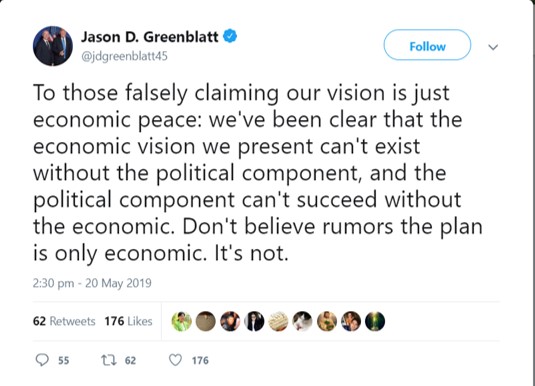
That’s a cogent argument – if one ignores the fact that it’s based on a lie.  In fact, the new peace plan’s architects have been very clear that, while the plan included economic incentives, those are designed to come alongside – not instead of – political solutions.  In fact, Jason Greenblatt – one of the plan’s main architects and, in consequence, one of the very few people who really know what it contains – made that clear repeatedly; including on 20 May, two days before Ms. Svetlova penned her diatribe.

One can argue against the ‘Trump plan’ (if one is inclined to argue against anything ‘Trump’) without resorting to dishonesty.  It would be more than legitimate to doubt, for instance, whether either economic incentives or political solutions can be delivered in practice, given that both the Palestinian Authority and Hamas have already rejected them out of hand.  One can argue that, in the face of that rejection, the ‘Trump plan’ is doomed to fail.

But then, decades of two-state-solution negotiations – including those led by Ms. Svetlova’s own party – have also failed.  It is difficult to see why the same approach that failed umpteen times in the past would succeed this (umpteen + 1) time.  And it is difficult to understand what's to be gained by rejecting a new approach out of hand – before even learning what that approach actually is.

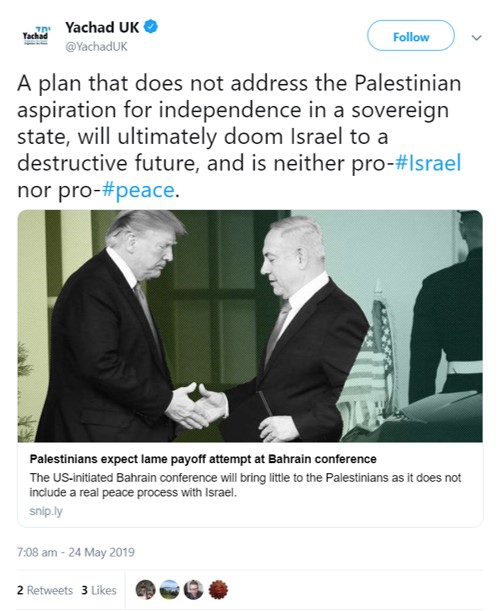
Among the cohort of critics of the yet-unpublished peace plan is the British-Jewish organisation Yachad, which describes itself as “pro-Israel, pro-peace”.  The group is so keen to attack that peace plan, that it even promoted an article from Al-Monitor, a ‘news’ website accused of being a mouthpiece for the Assad regime.

Yachad added their own view:


Once I got over my awe at the stentorian tone, I asked myself: how do Yachad activists know what the “Palestinian aspiration“ is?  Beyond the rather neo-colonialist tendency of attributing to other cultures our own ‘way of doing things’?  Of course, the Palestinian Authority/PLO/Fatah screams that aspiration to the entire world.  But what does that count for?  The last (and only) time Palestinians in West Bank, Gaza and E. Jerusalem had something remotely resembling free elections, a plurality voted for Hamas – whose declared goal is certainly not a sovereign state living in peace alongside Israel.

Yachad activists have visited the West Bank and met Palestinians – typically those that are themselves activists on behalf of the same Palestinian Authority/PLO/Fatah.  I have no doubt that, when queried by some starry-eyed Yachad activist, those Palestinians delivered the ‘correct message’.  But, again, what does that count for?

The 'peace activists' will tell you a tale of across-the-board Palestinian rejection of
Trump's plan.  But, as usual, the picture is more nuanced...

As I wrote elsewhere, the Palestinians are certainly entitled to their aspirations.  But what these aspirations actually are, it’s hard to know.  If anything, the more trustworthy opinion polls show them as ambivalent at best on the issue of ‘two-states’.

In fact, I would suggest that, leaving aside the corrupt political class, the Palestinian Arab masses are yet to make up their collective mind as to how their future should look like.  And why would it be any different?  The same can be said about Arab masses at large.  The fact is that Palestinians (like other Arabs) live under dictatorial regimes, with no freedom of speech and political debate.  It does not help that they also live in an ultra-conservative society rife with taboos, in which dissent is frowned upon and worse.

Unlike certain 'peace activists', I do not think Palestinians are stupid.  Why would they 'aspire' to a "sovereign state", if that just means exchanging Israeli occupation for the local brand of corruption-cum-tyranny?  For decades, foreigners and their local allies have tried to tell Palestinian Arabs what they should 'aspire' to: pan-Arabism, Islamism, or perhaps Western-style nationalism...  The one voice we have not heard is that of the Palestinians themselves.  But that does not seem to bother self-proclaimed ‘progressives’ who feel that they know what’s good for ‘the natives’.

Doesn’t it make sense, that, in order to formulate their collective “aspiration”, Palestinian Arab masses (and Arab masses in general) need to have the tools of free expression and the economic wherewithal that would allow them to think beyond tomorrow’s meal?

***
For decades now, ‘peace activists’ have been yelling at me: “Give peace a chance”.  Well, I listened.  And I did: I supported the two-state solution; the Oslo Accords; the withdrawal from Lebanon; the ‘disengagement’ from Gaza.  I rooted for Barak’s proposal, for Clinton’s parameters, for Olmert’s offer.

“You failed”, I tell the ‘peace activists’.  “But no matter, I will still give peace a chance.”
“Not this one”, they respond.  “This one’s different.  It’s wrong.”
“How the hell do you know?” I blurt, befuddled.  “And what’s ‘wrong’ with ‘different’, anyway?”
“Don’t you understand?” they yell, exasperation growing into shrill hysteria.  “This is coming from TRUMP!!!”
I shrug.

Saturday, 1 October 2016

Non-final ‘solutions’

It’s been already quite a few years since I last sat in a university study room, trying to get my head around complex case studies.  But I remember well a conversation I had with a French colleague.  We had done some work together and, in-lieu of a relaxing break (oh, the irony!) we started to debate the Israeli-Palestinian conflict.  My colleague was very critical of Israel – everything was the Jewish state’s fault.  Most of all, he opined, Israel was ‘stealing land’ and undermining the ‘two-state solution’.  Negotiations, he said, were just a ruse, a stalling device.  “Why not just give the Palestinians their state and be done with it?” he demanded; “we should force you to do it!”  “Well, it’s not that simple…” I attempted to explain.  “It’s very simple”, he interrupted, with more than a hint of impatience in his voice.  He pulled a block of paper, grabbed a pencil and, with a few quick and decisive lines, sketched the map of Mandatory Palestine ‘from the River to the Sea’.  “That’s the map”, he pronounced, stabbing the roughly sketched elongated pentagon.  Then, with another assertive motion, he drew a horizontal line across the pentagon’s narrow waist, from west to east.  It originated somewhere in the Mediterranean and, I figured, ran through both Tel Aviv and Jerusalem, before crossing the Jordan River.  “That’s it”, he declared, satisfied – and stabbed each half of the now divided pentagon, first the top half, then the bottom one.  “Now you guys take this bit and the Palestinians take the other bit.  I don’t give a s**t if you like it or not, you people have got to learn to get along with each other.  That’s it, problem solved!”  He was not joking – he was dead serious.  He spoke with the hauteur of a Louis XIV: he was ‘the state’ (or the ‘international community’); he must have felt like a new Charles de Gaulle, annoyed at having to deal with those pesky Algerians.

The 'Middle East Quartet' met in New York to promote a 'roadmap' for Israel and Palestine.
(photo from a previous meeting in Munich, Germany)

I was reminded of that discussion recently, when French politicians hosted a ‘summit’ aimed at re-starting ‘the Middle East Peace Process’ (which, despite the name, does not deal at all with the Middle East – as in Iraq, Syria, Lebanon, Yemen, Egypt or Libya – but only with Israel and the Palestinians).  According to The Guardian,
“The participants [which did not include any Israelis or Palestinians] called on the two sides to genuinely commit to the two-state solution.”
More recently, the Middle East Quartet (which, likewise, isn’t really about the Middle East, but only about Israel and the Palestinians) has met in New York and issued a statement.  Among other things, they say that
“The Quartet principals [i.e. United Nations Secretary-General Ban Ki-moon, Russian Foreign Minister Sergey Lavrov, United States Secretary of State John Kerry and European Union High Representative for Common Foreign and Security Policy Federica Mogherini] were joined by the Foreign Ministers of Egypt and France during the second part of the meeting to brief on their work to support Middle East peace.  All agreed on the importance of close and continuing coordination of all efforts to achieve the common goal of the two-State solution.”
As usual, the bulk of the opprobrium was directed at the Jewish state:
“The Quartet emphasized its strong opposition to ongoing settlement activity, which is an obstacle to peace, and expressed its grave concern that the acceleration of settlement construction and expansion in Area C and East Jerusalem, including the retroactive ‘legalization’ of existing units, and the continued high rate of demolitions of Palestinian structures, are steadily eroding the viability of the two-State solution.”
I was still ruminating on the French (from Louis VII to Napoleon, from George-Picot to President Hollande) meddling 3,000 miles away from Paris, when a friend e-mailed me.  She is a kind-hearted Jewish lady, who cares deeply for both Israelis and Palestinians and would like nothing better than to see those two populations living in peace, on either side of a secure border.  Yet all that talk about the ‘two-state solution’ was clearly getting on her nerves:
“I have always felt uncomfortable with the trope ‘two state solution’ in relation to Israel and the Palestinians.  It isn’t the two state bit which bothers me – it is this idea of a ‘solution’.  To start with, the word has a stark finality about it and this comes with dreadful connotations for Jews, with Hitler combining it with the word ‘final’.  He wanted to obliterate Jews – how did we come to rehabilitate this word when working towards peace with those who have also wanted to obliterate us? 
But there are other reasons to reject the word.  It is such an ahistorical concept.  When in history has there ever been ‘a solution’ to anything?  The moving hand of history weaves complex and varying stories; they change and evolve continuously – each ‘solution’ is but the beginning of a new ‘problem’.  Try putting History and Solution into Google and the fourth, fifth and sixth entries are about exterminating the Jews.  And the first three?  One is about therapy, the second about showing how one solves a mathematical problem and the third refers to an alternative history novel, in which the Axis wins the Second World War.”
My friend’s words got me thinking.  And, as always, I wanted to understand: why is it that the word ‘solution’ is so used and abused in the West?  How come that it is most frequently employed when discussing the Middle East?  And how come that, when discussing the Middle East, Westerners appear not just to desire ‘a solution’, but often to know what the solution should be – only to be suddenly possessed of a desire to impose it upon the people in question?

There’s nothing new in all this, I’m afraid.  The very term ‘Middle East’ is a quintessentially Euro-centric concept: it’s only ‘East’, of course, when seen from Europe, from ‘the West’.  The Middle East is very much ‘Middle West’ when seen from Japan, India or China.  As for America… well, it depends which way one’s looking; but under President Obama, America is looking Europe’s way.
What’s in a name?  There’s nothing new in the West’s desire to – ahem! – civilise the East (i.e., provide ‘solutions’ for the poor hapless ‘natives’).  And – interestingly – it has always been entwined with another, just-as-keen aspiration: that of relieving those same natives of various natural resources that they couldn’t possibly have a use for, themselves.  In past centuries, it was gold and spices.  Nowadays it is oil and gas.  Plus ça change, plus c'est la même chose!

In 1920, the Western ‘solution’ was to divide the Middle Eastern spoils of war among the victors – the French and British colonial Empires.  The Arab, predominantly Muslim inhabitants of those former Ottoman lands did not think of themselves as residents of separate countries.  True: influenced by contemporary Western ideas, a small minority of intellectuals among them (including, for obvious reasons, a high proportion of Christians) wanted an Arab nation state; as for the vast majority, they showed no signs of wanting to be anything but loyal citizens of the Ottoman Empire-cum-Caliphate.

But the wishes of brown-skinned, primitive natives were of little concern to the new imperial masters.  They had their own economic and political interests – which demanded that the Middle East be partitioned in chunks, along arbitrary borders.

A list of those artificial ‘countries’ reads conspicuously similar to the ‘menu’ of perennial Middle Eastern conflicts.

The League of Nations awarded Mandates for 'Mesopotamia' and 'Palestine' to Britain
 and for 'Syria' and 'Lebanon' to France. 

There was Mesopotamia, a descriptive name invented by ancient Greeks and meaning ‘Land between the rivers’.  That was all Greek to the local inhabitants, who reverted – as soon as they possibly could – to the 7th century Arabic name ‘Iraq’, cousin of the Biblical ‘Erekh’ and grandson of the Sumerian ‘Land of the City of Uk’ (Ur Uk).

Map of Bilad Al-Sham (the Land of the Semites, translated these days as Greater Syria) was a province of the early Islamic Caliphate, before being incorporated in the Ottoman Empire. The province was subdivided into military districts called 'ajnad' (singular 'jund'), of which Jund Filastin (Palestine) was one. Jund Dimashq (the district of Damascus) was the largest and included most of present day Lebanon, Jordan and the southern half of present-day Syria. The Ottomans later changed the organisation repeatedly, redrawing and renaming the provinces. And so did the Western powers after World War I. 

There was, then, Syria – another name that the West inherited from the ancient Greeks, who simply mispronounced the old name Aššūrāyu (Assyria).  After the 7th century Arab Conquest, the province became known in Arabic as Bilad Al-Sham – the Land of the Semites; an apt name, given that its inhabitants spoke Semitic languages, Aramaic and Hebrew.  ‘Sham’, by the way (and not ‘Syria’) is the origin of the second ‘S’ in ‘ISIS’.  Bilad Al-Sham included not just what is currently known (in theory, at least) as the Syrian Arab Republic, but also present-day Lebanon and ‘Palestine’ (another Greek name derived from the Philistines, Hellenic colonists who – sometime in the 12th century BCE – had established a handful of cities on the Mediterranean shore).

Around the 12th century BCE, proto-Hellenic 'Sea People' settled on the shores
 of the Mediterranean (see the red patch on the map). They were called Philistines.
Which is why the ancient Greeks called the area Palestine.
The name stuck especially in the West, which inherited the classic Graeco-Roman culture.

Although earmarked for revival as the old-new Jewish homeland, ‘Palestine’ was partitioned by its British rulers, with the Jordan River becoming a border and its Eastern bank (the lion’s share of the land) fashioned into a ‘royal’ fief for Britain’s local collaborators – the Hashimite clan, which was in the process of being ousted from its native Mecca by a rival clan, the Saudites.  The newly established kingdom was ‘christened’ (ahem!) ‘Transjordan’ – literally ‘Beyond the Jordan [River]’.  Needless to say, that had nothing to do with the will (or lack thereof) of local inhabitants: the land was only ‘Beyond the Jordan [River]’ when viewed from London!

Although part of the League of Nations Mandate of Palestine,
the area east of the Jordan River was detached, prohibited for Jewish habitation
 and made into the Emirate (later Kingdom) of Transjordan.

To complete the ‘menu’, let me add Egypt (at the time a British ‘Protectorate’), Yemen (another British ‘Protectorate’), Somalia and Libya (Italian colonies)…

Not everything is the West’s fault, of course – there’s plenty of guilt to go around.  What the previous (Ottoman) rulers bequeathed the new ones was fairly rotten eggs; the Western colonial powers did a good job at cracking them; and the local ‘kings’ and ‘lifetime presidents’ proceeded to vigorously scramble those ‘eggs’ – hence the rather appalling mess we see today.

Drawn by Western colonial powers, the Middle Eastern borders are being erased.
(Caricature by Dan Nott)

But we live in the 21st century.  And much too little has changed in the approach of some Western politicians – in the almost 100 years that passed since those initial ‘solutions’.

They still bring to the Middle East their quintessentially Euro-centric conceptions of ‘peoples’ or ‘nations’.  In 1920, those were predicated on ‘race’ or ethnicity; these politically-correct, ‘multi-cultural’ days, they centre on the legal concept of ‘citizenship’ or ‘nationality’.  But Middle Easterners have never been divided in ‘races’; and why would anyone care about citizenship of states which – on top of having been invented by foreigners – afford little protection and much oppression?
Clan and tribe are strong elements of identity in the Middle East.  Beyond those, many define that identity along religious and linguistic lines.  The word that best translates the Western concept of people/nation in Arabic is أمة (pronounced ‘umma’).  It derives from the word ‘umm’ (meaning ‘mother’) and is often used in its Qur’anic sense: the ‘Nation’ or ‘Community’ of Islam.  Apart from religion, it is easy to feel a sense of common affiliation with people who speak the same language – or at least who are able to communicate intelligibly using a common idiom, such as literary Arabic.
‘Multicultural’, ‘enlightened’ Westerners may have a hard time coming to terms with this reality.  But unless they do, unless they shed the arrogance of ‘civilising’ the Middle East to their one-and-only understanding of humanity, they have only more blood and tears to contribute.

Take, for instance, the ‘Palestine problem’.  Leaving aside the Western name and the fact that ‘Palestine from the River to the Sea’ is a Western invention, some Westerners have now decided that there are two peoples/nations in that country – and hence there should be a two-state solution; other Westerners want to turn the country into a multicultural heaven in which everyone lives with equal rights ever after – hence a one-state solution.  Note how both ‘solutions’ juggle Euro-centric notions (in italics) and are predicated on the concept of people/nation with its changeable but always Euro-centric meanings: indeed, the ‘two-state solution’ uses the traditional understanding of the term ‘nation’, while the ‘one-state solution’ adopts a more recent meaning, one which a certain Western audience has come to regard as ‘progressive’, ‘modern’ or politically-correct.

As usual, the last thing those Westerners care about is the opinion of the ‘two peoples/nations’ in question.  In fact, they have convinced themselves that both sides in the conflict think and behave like Westerners; that their aspirations are Western aspirations.

Western concepts (whether 1920-style or ‘progressive’) may indeed sound familiar and reasonable to Israeli ears.  After all, the ancient Israelites may have originated as a super-tribal faith community, but centuries of dwelling as isolated islands of otherness have forged for the Jews an identity more similar to Western-style nationhood.

As for the ‘Palestinians’, however, who is to say?  Westerners have decided that Palestinian Arabs are ‘a people’ – mostly because Westerners are familiar and comfortable with that concept.  Make no mistake: I have no problem with Palestinian Arabs declaring themselves a people – if that’s how they feel and that’s what they wish.  But it is a ‘Palestinian’ decision – not an Israeli or Western one.  And the ‘Palestinians’ have yet to speak their collective mind on the matter.

Of course, there is the PLO, whose leaders must have ‘affirmed’ their peoplehood a zillion times.  But who do those ‘leaders’ represent?  Leaving aside the fact that they lost the only Palestinian elections that could (even superficially) be characterised as ‘free’; leaving aside the fact that they would lose the next ones, if they allowed them to happen; leaving aside all that, the half a million salaried PLO ‘apparatchiks’ and stipended ‘supporters’ are little more than mercenaries; their ‘political opinion’ is based on the bank account, not inner sense of identity.  As for Hamas (which won those ‘free’ elections), they are much more concerned with faith and much less with ‘nationhood’ in the Western sense of the word.

So what do ‘the Palestinians’ really want?  With no freedoms, no plebiscite and an oppressive, taboo-enforcing society, it is really hard to say.  The best we can do, perhaps, is to look at opinion polls.  Granted, those too are often politicised and are generally problematic in the absence of freedom; still, I believe it is useful to look at the latest (June-August 2016) ‘Joint Palestinian-Israeli Opinion Poll’.  It contains some (however mild) criticism of both the PLO/Palestinian Authority and of Hamas – which makes it perhaps a bit more credible in my eyes.

The poll was conducted in Israel by the (strongly left-leaning) Israel Democracy Institute and by the Palestinian Center for Policy and Survey Research (PSR) in the West Bank and Gaza.  The European Union supplied the funding, while the German outfit Konrad-Adenauer Stiftung provided ‘partnership and support’.

Predictably, one of the questions was:
“Do you support or oppose the solution based on the establishment of a Palestinian state alongside Israel, known as the two-state solution?”
Circa 51% of the 1,270-strong Palestinian sample and circa 59% of the similarly sized Israeli sample expressed support for ‘the two-state solution’.  This is ‘the result’ that the poll authors and the Western funders promoted: a majority of Palestinians and Israelis still support the two-state solution.  But, of course, some would say, the two sides have divergent understanding of the term: Israeli politicians usually say ‘two states for two peoples’, meaning a Jewish-majority state and a Palestinian Arab-majority state; Palestinian leaders, on the other hand, never say ‘for two peoples’ – their ‘two states’ are an 100% Arab ‘Palestine’ and an ‘Israel’ populated by Jews and Palestinian Arabs endowed with equal rights – including the ‘right of return’ for the PLO-estimated 7 million Palestinian refugees.

This time, however, the pollsters asked the question again, using a more precise wording:
“Mutual recognition of Palestine and Israel as the homelands of their respective peoples.  The agreement will mark the end of conflict, the Palestinian state will fight terror against Israelis, and no further claims will be made by either side.  Support or oppose?”
When presented with this version of the question, support among Palestinians dropped to just 40%; 57% declared their opposition to the idea.  Among Israelis, support grew to 68%, with just 24% opposed.

In other words, only a minority of Palestinian Arabs support the ‘two-state solution’ – as understood by Westerners.  Interestingly, that minority dropped to just 20%, when an additional condition was added: that the Palestinian state be devoid of “major/heavy weapons”.  Even the putative deployment in Palestine of “a multinational force” only succeeded in raising the support among Palestinians to 36%.

But then the pollsters did something really interesting: this time they addressed only those who answered ‘opposed’ to the ‘Mutual recognition, etc.’ question and offered them additional incentives to change their mind to ‘support’.

A ‘bribe’ of $30 to $50 billion “to help in settling those refugees wishing to live in the Palestinian state and compensating them” persuaded 31% of the ‘opposed’ Palestinians to change their mind and ‘support’.  Perhaps surprisingly to some (but certainly not to me), the biggest change of mind occurred in Gaza (41%, compared to just 25% in the West Bank).  Gaza, of course, is home to considerably more ‘refugees’, who are likely to benefit personally from the financial windfall.  By the way, that same windfall to the Palestinians (combined no doubt with the idea of settling the refugees in Palestine, not in Israel) persuaded 37% of ‘opposed’ Israelis to swing to ‘support’.

But financial incentives are tricky.  No doubt, they would be welcome; but what happens after they have been paid?  Even more pertinently, what happens when much of the expected windfall is siphoned off by the PLO kleptocracy, while a lot is wasted through the corruption and incompetence of a ‘civil service’ populated by cronies?  What happens when the windfall fails to fulfill those great expectations?

Non-financial (or not-directly-financial) incentives are more interesting.

When offered membership of the European Union for ‘Palestine’, 32% of the Palestinian nay-sayers changed their tune to ‘support’ the proposed two-state deal.

The offer of a confederation with Jordan persuaded 29% of those ‘opposed’ to change their mind to ‘support’.

Now, that’s interesting.  Both joining the European Union and establishing a confederation with Jordan would involve a certain limitation of sovereignty, in comparison to an utterly independent, self-standing state.  With that in mind, perhaps, only 12% of Israelis opposed to the deal changed their mind when offered EU membership.  Yet rather than being put off, the yearning-for-independence Palestinians interpreted those offers as strong incentives.  In fact, within the constraints of the poll’s statistical significance, they reacted much in the same way to the direct financial incentive, to the offer of EU membership and to the idea of a confederation with Jordan.  Now, I can understand that EU membership may hold the attraction of freedom, good governance, rule of law and an indirect, but perhaps more tangible financial windfall.  But none of the above applies to a confederation with the Hashimite Kingdom of Jordan!

This may be surprising to those Westerners who only listen to themselves.  But it is hardly new.  West Bank ‘Palestinians’ have been ‘united’ with East Bank ‘Jordanians’ between 1948 and 1967 – and no ‘intifada’ took place.  They had representatives in the ‘Jordanian’ Parliament, ministers in the ‘Jordanian’ government and carried ‘Jordanian’ passports; in fact they carried them until 1988, when their ‘Jordanian’ nationality was unilaterally (and illegally) rescinded by the Hashimite king.  According to another opinion poll (run by An-Najah University and published in May 2016), 42.3% of Palestinians support the confederation project while 39.3% oppose it.

We do not know what ‘Jordanians’ think of such idea; opinion polls in that country are viewed as ‘a bridge too far’.  But, for whatever that’s worth, former Jordanian Prime Minister Abdelsalam al-Majali, announced (speaking in the West bank city of Nablus) that he personally supported a confederation.  That’s hardly evidence of popular support, of course; but in Jordan’s tightly controlled political environment, such ‘personal’ statements are inconceivable without the monarch’s blessing.

What, then, does all this mean in terms of that beloved Western ‘solution’?  Not much, perhaps.  There are no ‘solutions’ in the Middle East, only processes.  Processes that most Westerners do not understand.  Including the self-described ‘experts’, none of whom managed to predict – or even correctly interpret – a ‘Spring’ that (so far) killed 500,000 people and displaced ten million.

Let us not mince words: the Middle East is still the playground of Western politicians with neo-colonialist instincts.  As ever – they lack any deep understanding of ‘Eastern’ (especially Middle Eastern) issues.  As ever – they try to advance their own interests, with no regard for the unimportant desires and aspirations of ‘the natives’.  As ever – they envisage 'solutions' that involve drawing lines on a map.  As ever – they attempt to allay their own conscience (and dupe their constituencies), by wrapping a mantle of noble intentions around their rather base mindset.  Deep in their hearts, these white neo-colonialists despise what they see as uncivilised, swarthy natives, forever incapable of getting along with each other.  Like adults witnessing a fight among children, they patronisingly command those 'natives' to 'just shake hands and be friends'.

US Secretary of State John Kerry and
EU High Representative Federica Mogherini congratulate each other
in New York. They have finally set the Middle East right! 

In truth, neo-colonialist Westerners have little empathy with Israeli Jews or with Palestinian Arabs – and even less interest in understanding the conflict between them; what they’re really after is a 'solution' to their own worries – one that would provide: a) uninterrupted flow of oil and b) good-old docile 'Gastarbeiter,' rather than vindictive Islamists.


There’s only one short sentence that the Middle East owes these Westerners – and that’s ‘Mind your own business!’
Friday, 4 March 2016

Boycotts, Settlements and Beautiful Innocence

I recently read an interesting article. Penned by John Ware for the Jewish Chronicle and entitled ‘Israel must stop making it easy for the boycotters’, it contains a passionate plea in relation to Israel’s West Bank settlements.

I’ve read the article several times, but I’ve got to admit it’s still not entirely clear to me exactly what, in practical terms, “Israel must” do in order to “stop making it easy for the boycotters”. John speaks about“reversing settlement expansionism”, but what does that mean? Freezing the settlements? Evacuating them? One or the other, it is obvious that John Ware believes that “Israel must” do something or other about those settlements; and that, if only that ‘something’ were done,
"it would trigger a dramatic climate change. Fewer people would listen to their frenzied and selective ravings. The spotlight would swivel towards Ramallah and away from Jerusalem where it has been fixed for a generation at such a cost to Israel’s global standing. There would be renewed pressure on Ramallah to come to terms with its geographical reality."
Now, I like John Ware. He is a lover of Israel; he is a very, very good guy. He is also very, very naïve. I hate to spoil his beautiful innocence. But it has to be done.

Let me be very clear: like the vast majority of Israelis, I have few territorial hang-ups. In return for true, permanent peace – the kind of peace that would guarantee Israel’s existence as a Jewish and democratic state, the kind that would allow her to dedicate all its resources to the civilian pursuits in which it excels – I would give up the vast majority of the West Bank. Sure, Jews can claim that territory based on religious, historical and legal arguments. But – again like the vast majority of Israelis – I’m fundamentally a pragmatist.

And it’s as a pragmatist that I have a few issues with John’s beautiful dreams. See, the problem is that I’ve heard the promise ‘if only Israel did X – everything would be fine’ way too many times. Worse: I fervently believed in it.

In the early 1990s, Israel’s Prime Minister was Yitzhak Shamir – a stubborn individual many reviled as a perpetual nay-sayer. ‘If only’, John Ware’s precursors were saying, ‘Israel would start speaking with the Palestinians…’ So we did: we elected another Yitzhak – a yea-sayer. We did not just speak with the Palestinians, we made a deal with the PLO – the arch-enemy; with Yasser Arafat, the man we’d learned to hate just a notch less than Hitler. We gave him land concessions just for deigning to sit at the negotiations table with us. For peace, we offered him some 95% of what he said he wanted. But we did not get peace— we got humami bombs blowing up our buses, our restaurants, our shopping centres. Of course, decent people like John Ware condemned those terrorist attacks with utter disgust… before turning to Israel with a new set of ‘if only’ demands.

In the late 1990s, I used to hear another ‘if only’: ‘If only you guys withdrew from South Lebanon, you’d have peace at that border. After all, Hizb’ullah are Lebanese; they only want their land back’. So we did, we withdrew from Lebanon. But we did not get peace, you see – we got tens of thousands of Iranian rockets threatening us. How many of those rockets are aimed at my mum’s house in Haifa? How many, John?

Yet, almost immediately, we got a new set of ‘if only’. ‘If only’, they said, ‘you got out of Gaza… What are you guys doing there, anyway??’ So we did. We withdrew – to the last soldier; to the last settler. We dug out our dead, reversing even their illegal expansionism. As a hint of good intentions, we also uprooted four West Bank settlements. This, the likes of John Ware were telling us at the time, would surely signal to the Palestinians that if they gave us peace, we’d give them land. But they did not give us peace – we got Hamas, rockets and hate.

I believed in those ‘if only’. I pushed for those concessions, I hung my hopes onto those dreams. But you know what they say: ‘Fool me once – shame on you; fool me twice – shame on me’. I’ve been fooled too many times, John.

So now you’re telling me that ‘if only’ we ‘reversed settlement expansionism’ (whatever that means), there would be “a dramatic climate change”. Do you truly believe that West Bank settlements are the reason (rather than the latest excuse) for what you accurately described as the “fashionable disgust for Israel among many in the West”? You’re a dear, John! Unfortunately, you’re also wrong.

If only…’ Yes, ‘if only’, you say. If only we gave up building even one new flat in Gilo… If only we outlawed the ‘expansionism’ of settlers, including their illegal procreation… Better still, if only we kicked them all out, so that they ceased offending the world’s oh-so-selective sense of justice… ‘If only’ we did all that, surely we’d finally be loved; or at least accepted without a grimace. Or would we?

Or would we duly be presented with a fresh set of ‘if only’? What would the next ‘if only’ require us to do, John? The ‘right of return’? To place a crescent next to the Star of David on our flag, paint one of its stripes green? To finally admit that we are worse than Nazis – and thus liberate ‘progressives’ of their last annoying pangs of conscience? Do they really, really hate us for what we do, John? Or for who we are?

I really like you, John – you’re a good guy. But I’ll have to ask you to sing at another table. No offence, ‘If only’ is a lovely, lovely song; it’s just that we’ve listened to it too many times. See those guys in the opposite corner? They’re called Palestinians; I’m sure they’ll appreciate the melody – they’ve never heard it before…

Sunday, 25 October 2015

The Complete Idiot’s Guide to ‘Comprehensible Terrorism’

Much (and much junk!) has already been written about the most recent wave of terrorism that shook Israel.  While random Israeli Jews were being stabbed and shot in the street, much of the Western media was busy, as usual, trying to put a ‘pro-Palestinian’ spin on the ‘story’.  This tendency manifested itself, among other things, in a keen effort to discover ‘reasons’ for terrorism.  That in itself may not be a bad idea; but for so many of today’s lazy, talent-less and politically regimented ‘journalists’, the term ‘discover’ does not mean ‘investigate’, but rather ‘speculate’.  To Israeli ears, such attempts to present ‘reasons’ sound very much like finding justifications for terrorism.
Stephen Sackur
Stephen Sackur


That’s what Yair Lapid – a former Finance Minister who now leads one of Israel’s opposition parties – told BBC presenter Stephen Sackur, who was interviewing him for a programme entitled HARDTalk.  Sackur had said:
“The Palestinians are quite clear, as Mahmoud Abbas has said, ‘we are living’, he says, ‘under unbearable conditions’.  And when that is the case, you get the kind of desperation, particularly among nihilistic young people, who see no future, that results in violence on your streets.”
After Lapid accused him of justifying terrorism, Sackur countered:
“You use the word ‘justification’; I never used that word.  I’m trying to place what is happening in a context, trying to maybe explain it, not justify it.”
Sounds logical, doesn’t it?  He wasn’t justifying terrorism; just placing it in context, ‘explaining’ it.  Nothing wrong with that, surely?  Well, two things are very wrong with that, actually.
Firstly, such valiant attempts to use European logic in order to ‘explain’ Middle Eastern terrorism are only ever made when Israelis are its victims.  Mr. Sackur would not use a similar ‘logic’ to ‘explain’ 9/11, or 7/7.  When Muslim terrorists killed a random British soldier outside his barracks, no one at BBC ‘explained’ the act as “desperation, particularly among nihilistic young people, who see no future…”
Secondly, even assuming that ‘context’ and ‘explanations’ are necessary, why is it that, when Israel is involved (and only when Israel is involved) a particular ‘context’ is chosen, a particular ‘explanation’ is embraced as self-evident, with no attempt to actually investigate the reasons?  Where does such ‘explanation’ come from?  Mr. Sackur tells us in so many words: it comes from Mahmoud Abbas.  But is Abbas a credible source?  “The Palestinians are quite clear”, says Sackur.  Really, are they??  Who speaks for “The Palestinians” Abbas has become president 10 years ago, ‘winning’ stitched-up elections; there were no presidential elections since then.  The latest parliamentary elections (2006) were won by Hamas – Abbas’s arch-rivals.  Mahmoud Abbas speaks for the Palestinians just as Bashar Assad speaks for the Syrians.
Jeremy Bowen
Name: Jeremy Bowen; Occupation: anti-Israel militant masquerading as BBC's Middle East Editor 


Yet Sackur is not the only Western journalist adopting such irrational ‘reasoning’.  He is not even the only one at BBC.  Beeb’s Middle East editor Jeremy Bowen is also fond of ‘context’ and ‘explanations’ – when it comes to terrorism directed against Israel:
“Violence does not come out of the blue. It has a context. Once again, the problem is the unresolved conflict between Palestinians and Jews. It is at the heart of all the violence that shakes this city.
A big part of the conflict is the military occupation of the Palestinian territories, including East Jerusalem, that has lasted for nearly 50 years. It is impossible to ignore the effects of an occupation that is always coercive and can be brutal.
In successive Palestinian generations, it has created hopelessness and hatred. In some cases, that bursts out into murderous anger. Jerusalem this week is crackling with tension and hate, directed by both sides at each other.”
Again, if violence always has ‘a context’, then perhaps Mr Bowen should explain what was the ‘context’ of 9/11 and 7/7?  What ‘unresolved conflict’, what ‘coercive and brutal occupation’ caused that burst of ‘murderous anger’?  And, if that’s the ‘logic’ that he chooses to apply, shouldn’t the despicable murder of Drummer Lee Rigby be ‘explained’ as a consequence of the ‘coercive and brutal occupation’ of Iraq and Afghanistan – Muslim lands situated thousands of miles from British shores?
Karl Vick of Time Magazine: the face of Western comprehension {Photo: YouTube scree capture}
Karl Vick of Time Magazine: the face of Western comprehension 


It seems to me, however, that the award for The Most Stupid Comment in Years belongs by rights to Time Magazine’s Karl Vick.  After blaming the terrorist attacks on Israeli-induced Palestinian hopelessness, including of course an obligatory quote from Mahmoud Abbas, Vick calls Israel and ‘the Palestinian territories’
“the one part of the Middle East where the source of strife is comprehensible to Westerners: the aspiration–on the part of both sides–for a national home.”
The Middle East, of course, has no lack of conflicts: it’s Muslims against Christians, Muslims against Yazidis, Sunnis against Shi’a, Alawis against Sunnis, Kurds against Arabs, Turks against Kurds, Persians against Arabs, etc. etc.  All that, Mr. Vick confesses, is incomprehensible to the Western brain; the one conflict that is different is that between Arabs and Jews.  Why?  ‘Coz when it comes to Jews, Arabs only want a national home.
Given Karl Vick’s admirable comprehension of that 100-years-old conflict, I thought I’d ask him a simple question; one that none of the oh-so-knowledgeable Western journalists has yet asked: where are the Christians?
No, I don’t mean the hundreds of thousands of Christians that have been persecuted out of the Middle East; we know where they are.  What I mean is: why aren’t there any Christians among the terrorists?
Christians account for circa 2.5% of West Bank’s Arab population (they were 4% only a few years ago and circa 10% in 1948 – as they still are among Arab Israelis).  Yet none of the terrorists involved in the recent wave of attacks was a Christian.  And if you think that the number of those attackers is too small for reliable statistics, here is another fact: since 1993, circa 200 Arab Palestinians have blown themselves up in attempts to kill Jews; yet none of them was a Christian.
It’s not that Christians are uninvolved in the ‘Palestinian national struggle’.  They pay their dues.  God (or Allah) help them if they don’t!  Under the loving ‘guidance’ of their Muslim ‘brothers’, Christian ‘spiritual leaders’ (whose flock is increasingly fleeing that same tight ‘guidance’) lambast Israel at every possible opportunity, including appeals to foreign coreligionists to boycott the Jewish state out of existence.  Yet no Palestinian Christian has been involved – for decades now – in a serious terrorist attack against Jews.
This is understandable if, as Israelis assert, such acts of terrorism are the result of religious extremism, just as they are in Iraq, Syria, Lebanon, Afghanistan, India, Pakistan and many other places.  But if, as Messrs. Sackur, Bowen, Vick and numerous other Western 'useful idiots' seem to believe, Palestinian terrorism is an expression of ‘desperation’ and frustrated ‘national aspirations’, then let them explain what makes Palestinian Christians less ‘desperate’; or why are Christians (who, historically, have been the flag-bearers of Arab nationalism) less keen to express their longing for a ‘national home’ – by stabbing, shooting or blowing up a few Jews.
Oh, he's just a bit frustrated... {photo: YouTube screen capture}
Oh, he's just a bit frustrated...  It's because of the occupation... and the settlements...


It is Islamist fanaticism that begets stabbings, beheadings, suicide bombings and plane crashing all over the globe – from New York to London, from Madrid to Bali, from Moscow to Kunming, from Baghdad to Damascus and in many, many other places.  Not in Jerusalem, though – in that place terrorists are not Muslim extremists, but nice people who want a ‘national home’ and just got… well, a bit impatient waiting for it.  Welcome to Vick’s Planet!

Thursday, 5 June 2014

War and no Peace

Quite a few readers have asked me to comment on the failure of the latest round of ‘peace talks’.  “What’s going to happen now?” you’re asking, with worried faces.  “Is there still a chance for peace?”

So far, I have abstained from commenting.  It was necessary to wait, to see whether the latest Palestinian Authority move – forming a ‘national unity government’ with Hamas – was just another exercise in brinkmanship, aimed at extracting additional concessions.  It is now clear that it wasn’t: PA President Mahmoud Abbas has now sworn in that ‘unity government’.


Two old friends, slightly dead...
Needless to say, there can be no ‘unity’ between the PA and Hamas – any more than it can be between Egypt’s ‘secular’ dictators and Muslim Brotherhood.  The trumpeted Palestinian elections will either be manipulated or ignored– if they’ll ever be held at all.  This is not about either ‘unity’ or ‘democracy’; Hamas and the Palestinian Authority care very little about such lofty concepts – but they pay them lip service, ‘unity’ for the benefit of their Palestinian audience, ‘elections’ for Western ears.  Hamas’s motivations for the ‘unity’ deal are crystal clear: hemmed in in Gaza, with the Egyptian Muslim Brotherhood on the run and the new dictatorship in Cairo bitterly resentful, Hamas had to ‘make nice’ with the PLO, in a desperate attempt to regain some relevancy on the larger Arab and Muslim scene.  But what does Mahmoud Abbas stand to gain from this ‘unity’?


... and the 'young' ones.
To a large proportion of their constituency (insofar as the term ‘constituency’ applies to dictators) both Abbas and Hamas are guilty of ‘fitna’ – the Qur’anic term denoting internal dissension among Muslims, which weakens Islam and emboldens the infidels.  That’s why, at least twice in the past, Abbas agreed to similar deals with Hamas.  But on both previous occasions, there was no intention of implementing the agreement; Abbas just went through the motions long enough to be able to claim that he tried – and blame Hamas for the failure.  This time, however, it’s different; this time it is not just about ‘fitna’.  Quite simply, the ‘unity’ is Abbas’s emergency exit route from the negotiations process.  Towards the end of the US-mediated indirect negotiations, both sides (Israel and the Palestinian Authority) came under immense pressure to agree – not on a final peace agreement, but on a framework for such treaty.  From the Palestinian Authority’s point of view, that meant agreeing to a formula – however vague – that would have recognised the right of Jews to their own independent state.  For Abbas and his ‘moderate’ colleagues, that is a very thick, very prominent red line – one they have no intention of crossing.  The deal with Hamas was the perfect plot, certain to present the Americans with an insoluble conundrum: on one hand, Israel cannot be expected to negotiate with an organisation calling for the extermination of Jews; on the other hand, the current US Administration is also reluctant to be seen as promoting ‘fitna’ and opposing ‘Palestinian unity’.   Abbas got ‘off the hook’, for the small price of installing a ‘government’ that is – from his point of view – only slightly different from the previous one.  With the rug so deftly pulled from under their feet, President Obama and Secretary of State Kerry were left with just one option: to jump off it, trying not to look too foolish in the process.


Incitement -- from cradle to grave.  Literally.
Incitement -- from cradle to grave. Literally.
The upshot of all that is that ‘peace negotiations’ are hopeless, at least for the foreseeable future.  And the truth is – they were hopeless all along.  Because for years now, dear readers, you’ve been lied to; you’ve been taken for a ride.  Wily politicians and superficial journalists have repeatedly told you that ‘all that Palestinian want’ was ‘a state of their own’ in the West Bank and Gaza; that ‘the majority of Palestinians support a two-state solution’.  To persuade you, they’ve deployed ‘evidence’ such as politicised ‘opinion polls’, carefully selected quotes and fanciful interpretations, while dishonestly sweeping under the carpet anything that did not fit the predetermined conclusion.  Unfortunately, that’s all bull.  The truth, the only piece of irrefutable evidence, is that the only time they had something approaching free elections, a majority of Palestinians in the West Bank, Gaza and East Jerusalem voted for Hamas – an organisation fundamentally opposed to the two states solution.  I know, I know: that’s an uncomfortable truth, which is why so many people would rather not hear it; but it’s still the truth.  A large majority of Palestinians don’t want ‘a Palestinian Arab state living in peace and security alongside the Jewish State’; they don’t want ‘two states’ and they don’t want ‘one state’, they want no state – no Jewish State.  And why would they want anything else?  For decades, they have been told that ‘the Jews’ have no rights whatsoever in ‘Palestine’ – they just ‘stole’ it; ‘the Jews’ are nothing but colonialists, racists, practically demons.  All this has been drummed into every Palestinian Arab incessantly, from infancy to grave, by teachers and educators, by religious and political leaders.  And that demonising seed found a ground fertilised by old religious prejudice.

But that’s not all: on top of everything, most Palestinians have been led to believe that intransigence will eventually pay off: since ‘the Jews’ are 100% in the wrong, ‘the world’ cannot fail to eventually ‘wake up’ and ‘restore justice’ by magically turning the clock of history 100 years back, to an idealised ‘past’ that never was.

Weak leaders manufacture support by inciting against some external enemy and by promising triumphs ‘sometime soon’.  Lacking any real legitimacy, the ‘Palestinian leadership’ (excuse the oxymoron) has done exactly that:  fanned the flames of hatred and promised redemption in the form of a deus-ex-machina; someone – the ‘international community’, the UN, the International Court of Justice, etc., will ‘soon’ deliver Israel’s head on a silver platter.  Meanwhile, be patient and do as you’re told.

In short, for negotiations to have a chance of success – any chance at all – something fundamental needs to first change within the Palestinian Arab society; something that would reboot the public discourse, break the taboos and question the accepted conventions.  I am positive that it will happen; but, unfortunately, it won’t be anytime soon; and I can’t see peace coming before that.

So let’s go back to the question that started this article: “What’s going to happen now?”  Well, it’s simple: the opposite of ‘peace’ is ‘war’.  It may not be an all-out type of military conflict, á la 1948, 1967 or 1973 (though in the Middle East, even that possibility should never be completely discounted); in all probability, it will ‘just’ be the by-now-usual combination of terrorism and political assault.  Which still constitutes war, of course, because the aims are the same as they were in 1948, 1967 and 1973.

Peace, needless to say, is infinitely better than war.  But when war simply cannot be avoided, it needs to be won.  Israel will win this war, just as she won the previous ones.  The terrorism will be kept down to a painful but bearable level through a combination of checkpoints, security barriers, anti-missile measures, intelligence and deterrence.  As for the political assault, that too will be contained.  I’m not saying that it will be easy – it never was.  In its current embodiment, that assault includes calls for ‘BDS’, political and economic blackmail, threats with jihad, the lot.  Israel’s enemies will continue to deploy their entire ‘arsenal’: they’ll play the victim, the ‘weaker side’, even while enjoying knee-jerk support from the entire Muslim world; they will try to re-write historydistort information or simply lie; they will attempt to exploit the hidden, obstinate and insidious anti-Jewish prejudice that so many in the world still harbour; they’ll use as many Western ‘useful idiots’ as they can get.  No, defeating all that won’t be easy.  It will require effort, it will require mobilisation of the entire Jewish people, in Israel and the Diaspora.  Ultimately, however, the Jewish people will win this battle, because of its talents and ingenuity but also, crucially, because it never walks alone: throughout its history, Jews have been cursed with lots of bitter, dishonest and often berserk enemies; but they’ve also been blessed with great friends – righteous people with big hearts and uncompromising moral compass.

Yes, it’s war – or rather ‘still war’.  But, hey, what else is new?  It’s been war – and much worse than this – all along.  Yet Israel thrives.  So stop wringing your hands – and let’s go to work.
 
;