Showing posts with label citizenship. Show all posts

Friday, 29 May 2020

Yachad: “together” with intellectual dishonesty?

The Coalition Agreement which forms the basis of the new Israeli government includes the possibility for Prime Minister Netanyahu to proceed – with US blessing and as part of the new US peace proposal, plus a host of other conditions – with the ‘annexation’ (or ‘application of sovereignty’, however one chooses to call it) of parts of the West Bank/Judea & Samaria.
This has caused controversy both in Israel and among Diaspora Jews – even among staunch Zionists.  Yachad (Hebrew for ‘together’ – a group of hard-left British-Jewish activists who proclaim themselves as ‘pro-Israel’ but rarely, if ever, have anything positive to say about the Jewish state) has been particularly vocal in the campaign against ‘annexation’.  So far – so legitimate; nothing wrong with that.
But legitimacy – along with credibility and respect – evaporates when exposed to crass intellectual dishonesty.
One doesn’t need to lie in order to oppose ‘annexation’; one can campaign – even campaign passionately – without trying to deceive.  Passion is not a licence to cheat.

Yachad’s misleading newsletter
On 28 May 2020, Yachad’s Director sent a newsletter to the group’s list of contacts.  This is what she wrote, among other things:
Netanyahu is right, annexation is not democratic.
In an interview published today, Prime Minister Netanyahu admitted that Israel will not “apply sovereignty” and give citizenship to Palestinians living in West Bank areas which Israel intends to annex. “They will remain Palestinian subjects if you like,” he said. According to the Israeli Prime Minister’s plan, Palestinians living in annexed areas will live “under [Israel’s] security control” but will not be equal citizens.
Now, let’s go to the interview that Yachad refers to.  Here’s the question and Netanyahu’s response, which the newspaper even provides with the subtitle “A Palestinian enclave”:
Q: Nevertheless, several thousand Palestinians live in the Jordan Valley. Does that mean they will receive Israeli citizenship?
[Netanyahu]: “No. They will remain a Palestinian enclave. You’re not annexing Jericho. There’s a cluster or two. You don’t need to apply sovereignty over them, they will remain Palestinian subjects if you will. But security control also applies to these places.”
Clearly, Netanyahu talks about areas (such as the city of Jericho) that will not be annexed by Israel.  The US ‘Peace to Prosperity’ Plan describes such Palestinian enclaves – areas of Palestinian sovereignty connected to the envisaged State of Palestine by access roads.  Since they live in areas earmarked for the future State of Palestine, the inhabitants of these enclaves are Palestinian citizens, not Israeli citizens.  Conversely, there are also Israeli enclaves in the midst of the Palestinian state; these are connected to Israel through access roads and their inhabitants are citizens of Israel.  Here is the exact wording of the Plan:
The Palestinian population located in enclaves that remain inside contiguous Israeli territory but that are part of the State of Palestine shall become citizens of the State of Palestine and shall have the option to remain in place unless they choose otherwise. They will have access routes connecting them to the State of Palestine. They will be subject to Palestinian civilian administration, including zoning and planning, within the interior of such Palestinian enclaves. They will not be discriminated against and will have appropriate security protection. Such enclaves and access routes will be subject to Israeli security responsibility.
The Israeli population located in enclaves that remain inside contiguous Palestinian territory but that are part of the State of Israel shall have the option to remain in place unless they choose otherwise, and maintain their existing Israeli citizenship. They will have access routes connecting them to the State of Israel. They will be subject to Israeli civilian administration, including zoning and planning, within the interior of such Israeli enclaves. They will not be discriminated against and will have appropriate security protection. Such enclaves and access routes will be subject to Israeli security responsibility.
So let’s summarise: Netanyahu said (emphasis mine)
You’re not annexing Jericho. There’s a cluster or two. You don’t need to apply sovereignty over them, they will remain Palestinian subjects if you will.
Yachad says (emphasis mine)
Netanyahu admitted that Israel will not “apply sovereignty” and give citizenship to Palestinians living in West Bank areas which Israel intends to annex.
Netanyahu clearly talks about territory that Israel will not annex; Yachad says he referred to areas that Israel will annex.  This, without the shadow of a doubt, is twisting Netanyahu’s words.  It’s horribly misleading.  But, worse, I believe it is a deliberate misinterpretation, an attempt to deceive.  Here is why:
  1. The Yachad’s Newsletter does in fact include a link to the text of Netanyahu’s interview. But that link is placed at the bottom of the email, where most readers are likely to ignore it.  In addition, the link is to the Hebrew version of the interview.  But it is reasonable to assume that most of Yachad's audience (British Jews) typically do not read modern Hebrew – or not well enough to fully understand the meaning of what was said.  It would have been honest to place a link to the English translation of the interview (published in the same newspaper) in the actual paragraph.  For instance, by making the word 'interview' itself a link, as I did above, which would have allowed readers to easily access that interview and check for themselves.  
  2. Alterntively, Yachad could at least have quoted the short passage from Netanyahu’s interview, in English translation, just as I did above. Instead, they chose to (mis)‘interpret’ it, cutting and pasting small bits in a way that changed the meaning.  The question is – why?
  3. Yachad knows the situation in the West Bank – they’ve been organising ‘educational’ tours (read: indoctrination field trips) there for years. The city of Jericho and its hinterland are Area A – the part of the West Bank that, since the Oslo Accords, is under the complete control of the Palestinian Authority – with Israel allowed to intervene only in cases of severe security breaches.  Yachad knows very well that the ‘annexation’ refers to parts of Area C, the part of the West Bank where Israel was granted complete control.  I’ve heard the same Director of Yachad delivering a presentation on Oslo and Areas A, B and C.  Much as I’d like to, I cannot believe that she missed the reference to Jericho and its significance.
  4. Yachad are neither stupid nor newcomers to the intricacies of the US Peace Plan – they campaigned against it; they are familiar with Israeli politics and with the positions of the main personalities – certainly Netanyahu. They heard, not so long ago, Mark Regev, Israel’s Ambassador to London explaining that Israel will indeed offer citizenship to Palestinians inhabiting areas ‘annexed’ by Israel – just as she did when it ‘annexed’ the Golan Heights and East Jerusalem.  At the very least, that knowledge should have made Yachad circumspect in reading and ‘interpreting’ that part of Netanyahu’s interview.

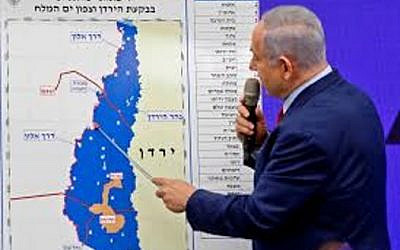
Netanyahu has previously explained the extent of his planned Jordan Valley ‘annexation’. The orange patch in the thicker part of the blue area is the Jericho area. This is part of Area A and is not included in the planned ‘annexation’. {Youtube screen capture}
Yachad may point to some Israeli journalists (notably Ha’aretz) who made the same dishonest claim.  But two liars don’t make a truth.  At least Ha’aretz published the original fragment from Netanyahu’s interview, allowing people to judge for themselves, to spot the spin.
Yachad’s Director now has a last-ditch opportunity to be a mensch: she can write to the group’s contacts, apologising – without reservations, without ‘hochmes’, without trying to squeeze further dishonest propaganda from what she will say is an honest mistake.  She should furthermore publish her apology in the Jewish News and Jewish Chronicle – the same newspapers the group often uses to convey their other messages.  She should apologise in situ for the equally misleading social media posts.
If she chooses not to do all that, then the verdict is inevitable.  This is not about ‘annexation’ or Israel – we can agree or disagree on that.  It’s about ethics; it’s about salvaging a remnant of credibility.
Intellectual dishonesty is always off-putting.  But it is never more appalling than when employed by the self-righteous, by those who seek to cover themselves in the noble mantle of morality.  Lies and deceit make shaky rungs on a ladder leading not to high moral ground – but to the depths of moral turpitude.

Note: a previous version of this article mistakenly stated that no link to the interview was provided in Yachad's email.  It was – though the link was to the text in Hebrew (a language most British Jews do not speak) and it was included in the 'Read more' section at the bottom of the message, where most people would probably ignore it, as I did initially.

Sunday, 10 May 2020

Taking the Mick out of Davis


If I were a rich man,
Yubby dibby dibby dibby dibby dibby dibby dum.
All day long I'd biddy biddy bum.
If I were a wealthy man.  […]
And it won't make one bit of difference if I answer right or wrong.
When you're rich, they think you really know!

An absolute giant of Yiddish literature, Sholem Aleichem populated his stories with all the colourful characters of the Eastern European shtetl.  And one of the most convincing is the ‘gvir’: the rich Jew; the parvenu, the village boss who mistakes subservience for respect and trades ‘charity’ for influence and power.

The Jewish shtetl is a thing of the (nostalgic) past; not so the gvir; that tragi-comic character, it seems, still struts around: among us, but not quite one of us.

*** 

Sir Mick Davis is a very rich man.  He made his money in mining (coal, metals, petroleum); but don’t picture him in a hard hat with black on his nose – I suspect that he mines primarily from the comfort of a well-upholstered, directorial armchair.  And I guess he’s put that money to good use: he is an important donor to the Conservative Party (Labour also likes money; but it doesn’t like Jews – let alone rich ones!)  Davis served as Treasurer and – until recently – Chief Executive of the Tory Party.

I know, I know… a miner called Davis… what a cliché!  But no: Sir Mick ‘the Miner’ isn’t Welsh – he’s Jewish.  So, naturally, he also took an interest in the affairs of British Jewry: in 2009, he became Chairman of the Jewish Leadership Council.  How, you’re asking?  Well… previously, the JLC had been led by an elected official: the President of the Board of Deputies of British Jews.  It looks like Mr. Davis took advantage of a change of guard at the helm of the Board to shoulder aside the new President.  Or (to use the far more delicate language employed by the Jewish Chronicle)
he grasped the reins of its [the JLC’s] executive.
The newspaper commented – perhaps with a hint of irony – that this
may not have been exactly a palace coup but it showed who was boss in town.
Didn't it just!  I should warn you here: irony plays a big role in this story; where are you, Sholem Aleichem, when we most need you?

Mr. Davis first courted controversy in 2010, when he opined (in English and in public) that Israel ‘could become’ an apartheid state.  Some may see quite a bit of irony in that: Mick Davis was born and lived his formative years in Apartheid South Africa.  And… I might be wrong here, but I’ve never seen his name listed among the many South-African Jews who actively fought that appalling regime; unless, that is, one considers immigrating from South Africa to the UK as a brave act of social protest.  If indeed young Mr. Davis omitted to valiantly combat the apartheid in his home country, it must’ve been just a matter of  perspective: it seems it’s easier to recognise (and, consequently, criticise) potential apartheids that ‘may occur’ thousands of miles away; it’s not always easy to spot an actual apartheid operating under one’s very nose.

Mr. Davis’s comments on Israel’s putative apartheid-hood so outraged many in the British Jewish community that a petition was written demanding his resignation from public community positions.  But it was quickly withdrawn, when Sir Mick threatened to let the whole weight of his… err… indignation bear – by threatening to deploy his heavy legal artillery against the poor... err... much less indignant petitioner!  Not, God forbid, that Mr. Davis believes that freedom of speech is for him, but not for others; no, it’s just that, apparently, the petition had ‘misrepresented his positions’…

More recently, Sir Mick has once again become the talk of the (virtual) shtetl: in the cover-page article of the (almost bankrupted, but fortunately freshly resuscitated) Jewish News, he accused “Israeli politics” of “violat[ing] values of the Diaspora”.

I find the article full of (unintended) irony.  So let me read it to you with a running commentary.
Says Sir Mick:
Israel remains surrounded by hostility but its emerging existential threats come from within.
Now, when he’s right – he’s right: the Jewish state is indeed surrounded by enemies: there’s for instance Iran (80 times larger than Israel in area, 9 times in population, 5 times in economic output), whose Holocaust-denying leaders call for Israel’s blood every day – and twice on Saturday.  Leaving aside its nuclear ambitions, Iran has a large, strong and well-equipped military, which is currently busy entrenching itself in Syria, as close as it dares to Israel’s borders.  Another of those borders precariously separates Israel from an Iranian ally: Hezbollah – and its 100,000+ rockets.  To the south, there’s Hamas and the Palestinian Islamic Jihad; i.e., tens of thousands of rockets and mortar rounds, some capable of reaching targets hundreds of miles away.  In Sinai (a territory 3 times larger than Israel, which the Jewish state once controlled but ceded in return for peace and security) lurks a very active branch of the Islamic State.  You know – those nice people who’ve recently beheaded, crucified and burned a broad swath of blood and tears through Syria and Iraq.  And that’s before one thinks of threats that currently seem – for whatever that’s worth in the Middle East – less imminent: such as a certain manic dictator with neo-Ottoman ambitions.

Yet Sir Mick has decreed that these are not really existential threats.  ‘The problem’, he seems to preach to those Israelis who face the rockets, the bullets and the knives, ‘the problem is not that they want to kill you.  No, let me tell you what the real problem is: it’s your own suicidal tendencies!’ 

Now, Mick Davis is certainly entitled to his opinion.  It would be good to understand, however, on what specialist knowledge it is based?  Because, although Costa Coffee has hosted many a debate on grand strategy, it doesn’t actually count as an accredited military academy.

But, as we know, people don’t actually need to have a clue what they’re talking about – they can still talk.  The problem, says Sir Mick, is Israel’s 
own dysfunctional political system.  
And why is that political system so bad?  First, he explains, there are
the hazards of proportional representation.
And I thought “proportional” was actually a positive thing… stupid me!  I thought that it meant that each citizen gets a vote that is worth exactly the same; that the makeup of the Parliament is a true reflection of the views of the electorate, warts and all.  That’s not what ‘first past the post’ delivers. In 2019, for instance, 1 in every 8 Brits (circa 12%) voted for the Liberal Democrats; but, because of the ‘first past the post’ system, that party only has 11 MPs – i.e. a mere 1.7% of the House of Commons.  

In a proportional system, with 12% of the votes they would have gotten, of course 12% of the seats in Parliament – that’s what “proportional” means.

Don’t get me wrong: one can argue about the advantages and disadvantages of either system – till one’s blue in the face; if one donates to the Tories, I suppose that ‘first past the post’ is wonderful – it results in more bang for the buck; if I were to ask Liberal Democrat supporters, they might feel differently.  But is the “proportional representation” any less democratic?

So what is Sir Mick’s beef with Israel’s “proportional representation”.  Well, he tells us:
the outcome is a government the public didn’t vote for, led by a prime minister seemingly driven by holding onto power and propped up by parties who had previously pledged on principle not to govern with him.
So, Mr. Davis doesn’t like the outcome of the elections.  I get that.  I just don’t think that’s a good enough reason to change the system.  No disrespect, Sir Mick!

But why is this new government one “the public didn’t vote for”?  It represents a broad coalition, from left (the Israeli Labour Party) to centre (Blue & White) to right (Likud).  The prime minister will be Benjamin Netanyahu (leader of the largest party, which received 29% of the votes), followed by Benny Gantz (whose party received 27% of the votes).

True, before the elections Gantz promised not to serve in a Netanyahu government.  You caught him there, Mr. Davis, Sir!  He’s a terrible, terrible man – the first politician ever to break a pre-election promise.  I’m sure nothing like that ever happened while you were Chief Executive of the Conservative Party.  (In Gantz’s defence, he may have followed bad examples: before elections, every US president in the past 25 years promised to move the US Embassy to Jerusalem.  It took a quarter of a century to find one that actually did – and I doubt you like him much.)

It is, I agree, terrible that Israel has such a “dysfunctional political system”.  It gets people frustrated.  So unlike UK’s wonderfully functional political system; the one that produced a pro-Remain Parliament despite a clear pro-Brexit referendum; plus 3 years of paralysis, a government begging for elections and an opposition courageously opposing them, etc. etc.

Where Sir Mick is right is that Israel will now have (for a while, at least) a Prime Minister who faces “corruption charges”.  Netanyahu stands accused of having traded favours in return for a ‘kinder treatment’ at the hands of a major news outlet.  British politicians would certainly never do anything like that!  Although there were things… I seem to remember quite a few MPs (including ministers and shadow ministers) dipping their hands rather dishonestly into the public purse…  But that’s a different thing altogether!

Oh, I do admire Sir Mick’s principled stance.  In fact, I herewith demand that Netanyahu’s sorry ass be put in prison – if found guilty by a court of law.  It’s just surprising for me to hear rumours that, in the past, Mr. Davis may have taken a less righteous position against alleged corruption by one of his own underlings.  Well, given those false rumours, I’m sure that Sir Mick cannot but agree with me that people (including the Chairman of the Jewish Leadership Council and the Prime Minister of Israel) are innocent, unless proven guilty.

It’s only halfway through his article that Mr. Davis comes to the issue that really awoke his ire: the planned annexation by Israel of parts of the West Bank – in accordance with the latest US ‘Peace to Prosperity’ plan.
When we talk of existential threats to Israel, then annexation is the genuine article.
That’s, of course, a valid opinion.  Unfortunately for Mr. Davis, it is just the opinion of an outsider.  Sir Mick is not Israeli; he is a British citizen, paying his taxes in the UK.  It is Israeli citizens (i.e., people who live in Israel, pay taxes in Israel, serve in the army in Israel and risk being bombed to smithereens in Israel) that are entitled to decide (as opposed to opine) what constitutes genuine existential threats to Israel.  And a clear majority of those Israeli citizens voted for parties that accepted the US proposal.

But it doesn’t look like Sir Mick is content with ‘just’ an outsider’s opinion:
The keep your wallets open and mouths shut model of Israel-Diaspora relations was viable when Diaspora Jewry saw in Israel’s political leadership an embodiment of its values rather than a violation of them.
The “wallets open” was understood – and not just by me – as a hint.  After all, as the Jewish News says, Sir Mick is not just any outsider; he is
[o]ne of Britain’s biggest philanthropists to Israel.
I just wonder if, when Mr. Davis decided to give whatever he gave “to Israel” (or, more likely, to whatever causes and organisations he finds useful in Israel), he informed people that those donations came with a clear caveat: ‘I pay – I get the say’.  ‘Coz, had he said so to me (I’m Israeli), I would’ve told him to keep his money.  I have no idea what Sir Mick’s experience is with donations to the Conservative Party; but Israel is a sovereign country.

Isn't 'philanthropy' something done without ulterior motives?


Apparently, however, some sovereign countries have duties to set up other sovereign countries.  How else am I to understand Sir Mick’s sententious determination that Israel has a
moral and strategic imperative to extricate itself from ruling over [the Palestinians].
Before I read Sir Mick’s wise words, I rather stupidly thought it’s the task of every nation that doesn’t yet have independence to “extricate” itself from its rulers.  Including by making the necessary concessions and compromises to achieve that goal.  As Jews – and Indians, and Pakistanis – did in 1947.  In Sir Mick’s perfect world, however, it is the sacred duty of Israel to   offer
a tangible alternative on this issue.
Well, a (or, rather, another) “tangible alternative” has just been offered by the US Administration.  It may not be an administration to Sir Mick’s liking; it may not be an “alternative” he likes, or that the Palestinians like.  But, surely, Mr. Davis hasn’t made his millions by walking away from deals, simply because the opening offer wasn’t to his liking.  While the US document unsurprisingly expresses a US ‘Vision’, it also leaves the door wide open for negotiations:
The peace agreement that will hopefully be negotiated on the basis of this Vision should be implemented through legally binding contracts and agreements (the “ISRAELI-PALESTINIAN PEACE AGREEMENT”).
In fact, the reputed architects of the ‘Vision’ have gone to great pains to make that clear.  Speaking about the Palestinian leadership in an interview he gave to an Egyptian media outlet, Jared Kushner said:
If there are things they want to change, if they don’t like where we drew the lines, they should come and tell us.
Were they able and willing to make peace, the Palestinian leaders could simply have said ‘We agree with the principle that there should be an independent Palestinian state alongside Israel.  Everything else – let’s negotiate.’

In the absence of such a response, Israel’s ‘duty’ of providing “a tangible alternative” becomes a duty to provide ‘a tangible alternative acceptable to the kind of leadership for whom no alternative was acceptable in the past 100 years’.  I am not as knowledgeable as Sir Mick – but I found no such ‘duty’ in the Torah.  Maybe it’s in the Statutes of Values of the Diaspora that he appears to own.

But the relationship with the Palestinians isn’t Sir Mick’s only imputation towards the Jewish state.  Israel, he intones
must radically improve social mobility within its own society.
And why does he think that Israel has such poor social mobility?  Because
for an OECD country, Israel’s gaps between rich and poor are extraordinary.
Some may view as ironic that a multi-multi-millionaire preaches about narrowing the “gaps between rich and poor”.  But beyond the irony, according to OECD data, Israel has a Gini Coefficient of 0.35.  UK’s is 0.36. Gini is a widely used measure of income inequality: 0 (zero) corresponds to perfect equality, 1 (one) to worst possible inequality – so the lower, the better.  Well, I’d like to think that Sir Mick applies more rigorous research and due diligence to his business dealings than he does to his pronouncements on social issues.  Otherwise, I’d say such sloppiness is… how should I put it… “extraordinary”!

Income Inequality in OECD countries.  Israel in red.  The UK is the 4th bar to the right of Israel.


Next, Sir Mick’s bounces from pseudo-economics back to pseudo-politics:
Israel advocates around the world, of which I am one, boast about the full citizenship rights of Israel’s Arab citizens and their role in Israeli life. However, the MKs those citizens elect are still considered governmentally trayf.
Firstly, on behalf of all my countrymen, I’d like to thank Sir Mick for his unparalleled advocacy.  It’s valiant defenders like him that make us feel so much safer!

However, the rest of the passage is a bit of a spin.  Those MKs are not considered “governmentally trayf” because they are Arabs (indeed, one of them happens to be Jewish); nor because they are elected by Arabs (there are Jews who vote for the ‘Arab List’ and there are Arabs who vote for the ‘Jewish’ parties);  no, the problem is not the ethnicity or religion of those MKs or of their supporters – but the political views that they represent.  It’s about Zionism vs. anti-Zionism, yes – but not just.  The Arab Joint List includes a communist party; a hyper-nationalist party; and an Islamist Party.  Given the record of those ideologies in the region and the world, mainstream Israeli politicians may perhaps be forgiven for not wanting such parties in the governing coalition.

But the issue is more fundamental than that.  In a parliamentary democracy, there is a right to vote, to elect their parliamentary representatives (and be elected as such); I wasn’t aware that there was a right to have one’s representatives included in the governing coalition – whatever their politics.  Are you making up democratic rules as you go along, Mr. Davis?

Apparently, Sir Mick’s list of Israel’s many violations of ‘values of the Diaspora’ also includes the fact that the Jewish state has failed to teach British Jews Hebrew:
How for example, can we nurture a thriving and mutual beneficial sense of shared peoplehood, when so many Diaspora Jews, particularly in the English-speaking world are unable to speak Hebrew, the language of their homeland?
That is indeed a problem – and I must thank Mr. Davis for pointing it out.  Too bad he pointed it out… in English; in a Diaspora Jewish English language newspaper!

And it’s not Israel’s only linguistic and cultural sin.  Mr. Davis also determines that:
Jewish Israelis need more and better education in Arabic and Arab culture. Arab Israelis need more and better education in Jewish culture and history.
Don’t you just looove one that always asks for “more and better” – but fails to even mention what has already been achieved?  To start with, most Israelis (or their parents or grandparents) hail from Arab lands – so Arab culture is hardly unfamiliar to them.  Arabic is part of the curriculum in most Israeli secular schools – at all levels.  True, it is not compulsory to study Arabic – it’s one of the optional languages students can choose to study (and many do).  In recent years, more teachers of Arabic are employed in Jewish schools – no doubt because Mr. Davis has determined that this is the way forward.  Most Arab Israeli parents understandably choose to give their kids an education in Arabic schools – but that education includes the study of Hebrew.

And actually, may I suggest that – before he idly shoots his mouth off again – Sir Mick takes the time and the trouble to watch the excellent Israeli series ‘Fauda’?  It is available on Netflix.  With English subtitles, Sir Mick; no worries!

Don’t get me wrong: Mr. Davis can actually have a say on how Israel looks like – and how she should look like in the future; once he comes to live there, of course.  I’m sure he has enough money to buy himself a decent flat in Sderot!

But, let’s face it – he is unlikely to make Aliyah.  In fact, he doesn’t even envisage such possibility.  He bashes Israel ‘as a Jew’ from the Diaspora.  Why?  A very charitable explanation would be ‘because he cares’.  It’s a very strange way to show it, but hey-ho…

Unfortunately, I am more inclined to believe an explanation that Sir Mick himself let slip at some point:
I think the government of Israel […] have to recognise that their actions directly impact me as a Jew living in London, the UK.  When they do good things it is good for me, when they do bad things, it's bad for me. And the impact on me is as significant as it is on Jews living in Israel.
There are no less than 4 rather emphatic me’s in that short peroration.  It would seem that Mick Davis does care deeply… about Mick Davis!

Well, Mr. Davis Sir, as an Israeli who served for 20 years in the IDF, I am sorry for all the inconvenience that we caused you!

Oh, and… for whatever it’s worth, this Jewish Israeli (of the Ashkenazi variety) loves the Arabic language and culture.  Take for instance this brilliant proverb, which applies so well to you and your hatchet-job of an article:
الكلاب تنبح والقافلة تسير
It means: ‘The dogs bark, but the caravan moves on’.  So long, Sir Mick!

Saturday, 31 August 2019

Israelis, Palestinians and ‘Love Island’

I have a confession to make: I am one of those few weirdos who never bothered to watch an episode of Love Island.  Which is why my knowledge of this TV show is second-hand at best; and why using this metaphor is – I have to admit – a bit of a cheap trick to get you hooked, dear reader.

I understand the attractions of love – but why on an island?  Perhaps because islands have that strange allure: they are constrained geographies suggestive of enforced isolation from without and imposed intimacy within.

From Gauguin to Attenborough, from Defoe to Swift, we’re all fascinated by islands.  They are world’s quintessential test tubes: riveting experiments in natural and social eccentricity.


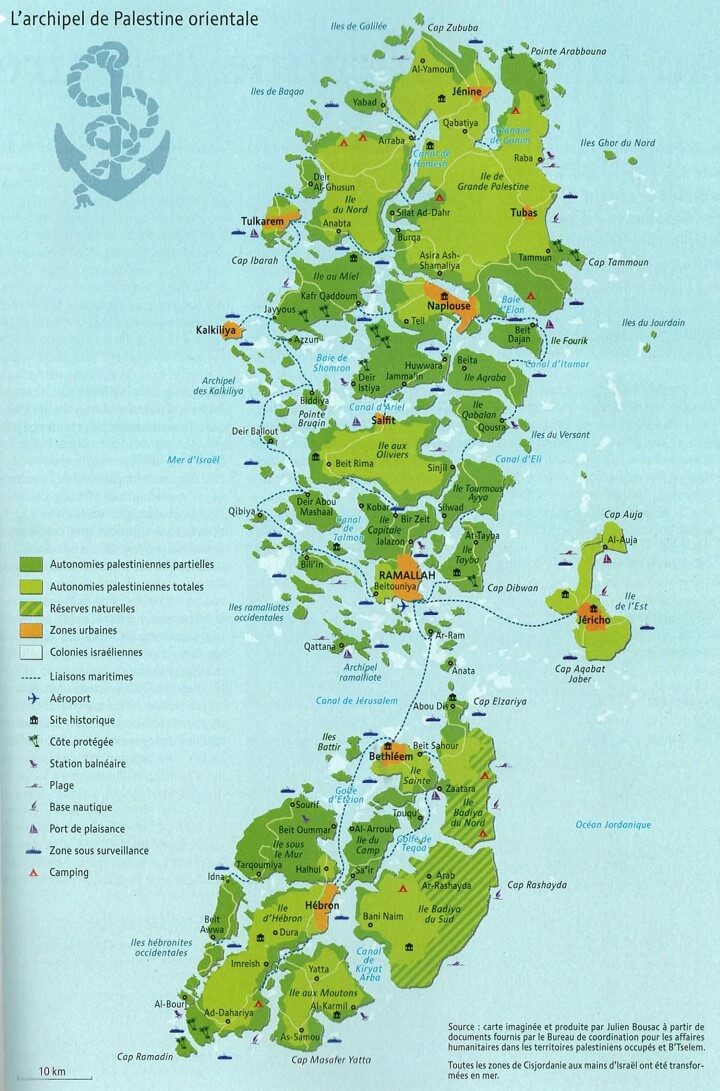
With their rich, often over-the-top imagination, ‘pro-Palestinian’ activists could not possibly have missed the metaphoric potential of islands.  They harnessed that potential ‘for the cause’ by portraying the Palestinian Authority-governed areas of the West Bank (defined in the Oslo Accords) as an ‘archipelago’ of small islands in a ‘sea’ of Israeli ‘settlements’.  Such allegoric maps travel far and reach wide; their message is clear: a patchwork of Palestinian ‘islands’ cannot be turned into a viable state.


Not satisfied with the mere allegory, some activists are shouting that message in full-throated, indignant, moralising voice: it is too late for the two state solution.  Often, they blame Netanyahu and ‘his settlements’; but Seumas Milne (a former journalist and currently top courtier to Labour Party leader Jeremy Corbyn) suggested, even 15 years ago, that the two-state solution was no longer achievable.

Among certain ‘pro-Israel’ activists (and even among some Israelis), such suggestions are a source of dread and despair.  In the absence of a Palestinian state, they say, Israel’s choices are grim: either ‘one-state’ in which Jews will be (or will quickly become) a minority; or else an apartheid state – in which the Palestinians won’t possess full political rights.

A recent Jewish Chronicle article quotes Tal Keinan, an American-Israeli businessman and former Israeli fighter pilot, who argues that there are “only three possible endgames” for Israel:
"The first is that Israel could annex the West Bank and give its Arab residents citizenship – which would mean Israel ‘opening itself to the prospect of demographic suicide’. […]
The second option would be to annex the Palestinian territories without granting the Palestinians citizenship – imposing sovereignty on a large number of people without representation. […]
The final option […] is for Israel to withdraw from most of the territories, with or without an agreement with the Palestinians. If the Palestinians build a state, there will be a state, but if not, the West Bank ‘will likely become another rocket base’."


So there you are: the options are oblivion, apartheid or being bombed to smithereens.  As the current British Prime Minister would put it, doom or gloom!

There’s a debate to be had on whether it is indeed too late for the ‘two state solution’; and whether lack of ‘full political rights’ equals ‘apartheid’.  But I do not wish to go there now.  My question is: are those ‘3 choices’ really the only possible ‘endgames’?  Or are the prophets of doom merely demonstrating their own stale thought processes, their own lack of imagination and creativity?

I am fascinated by islands.  They are such interesting places!  Let’s let our minds travel to a few islands – and see what we can learn.

A ‘Great’ Britain with some little ‘dependencies’

To start with, I won’t have to travel too far: I live on the island of Britain, which some (both on and outside it) still sometimes call ‘England’.  But it isn’t ‘England’ – the island of Britain is part of a sovereign state called the United Kingdom of Great Britain and Northern Ireland.  Although it is not formally called a federation, this is in fact a federal state made up of four ‘countries’: England, Scotland, Wales and Northern Ireland – each of them endowed with a great deal of political, economic and cultural autonomy.  Nonetheless, there are nationalist movements in each of these ‘countries’, aspiring to more autonomy and even to outright secession from the federation. 

I have recently travelled to Scotland, where great efforts are being made to revive and expand the use of Scottish Gaelic.  Upon return to London, I discovered that I still had a pocketful of Scottish banknotes.  The ‘Scottish pound sterling’ is worth exactly as much as the ‘British (not English!) pound sterling’; but the banknotes are underwritten by the Royal Bank of Scotland and bear different images from their ‘British’ counterparts.  Those strange-looking banknotes may be legal tender throughout the UK; but they are, let me tell you, viewed with suspicion by London retailers, many of whom seem to see them for the first time.

Another ‘country’ – Wales – occupies a peninsula in the West of Britain.  Wales is very similar in size to Israel, but it is less densely populated.  The vast majority of its inhabitants speak English and only one in five has Welsh as their mother tongue.  Still, Welsh is an official language in Wales, on a par with English; no expenses are spared – everything (from road signs to court summons) is written in both languages.  And children have to study Welsh in school, whether they have any use for it or not.

But ‘Great’ Britain is not as interesting as some of the smaller islands off its coast.  Take for instance the Isle of Man, a territory just one-and-a-half times the size of Gaza Strip.  The Isle isn’t part of the United Kingdom; nor is it a sovereign, independent state.  It is, instead, defined as a ‘British Crown Dependency’.  If you think that this means ‘owned by the Queen’ – think again: Queen Elizabeth the Second could not sell off that piece of real estate to – say – Donald Trump; even if he was interested and however much Her Majesty wanted to oblige!

Most Isle of Man inhabitants have the status of ‘Manxmen’ (and Manxwomen?)  Manxmen are ‘in principle’ British citizens; in principle only, because they cannot, for instance, vote in UK national elections and are hence not represented in the UK Parliament.  Although decisions made in that Parliament can have a huge impact upon their lives.  For instance, Manxmen could not vote in the 2016 Brexit referendum.  But, although the island is not part of the United Kingdom – and also not part of the European Union – its economy is strongly affected by the trade between the two…

Manxmen do elect the 24 members of the House of Keys – the lower chamber of the local ‘Parliament’, which deals with most internal matters.  Issues pertaining to defence, international relations, as well as the final say on matters of ‘good governance’, however, are the competence of the UK government and parliament.

Fiercely dependent:
Manxmen are proud citizens of a British Crown 'Dependency'
Upon application, Manxmen are issued with specially printed  British passports.  But instead of ‘United Kingdom’, those passports declare their bearers citizens of a strange entity called ‘British Islands – the Isle of Man’.  Such passports allow Manxmen to travel to – for instance – EU countries; but, unlike ‘regular’ British citizens, they are not entitled to work there.  Nor are EU nationals entitled to work on the Isle of Man, although they (still) can work in the UK.


The British Crown possesses also other ‘Dependencies’ – including several islands in the English Channel/La Manche: Jersey, Guernsey, Alderney and Sark.  Each island is governed separately, according to its own traditional system, mostly originating in the early Middle Ages.  Their combined population is estimated at around 165,000.  None of the Channel Islands is represented in the UK Parliament and, as a rule, their ‘citizens’ cannot vote in UK national elections and referenda.  Their status is, roughly speaking, similar to that of Manxmen.

Something is rotten in the state of Denmark


If we let our mind fly north-west of Britain, across the North Atlantic ocean, we come across Donald Trump’s latest real-estate project: Greenland.  It is the world’s most sparsely populated ‘country’ – with just one inhabitant on average per 10 square miles of territory; but it is also the world’s largest island: circa 10 times larger than Great Britain and 100 times larger than Tiny Israel.

Politically, Greenland is defined as an ‘autonomous region’ of the Kingdom of Denmark – a ‘region’ 50 times larger than Denmark-proper.  Some call it a ‘constituent country’ – similar in principle to the status of Scotland or Wales within the UK.

Happy Greenlanders

The majority of Greenland’s population (circa 88%) belongs to the indigenous Inuit (a.k.a. Eskimo) ethnicity, akin to the natives of North Canada and Alaska.  They speak their own language.  The balance consists of Danish settlers.

Greenlanders elect 2 representatives to Denmark’s parliament, out of a total of 179.  They also elect the 31 members of Greenland’s own parliament, which in turn elects a local government with a high degree of internal autonomy.  However, the Danish government sitting in Copenhagen is responsible for decisions pertaining to defence and international relations; even for those that directly affect the inhabitants of the ‘constituent country’ of Greenland – such as the permission to locate nuclear weapons on the island.

In 1973, the Kingdom of Denmark (including Greenland) became a member state of the European Community – precursor to the European Union.  But, using its greater autonomy achieved in 1979, Greenland voted in 1982 to leave the economic block – and completed that exit by 1985.  It is no longer part of the European Union; but it is still part of the Kingdom of Denmark, a member state of the European Union…

Economically, Greenland has long been highly dependent on Denmark.  However, for the past decade or so, the Greenlandic government has worked steadily to gradually reduce the economic dependence, with the ultimate goal of attaining political independence.

The Kingdom of Denmark ‘owns’ also another ‘constituent country’: the Faroe Islands.  Their status is roughly similar to that of Greenland: the Faroese elect 2 members of the Danish Parliament, as well as all 33 members of the local parliament.  Just like in Greenland, there is a local government, led by a Prime Minister; there is also a strong movement demanding political independence.  A separate Faroese Constitution drafted in 2011 has been rejected by the Danish government of the time, as ‘incompatible’ and ‘cannot co-exist’ with the Danish Constitution.

The poor ‘rich harbour’

By now, you probably think that ‘special status’ islands are but vestiges of medieval kingdoms, bizarre anachronisms somehow preserved into modernity.  Well, not exactly: some of them are part of relatively young republics.

One such island is Puerto Rico.  ‘Discovered’ by Columbus, it was incorporated into the Spanish Empire and colonised by (mainly) Spanish settlers, who wiped out the indigenous population and culture.  But in 1898, it was conquered by the United States.

The term ‘colony’ is not en-vogue any more; but Puerto Rico is not a federal US state, nor is it part of a state.  It is, therefore, defined these days as a ‘United States unincorporated territory’.  In this context, ‘unincorporated’ means that the US Constitution does not apply in full: only ‘fundamental rights’ are protected, other constitutional rights are not.  As a consequence, although the Puerto Ricans are ‘in principle’ US citizens (since 1917), they cannot vote in US presidential elections and do not have senators or voting representatives in the US Congress.  Instead, the 3.2 million Puerto Ricans elect a local Governor and a bi-cameral parliament.  However, the head of state is the President of the United States.  The jurisdiction and sovereignty belongs to the United States of America and the ultimate power is vested in the US Congress.  Laws adopted by the latter apply to Puerto Rico by default.  Many US federal agencies (notably the FBI) are active in Puerto Rico.


A very lonely star...
Puerto Rico calls itself Estado Libre (Free State). But it is neither an independent state, nor a US state.

As US citizens, Puerto Ricans can serve in the US military – in fact they were historically forced to serve whenever the US adopted compulsory military draft.  However, Puerto Rico also has its own National Guard, distinct from the US National Guard.  The commander-in-chief of the Puerto Rican National Guard is… the President of the United States.

On average, Puerto Ricans are significantly poorer than the citizens of the State of Mississippi – the poorest of US states.

US controls a few other ‘unincorporated territories’ with roughly similar regimes – and they happen to also be islands: Guam, Northern Mariana Islands, U.S. Virgin Islands and American Samoa.

And a ‘fragrant’ harbour

I never noticed any particularly pleasant smell when I visited Hong Kong, but many believe that ‘Fragrant Harbour’ (hēung gong in Cantonese) is the origin of the modern name.
Hong Kong consists of the eponymous island, plus an archipelago of some 200 other islands and two small pieces of territory on the coast of Southern China.  In total, it is not much larger than the Gaza Strip – but it is more densely populated: more than 17,500 inhabitants per square mile, compared to Gaza’s 13,000.


How to live on an archipelago:
one can travel among the main islands of Hong Kong by underground train.

In theory, Hong Kong is part and parcel of the sovereign territory of the People’s Republic of China.  But it certainly does not feel that way.  And it’s not just a matter of a different flag, state symbols and anthem.

The official language of China is Mandarin – written with simplified Chinese characters.  In Hong Kong, it is Cantonese, inscribed with traditional characters.  Which render anything spoken or written in Hong Kong unintelligible to most people in China.

Cars cling to the left side of the road in Hong Kong, still following the British tradition; but they are driven on the right in China.

Five years ago, I travelled to China via Hong Kong.  To start with, I had to apply for a Chinese visa; but when I finally got it, was told that it’s not valid in Hong Kong – where one needs a separate visa; or, in the case of my Israeli passport, no visa for Hong Kong, yes visa for China.

Flights from Hong Kong to Beijing are expensive, as they are considered international flights.  I was advised, instead, to buy a seat on one of the many cars and coaches ferrying passengers from Hong Kong Airport to Shenzhen Airport just across the border with China.  I do not use the term ‘border’ lightly: en-route to Shenzhen, my passport was checked twice, within a 50 yards stretch of road: first by the border police of Hong Kong, then by Chinese border officials.

Once at Shenzhen Airport, I boarded a much cheaper, probably subsidised ‘domestic’ flight to Beijing.

I paid for the transfer from Hong Kong to Shenzhen with Hong Kong dollars, but they’re not legal tender in China; so I had to buy the flight ticket Beijing with Chinese ‘renmimbi’, not accepted in Hong Kong.

All this may sound and feel strange, given that Hong Kong is not an independent state.  Officially, Hong Kong is called a ‘Special Administrative Region of the People's Republic of China’.  But in this case, ‘special’ is an understatement.

As I am writing this, there are widespread protests in Hong Kong against Chinese ‘interference’ – protests triggered by a change in law allowing certain offenders to be ‘extradited’ from Hong Kong to... another part of China’s ‘sovereign territory’.  Go figure!

So what?

By now, I can hear quite a few of you grumbling: what do all these islands have to do with anything?  Israel has occasionally been called ‘an island’ – as in ‘an island of freedom in a sea of tyranny’; but geographically it certainly is no island.

Well, I’m afraid I used the ‘islands’ allegory only as a crafty rhetorical device.  This isn’t just about islands, there are many other, ‘continental’ examples.

The point is that the ‘sovereign state/no state’ paradigm is based on a false dichotomy.  Reality is much more complex than that; there are almost-states, states-within-states, incorporated ‘unincorporated territories’, ‘constituent countries’, ‘special administrative regions’ and a myriad other ‘unconventional’ political constructs.

It may be that none of the existing models described above precisely fits the requirements of a future Israel-Palestinian Arabs accommodation.  But what these ‘islands’ prove is that there’s a huge breadth of possibilities – rather than a binary option.

Human beings are endowed with imagination, creativity and problem-solving abilities.  They are also ‘tribal’ and seek self-determination: the right to control their destiny, while organising themselves along ‘tribal’ identities that both unite and divide.  And, as a result of all that, human communities have evolved and are evolving in many complex, unusual, original ways.  Because no man is an island; not even on the Isle of Man.


The conflict between Jews and Arabs – or between ‘Israelis’ and ‘Palestinians’ – is a conflict between right and right.  Not a dilemma, or even a multiple-choice question; but an art project, a piece of blank canvas.

We live in a world of endless possibilities.  There are no slim choices, just narrow minds; mankind doesn't inhabit rigid, tidy little boxes – only some men do.

Sunday, 29 July 2018

Israel’s Nation State Law: drink driving vs. sober analysis

Recently, the Israeli Parliament (the Knesset) has adopted a piece of legislation entitled ‘Basic Law: Israel – the Nation State of the Jewish People’.  Pretty much everything that happens in Israel can be described as ‘controversial’ if one follows traditional news outlets (let alone the social media).  But this new law is certainly even more ‘controversial’ than usual.  It has been criticised by many in Israel and by most Jewish organisations in the Diaspora.  Others, of course, have defended it.
There are three main ‘strains’ of criticism: the first basically accuses the Israeli legislators of unnecessarily ‘rocking the boat’.  Indeed, despite the brouhaha, the new law does not ‘do’ anything; it has no practical effect, it does not change the reality on the ground one iota.
A second type of criticism is that the law is poorly designed and drafted: it includes superfluous articles, while leaving out important principles.
I confess that I feel a lot of sympathy towards both these criticisms.  But then there is a third category – those who claim that the law is terribly wrong, even utterly evil.  The degree of ‘wrong’ varies between ‘incompatible with democratic principles’ and ‘profoundly racist’ – depending mainly on the critic’s own ideological inclinations.
Confronted with this new development in Israel, most commentators did what they always do – they quoted other pundits.  I’m otherwise inclined – rather than playing the pointless ‘X said/Y said’ game, I suggest taking a look at the actual text and analysing it, article by article.  Tedious – I know; but also meaningful.  Those who have no patience for such things are invited to let journalists tell them what they should see and think.
If you are still with me, let’s see what we have:
1a. The Land of Israel is the historical homeland of the Jewish people, in which the State of Israel was established.
This is only controversial among Israel’s enemies.  It’s also hardly new: Israel’s Declaration of Independence famously stated:
The Land of Israel was the birthplace of the Jewish people. Here their spiritual, religious and political identity was shaped. Here they first attained to statehood, created cultural values of national and universal significance and gave to the world the eternal Book of Books.
 The League of Nations Mandate also declared
[R]ecognition has thereby been given to the historical connection of the Jewish people with Palestine and to the grounds for reconstituting their national home in that country;
Let’s move on:
1b. The State of Israel is the national home of the Jewish people, in which it fulfils its natural, cultural, religious and historical right to self-determination.
This is nothing else than ‘Zionism in a nutshell’.
The next article is much more controversial:
1c. The right to exercise national self-determination in the State of Israel is unique to the Jewish people.
I’ve heard a lot of criticism that points (without actually quoting it) to this particular article.  What I haven’t heard is a counter-proposal.  If we’re not saying that, what are we saying?
Are we saying that the Palestinian people also “has the right to exercise national self-determination in the State of Israel”?  One can say that, if one is so disposed – but one cannot say that and militate for the two-state solution.  If the Palestinian people can exercise self-determination in Israel, then what’s the point of a Palestinian state?
Are we then saying that anyone who’s an Israeli citizen “has the right to exercise national self-determination in the State of Israel”?  Again, one can say that – but how then is Israel “the national home of the Jewish people”?  How does one justify the Law of Return, which gives any member of the Jewish people (but not to non-Jews) the almost unconditional right to become an Israeli citizen?  How does one justify the Jewish character of the state – the flag, the symbols, the holidays, etc.?
Let me quote again from the League of Nations Mandate:
the Principal Allied Powers have also agreed that the Mandatory should be responsible for putting into effect the declaration originally made on November 2nd, 1917, by the Government of His Britannic Majesty, and adopted by the said Powers, in favor of the establishment in Palestine of a national home for the Jewish people, it being clearly understood that nothing should be done which might prejudice the civil and religious rights of existing non-Jewish communities in Palestine, or the rights and political status enjoyed by Jews in any other country.
It seems rather obvious: the League recognises that the ‘national rights’ belong to the Jewish people; when it comes to “the existing non-Jewish communities in Palestine”, it sees only “civil and religious [but not national]rights”.
This is further strengthened in Article 4 of the Mandate:
An appropriate Jewish agency shall be recognised as a public body for the purpose of advising and co-operating with the Administration of Palestine in such economic, social and other matters as may affect the establishment of the Jewish national home and the interests of the Jewish population in Palestine, and, subject always to the control of the Administration to assist and take part in the development of the country.
… and Article 7:
The Administration of Palestine shall be responsible for enacting a nationality law. There shall be included in this law provisions framed so as to facilitate the acquisition of Palestinian citizenship by Jews who take up their permanent residence in Palestine.
No equivalent provisions were envisaged for the non-Jewish communities.
Nor was that view abandoned with the dissolution of the League of Nations and its replacement by the United Nations.  UN General Assembly Resolution 181(II)/29 Nov. 1948 called for the establishment of two states and it referred to them as “the Jewish state” and “the Arab state” – although both states were to include minorities belonging to the other ethnicity.  In each state, the Resolution called for:
Guaranteeing to all persons equal and non-discriminatory rights in civil, political, economic and religious matters and the enjoyment of human rights and fundamental freedoms, including freedom of religion, language, speech and publication, education, assembly and association;
Again, the reference is to “civil, political, economic and religious [rights] […] and fundamental freedoms”, but not to ‘national rights’, or ‘national self-determination’.  To the authors of the Resolution, it seemed obvious that the ‘national’ rights in the Jewish state belonged to Jews – why else would they define it as “the Jewish state”?
Finally, Israel’s Declaration of Independence proclaimed
the natural right of the Jewish people to be masters of their own fate, like all other nations, in their own sovereign State.
The Declaration also states:
The State of Israel […] will ensure complete equality of social and political rights to all its inhabitants irrespective of religion, race or sex; it will guarantee freedom of religion, conscience, language, education and culture;
Just like the previous documents, the Declaration differentiates between on one hand ‘national rights’ (which it assigns to the Jewish people); and on the other hand other individual and collective rights, as well as basic freedoms, which are to be enjoyed by all inhabitants of the State, without discrimination.
Still, to people coming from a certain ideological environment, all this does not sound right.  In a recent Jewish Chronicle article, Jonathan Freedland fulminates:
Israel has explicitly granted collective rights to one group of citizens and denied them to another.
The article implies that this is inherently racist; it even hints that Israel may now be accused of apartheid – with more justification than before.  The author then goes on to claim that Israel is no longer a democratic country:
Those used to shouting that ‘Israel is the only democracy in the Middle East’ will need to find another slogan — because this is not how democracies behave.
Except that Freedland’s own country recognises Christmas and Easter as official state holidays (‘bank’ holidays).  Neither Rosh Hashanah, nor Eid-El-Fittr (or indeed Diwali, the Chinese New Year, etc.) enjoy that status.  The Christian cross (but not the Star of David or the Islamic Crescent) features on the national flag.   The Church of England is UK’s Established Church and no other faith has that status; the Head of State is also the Head of the Church, etc.  It would seem that – on some level at least – the UK has “granted collective rights to one group of citizens and denied them to another.”
UK does not have a constitution, so that ‘granting’ is done in practice.  But other countries do it explicitly – in fact at least as explicitly as Israel did.
Let’s have a look, for instance, at the Slovak Constitution.  Its Preamble proclaims:
We, the Slovak nation, mindful of the political and cultural heritage of our forebears, and of the centuries of experience from the struggle for national existence and our own statehood, in the sense of the spiritual heritage of Cyril and Methodius and the historical legacy of the Great Moravian Empire, proceeding from the natural right of nations to self-determination, together with members of national minorities and ethnic groups living on the territory of the Slovak Republic, in the interest of lasting peaceful cooperation with other democratic states, seeking the application of the democratic form of government and the guarantees of a free life and the development of spiritual culture and economic prosperity, that is, we, citizens of the Slovak Republic, adopt through our representatives the following Constitution.
Note that the Preamble postulates a “Slovak nation” acting “together with members of national minorities and ethnic groups”.  The term “together with”unites, but also divides.  It clearly says that “members of national minorities and ethnic groups” are not part of the “the Slovak nation”, though they arepart of the citizenry of the Slovak Republic.  In fact, the Preamble establishes two kinds of “we” – two collectives:
  • “We, the Slovak nation”, and
  • “we, citizens of the Slovak Republic”.
The equation it draws is: “We, the Slovak nation” + “national minorities and ethnic groups” = “we, citizens of the Slovak Republic”
How is this fundamentally different from ‘Jewish people’ and ‘Israeli citizens’?
Crucially, the Slovak Constitution talks about “the natural right of nations to self-determination” – a discussion included in the “Slovak nation” term of the equation and not in the ‘minorities/citizenry’ one.
This is not mere semantics.  Slovakia is home (but obviously not ‘national home’) to a sizable – circa 10% –  ethnic Magyar (Hungarian) minority, which has lived in the country for many centuries.
Demographics of Slovakia: the yellow areas have majority Magyar population.
Yet the Preamble to the Slovak Constitution is designed in ethnic terms.  References to “the spiritual heritage of Cyril and Methodius and the historical legacy of the Great Moravian Empire” are no doubt very meaningful to the (West-Slavic) “Slovak nation”; but the (non-Slavic) Magyar minority may find it hard to identify with such symbols of Slavic character.  In fact, they may be decidedly underwhelmed by “the historical legacy of the Great Moravian Empire” (830-907 CE) and prefer to remember the Kingdom of Hungary, which – from circa 1000 CE until after World War I – included the territory of modern-day Slovakia.
The Slovak Constitution is not some outdated document, preserved merely by tradition: it was adopted in 1992.
Has Jonathan Freedland read the Slovak Constitution?  Would he say that it “has explicitly granted collective rights to one group of citizens and denied them to another”?  Would he say that it justifies claims of ‘apartheid’?
Yet Slovakia acceded to the European Union in 2004.  The accession process involves punctilious verification that the country fulfils the Accession Criteria, the first of which is:
political criteria: stability of institutions guaranteeing democracy, the rule of law, human rights and respect for and protection of minorities;
The European Union has judged Slovakia (with the Constitution I quoted from above) to fulfil the criterion above.

But let us return to the Israeli Nation State Law.  Paragraph 3 says:
3. The capital of the state: Jerusalem, complete and united, is the capital of Israel.
In the case of Israel (and only in the case of Israel!) this is seen by many as controversial.  But it isn’t new: it is nothing but ‘copy and paste’ from another Israeli law – ‘Basic Law: Jerusalem, Capital of Israel’, adopted in 1980!  Paragraph 1 of that law states:
Jerusalem, complete and united, is the capital of Israel.
Another controversial provision of the Nation Law states:
4a. The state’s language is Hebrew.
4b. The Arabic language has a special status in the state; Regulating the use of Arabic in state institutions or by them will be set in law.
4c. This clause does not harm the status given to the Arabic language before this law came into effect.
The BBC claims that the
so-called Jewish nation state bill […] downgrades Arabic from official language status
Except that Arabic has never been an official language in the State of Israel.  It has been (along with Hebrew and English) an official language in the British Mandate of Palestine.  While the State of Israel never declared Arabic (or English) an official language, it did enshrine in its laws and regulations the obligation of state institutions to provide services in Arabic, as well as Hebrew.  Articles 4b and 4c of the new law in effect guarantee the continuation of that obligation.
But is that (to borrow Jonathan Freedland’s expression) “how democracies behave”?  Let’s start with Jonny’s own country: it may surprise him to learn that the official language of the United Kingdom is English and… English.  Of course, the UK government provides services in Welsh (and occasionally in Hindi, Punjabi, Gujarati, Bengali, etc.) – but these are not official languages in the UK.
The official language of Sweden is Swedish, notwithstanding the fact that a sizable proportion of Sweden’s population has Finnish as their mother tongue.
When it comes to language, Slovakia is infinitely harsher than Israel: a 2009 amendment to the ‘Language Law’ not only establishes Slovak as the only ‘state language’ throughout the country’s territory, but severely restricts the use of Hungarian – even among ethnic Magyars.
According to EU Observer:
The Law […] seeks to regulate any and all meetings, gatherings, associations and other forms of communication by insisting on the parallel use of the ‘state language’, Slovak, whenever and wherever members of the minority get together in public, and ‘public’ is very broadly defined. Thus, if a group of Hungarian-speakers establish a literary circle, say, their proceedings would have to have a parallel Slovak translation, whether anyone actually needed this or not.  Minority-language schools are obliged to run their administration and documentation in Slovak and the same applies to the health service. The armed forces, the police and the fire service are to be monolingually Slovak. This last, by way of example, creates interesting scenarios – thus in a Hungarian-speaking area, the firemen are very likely to be all Hungarian-speakers, but when putting out a fire, they must speak Slovak to each other and also, of course, to the owner of the house where the fire is.
Violating the Slovak Language Law is punishable by a fine of EUR 5,000 (equivalent to 5-6 months’ average wages in Slovakia).

But let’s go back to Israel’s newly adopted Nation State Law:
2a. The name of the state is ‘Israel.’
2b. The state flag is white with two blue stripes near the edges and a blue Star of David in the center.
2c. The state emblem is a seven-branched menorah with olive leaves on both sides and the word “Israel” beneath it.
2d. The state anthem is “Hatikvah.”
Details regarding state symbols will be determined by the law.

Jonathan Freedland might see these provisions as less controversial.  He would be wrong again, however.  It’s in the eye of the beholder, apparently.
Adalah is a foreign-funded Israeli Arab organisation which set as its mission
to promote human rights in Israel in general and the rights of the Palestinian minority, citizens of Israel, in particular.
Among other projects, Adalah compiled a database of Israeli ‘racist laws’ – laws that, in the organisation’s view, discriminate against the Arab minority.  This includes, for instance, the Flag and Emblem Law (adopted by the Knesset in 1949).  Adalah explains that the law
Adopts the flag of the First Zionist Congress and the Zionist Movement [which Adalah considers a colonial enterprise], a combination of a prayer shawl and the Shield of David, as the official flag of Israel.  The emblem of the State of Israel is a candelabrum, one of the symbols of the Temple era in Jewish history.
The Constitution of (EU member) Malta proclaims in Chapter 2: “The religion of Malta is the Roman Catholic Apostolic Religion. […] Religious teaching of the Roman Catholic Apostolic Faith shall be provided in all State schools as part of compulsory education.”
 Back to the Nation State Law:
5. Ingathering of the exiles: The state will be open for Jewish immigration and the ingathering of exiles
6. Connection to the Jewish people
6a. The state will strive to ensure the safety of the members of the Jewish people in trouble or in captivity due to the fact of their Jewishness or their citizenship.
6b. The state shall act within the Diaspora to strengthen the affinity between the state and members of the Jewish people.
6c. The state shall act to preserve the cultural, historical and religious heritage of the Jewish people among Jews in the Diaspora.
Jonathan Freedland appears to object less to these provisions.  Frankly, I can’t understand why.  If Israel is the embodiment of the Jewish right of self-determination, then they are easy to understand as expressions of that right; but if Israel embodies the right of self-determination of its Arab (or Palestinian Arab) citizens, then how does Freedland justify them?  Surely, that position should imply that Israel is obligated to rise to the defence of Palestinian besieged in the Yarmouk refugee camp – just as it would do if Yarmouk’s inhabitants were Jewish?  And why should the state “be open for Jewish immigration”, but not for Palestinian Arab immigration (or indeed for the ‘return’ of Palestinian refugees and their descendants)?  Freedland’s (unstated, but implied) views necessarily lead to the position of Adalah, which postulates that Israel’s preferential immigration law is discriminatory and racist.
7. Jewish settlement: The state views the development of Jewish settlement as a national value and will act to encourage and promote its establishment and consolidation.
Here, a tedious linguistic explanation is necessary: the English word 'settlement' is likely to be misinterpreted, because it’s been intensively used (and abused) in relation to Israeli towns and villages beyond the Green Line.  But that would be a mistranslation.  The Hebrew word for ‘settling beyond the Green Line’ is ‘hitnahalut’.  But the law talks about “hityiashvut” – which is the word used for Jewish settlement before the establishment of the State (the term Yishuv – used to refer to the Jewish community in the British Mandate of Palestine – comes from the same root).  So no – this has nothing to do with the ‘illegal settlements’.
In fact, this paragraph of the law mimics the language of the League of Nations mandate, which called on the Administration of Palestine to “encourage […] close settlement by Jews on the land”.
Back to the Nation Law again:
8. Official calendar: The Hebrew calendar is the official calendar of the state and alongside it the Gregorian calendar will be used as an official calendar. Use of the Hebrew calendar and the Gregorian calendar will be determined by law.
9. Independence Day and memorial days
9a. Independence Day is the official national holiday of the state.
9b. Memorial Day for the Fallen in Israel’s Wars and Holocaust and Heroism Remembrance Day are official memorial days of the State.
10. Days of rest and Sabbath: The Sabbath and the festivals of Israel are the established days of rest in the state; Non-Jews have a right to maintain days of rest on their Sabbaths and festivals; Details of this issue will be determined by law.

These paragraphs sketch the Jewish character of the state.  Once more, they might look less controversial to Jonathan Freedland – but these aspects are listed in Adalah’s database of ‘discriminatory laws in Israel’.
The national anthem of Cyprus praises the “Greeks of old”. Which might not impress the country’s ethnic Turkish citizens. 
Finally:
11. Immutability: This Basic Law shall not be amended, unless by another Basic Law passed by a majority of Knesset members.
Which says that the Nation State Law can only be amended by another Basic Law – and not by ‘just any old law’.
***
When all is said and done, the crux of the matter remains paragraph 1c, which makes “national self-determination in the State of Israel” a unique prerogative of the Jewish people.
Jonathan Freedland believes that this is inherently undemocratic and racist; that it turns Arab Israelis into ‘second-class citizens’.
As I’ve shown, if this is true of Arab Israelis, it is also true of Slovak Magyars and other minorities.  But is it?  Well, it depends on the ideology one chooses to subscribe to.  More precisely, it depends on where one chooses to position oneself on the universalism-vs.-particularism scale (I’ve touched briefly on this subject here).
For extreme universalists, states (viewed at best as a temporary and necessary evil) exist as artificial constructs, aimed at placing barriers between people.  For extreme particularists, they are exclusive ethnic fortresses, to be fiercely defended against any foreign trespassers.  In-between, however, there is a wide range of legitimate opinions.
Sadly, in Jonathan Freedland’s world, there is but one ‘good’ opinion (indeed, just one legitimate world view) – the one he subscribes to.  Anyone who dares disagree is automatically placed outside what David Hirsch calls ‘the community of the Good’; s/he is racist, undemocratic, etc.  Well, I’m afraid, Jonny dear, that this in itself smacks of intolerance and bigotry.
I resent ethnic exclusivism and despise ethnic supremacism; but I also view the state as repository of a people’s historical and cultural heritage, a ‘safe space’ for a particular flavour of humanity to develop and grow.  Complemented and enriched by others – yes; overwhelmed by others – no.
In its most profound sense, ‘national self-determination’ means the right of a people to impart to their state its distinct, unique, ‘national’ character.  It’s about flavour and texture Jonny – not power and subjugation.
I strongly believe that Arab Israelis should have equal political, civil, economic and social rights, as well as personal and collective freedoms.  They should be free to use their own language, to develop, enjoy and pass on to future generations their own culture.  Israel is their home – in every sense but one.  Physically, politically, legally, economically and socially Arab Israelis fully ‘belong’ in the State of Israel – just like Slovak Magyars ‘belong’ in Slovakia.  But we also need to understand that Arab Israelis will always look to the Arab world (and – one day if they so desire – to a Palestinian Arab state) as their cultural and ‘national’ home.  Just like Slovak Magyars will look to Hungary; just like Swedish Finns look to Finland; and – dare I say – just like British Jews look to Israel.  There is nothing wrong with that; nothing untoward or illegitimate.  That makes them neither a ‘fifth column’, nor ‘second class citizens’.
These are my views.  Jonathan Freeland is, of course, welcome to his opinions – as long as they are logical and consistent.  But there is a huge internal contradiction in his world view: even while railing against Israel’s Nation Law, Mr. Freedland is asking the UK Labour Party to adopt in full the IHRA Definition of Antisemitism.  Jonathan objects to the fact that Labour has excluded from their Code of Conduct some of the examples of antisemitism – including
Denying the Jewish people their right to self-determination, e.g., by claiming that the existence of a State of Israel is a racist endeavo[u]r.
But if Jonathan claims that the right of self-determination of Palestinian citizens of Israel should be satisfied in Israel, then it follows that the right of self-determination of British Jews should be satisfied in Britain (and that of Russian Jews in Russia, etc.)  How, then, does Jonathan Freedland justify his other claim, that the right of self-determination of Jews is embodied by the State of Israel and that denying that right (i.e. denying Israel’s right to exist as the State of the Jews) is an antisemitic prejudice?  And how does he justify his demand for a separate Palestinian state?
Ideology is like alcohol: it affects people’s ability to think straight and constrains their peripheral vision.  One should neither drive a car, nor write a political article while ‘under the influence’!
 
;