Showing posts with label colonialism. Show all posts

Saturday, 31 August 2019

Israelis, Palestinians and ‘Love Island’

I have a confession to make: I am one of those few weirdos who never bothered to watch an episode of Love Island.  Which is why my knowledge of this TV show is second-hand at best; and why using this metaphor is – I have to admit – a bit of a cheap trick to get you hooked, dear reader.

I understand the attractions of love – but why on an island?  Perhaps because islands have that strange allure: they are constrained geographies suggestive of enforced isolation from without and imposed intimacy within.

From Gauguin to Attenborough, from Defoe to Swift, we’re all fascinated by islands.  They are world’s quintessential test tubes: riveting experiments in natural and social eccentricity.


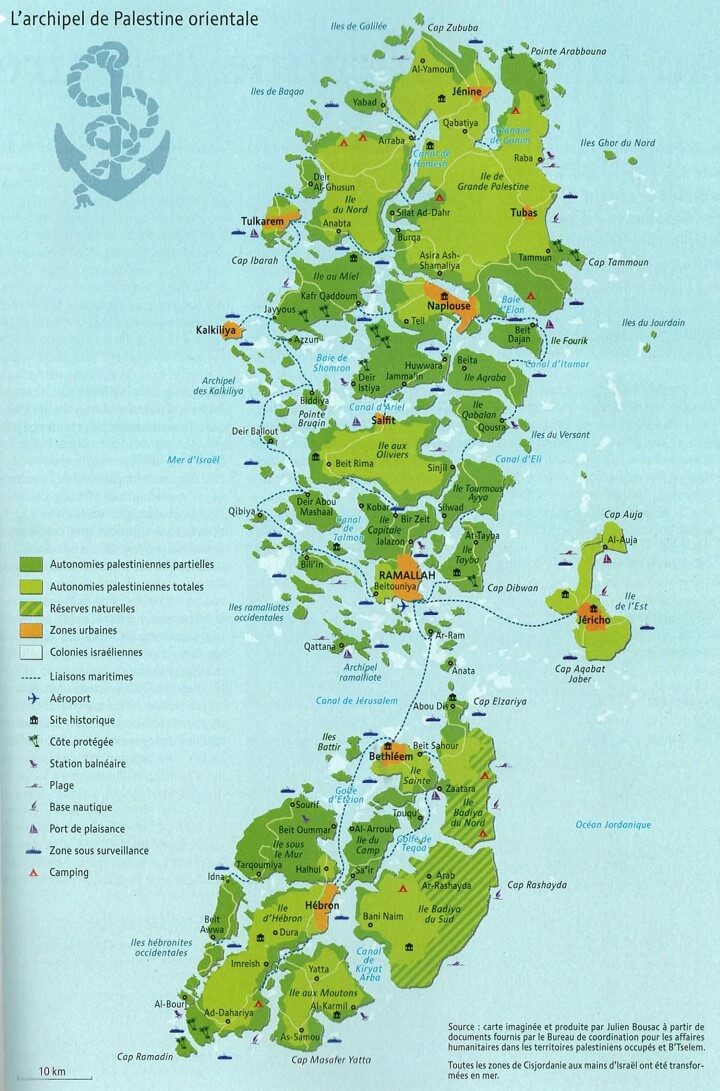
With their rich, often over-the-top imagination, ‘pro-Palestinian’ activists could not possibly have missed the metaphoric potential of islands.  They harnessed that potential ‘for the cause’ by portraying the Palestinian Authority-governed areas of the West Bank (defined in the Oslo Accords) as an ‘archipelago’ of small islands in a ‘sea’ of Israeli ‘settlements’.  Such allegoric maps travel far and reach wide; their message is clear: a patchwork of Palestinian ‘islands’ cannot be turned into a viable state.

Not satisfied with the mere allegory, some activists are shouting that message in full-throated, indignant, moralising voice: it is too late for the two state solution.  Often, they blame Netanyahu and ‘his settlements’; but Seumas Milne (a former journalist and currently top courtier to Labour Party leader Jeremy Corbyn) suggested, even 15 years ago, that the two-state solution was no longer achievable.

Among certain ‘pro-Israel’ activists (and even among some Israelis), such suggestions are a source of dread and despair.  In the absence of a Palestinian state, they say, Israel’s choices are grim: either ‘one-state’ in which Jews will be (or will quickly become) a minority; or else an apartheid state – in which the Palestinians won’t possess full political rights.

A recent Jewish Chronicle article quotes Tal Keinan, an American-Israeli businessman and former Israeli fighter pilot, who argues that there are “only three possible endgames” for Israel:
"The first is that Israel could annex the West Bank and give its Arab residents citizenship – which would mean Israel ‘opening itself to the prospect of demographic suicide’. […]
The second option would be to annex the Palestinian territories without granting the Palestinians citizenship – imposing sovereignty on a large number of people without representation. […]
The final option […] is for Israel to withdraw from most of the territories, with or without an agreement with the Palestinians. If the Palestinians build a state, there will be a state, but if not, the West Bank ‘will likely become another rocket base’."


So there you are: the options are oblivion, apartheid or being bombed to smithereens.  As the current British Prime Minister would put it, doom or gloom!

There’s a debate to be had on whether it is indeed too late for the ‘two state solution’; and whether lack of ‘full political rights’ equals ‘apartheid’.  But I do not wish to go there now.  My question is: are those ‘3 choices’ really the only possible ‘endgames’?  Or are the prophets of doom merely demonstrating their own stale thought processes, their own lack of imagination and creativity?

I am fascinated by islands.  They are such interesting places!  Let’s let our minds travel to a few islands – and see what we can learn.

A ‘Great’ Britain with some little ‘dependencies’

To start with, I won’t have to travel too far: I live on the island of Britain, which some (both on and outside it) still sometimes call ‘England’.  But it isn’t ‘England’ – the island of Britain is part of a sovereign state called the United Kingdom of Great Britain and Northern Ireland.  Although it is not formally called a federation, this is in fact a federal state made up of four ‘countries’: England, Scotland, Wales and Northern Ireland – each of them endowed with a great deal of political, economic and cultural autonomy.  Nonetheless, there are nationalist movements in each of these ‘countries’, aspiring to more autonomy and even to outright secession from the federation. 

I have recently travelled to Scotland, where great efforts are being made to revive and expand the use of Scottish Gaelic.  Upon return to London, I discovered that I still had a pocketful of Scottish banknotes.  The ‘Scottish pound sterling’ is worth exactly as much as the ‘British (not English!) pound sterling’; but the banknotes are underwritten by the Royal Bank of Scotland and bear different images from their ‘British’ counterparts.  Those strange-looking banknotes may be legal tender throughout the UK; but they are, let me tell you, viewed with suspicion by London retailers, many of whom seem to see them for the first time.

Another ‘country’ – Wales – occupies a peninsula in the West of Britain.  Wales is very similar in size to Israel, but it is less densely populated.  The vast majority of its inhabitants speak English and only one in five has Welsh as their mother tongue.  Still, Welsh is an official language in Wales, on a par with English; no expenses are spared – everything (from road signs to court summons) is written in both languages.  And children have to study Welsh in school, whether they have any use for it or not.

But ‘Great’ Britain is not as interesting as some of the smaller islands off its coast.  Take for instance the Isle of Man, a territory just one-and-a-half times the size of Gaza Strip.  The Isle isn’t part of the United Kingdom; nor is it a sovereign, independent state.  It is, instead, defined as a ‘British Crown Dependency’.  If you think that this means ‘owned by the Queen’ – think again: Queen Elizabeth the Second could not sell off that piece of real estate to – say – Donald Trump; even if he was interested and however much Her Majesty wanted to oblige!

Most Isle of Man inhabitants have the status of ‘Manxmen’ (and Manxwomen?)  Manxmen are ‘in principle’ British citizens; in principle only, because they cannot, for instance, vote in UK national elections and are hence not represented in the UK Parliament.  Although decisions made in that Parliament can have a huge impact upon their lives.  For instance, Manxmen could not vote in the 2016 Brexit referendum.  But, although the island is not part of the United Kingdom – and also not part of the European Union – its economy is strongly affected by the trade between the two…

Manxmen do elect the 24 members of the House of Keys – the lower chamber of the local ‘Parliament’, which deals with most internal matters.  Issues pertaining to defence, international relations, as well as the final say on matters of ‘good governance’, however, are the competence of the UK government and parliament.

Fiercely dependent:
Manxmen are proud citizens of a British Crown 'Dependency'
Upon application, Manxmen are issued with specially printed  British passports.  But instead of ‘United Kingdom’, those passports declare their bearers citizens of a strange entity called ‘British Islands – the Isle of Man’.  Such passports allow Manxmen to travel to – for instance – EU countries; but, unlike ‘regular’ British citizens, they are not entitled to work there.  Nor are EU nationals entitled to work on the Isle of Man, although they (still) can work in the UK.


The British Crown possesses also other ‘Dependencies’ – including several islands in the English Channel/La Manche: Jersey, Guernsey, Alderney and Sark.  Each island is governed separately, according to its own traditional system, mostly originating in the early Middle Ages.  Their combined population is estimated at around 165,000.  None of the Channel Islands is represented in the UK Parliament and, as a rule, their ‘citizens’ cannot vote in UK national elections and referenda.  Their status is, roughly speaking, similar to that of Manxmen.

Something is rotten in the state of Denmark


If we let our mind fly north-west of Britain, across the North Atlantic ocean, we come across Donald Trump’s latest real-estate project: Greenland.  It is the world’s most sparsely populated ‘country’ – with just one inhabitant on average per 10 square miles of territory; but it is also the world’s largest island: circa 10 times larger than Great Britain and 100 times larger than Tiny Israel.

Politically, Greenland is defined as an ‘autonomous region’ of the Kingdom of Denmark – a ‘region’ 50 times larger than Denmark-proper.  Some call it a ‘constituent country’ – similar in principle to the status of Scotland or Wales within the UK.

Happy Greenlanders

The majority of Greenland’s population (circa 88%) belongs to the indigenous Inuit (a.k.a. Eskimo) ethnicity, akin to the natives of North Canada and Alaska.  They speak their own language.  The balance consists of Danish settlers.

Greenlanders elect 2 representatives to Denmark’s parliament, out of a total of 179.  They also elect the 31 members of Greenland’s own parliament, which in turn elects a local government with a high degree of internal autonomy.  However, the Danish government sitting in Copenhagen is responsible for decisions pertaining to defence and international relations; even for those that directly affect the inhabitants of the ‘constituent country’ of Greenland – such as the permission to locate nuclear weapons on the island.

In 1973, the Kingdom of Denmark (including Greenland) became a member state of the European Community – precursor to the European Union.  But, using its greater autonomy achieved in 1979, Greenland voted in 1982 to leave the economic block – and completed that exit by 1985.  It is no longer part of the European Union; but it is still part of the Kingdom of Denmark, a member state of the European Union…

Economically, Greenland has long been highly dependent on Denmark.  However, for the past decade or so, the Greenlandic government has worked steadily to gradually reduce the economic dependence, with the ultimate goal of attaining political independence.

The Kingdom of Denmark ‘owns’ also another ‘constituent country’: the Faroe Islands.  Their status is roughly similar to that of Greenland: the Faroese elect 2 members of the Danish Parliament, as well as all 33 members of the local parliament.  Just like in Greenland, there is a local government, led by a Prime Minister; there is also a strong movement demanding political independence.  A separate Faroese Constitution drafted in 2011 has been rejected by the Danish government of the time, as ‘incompatible’ and ‘cannot co-exist’ with the Danish Constitution.

The poor ‘rich harbour’

By now, you probably think that ‘special status’ islands are but vestiges of medieval kingdoms, bizarre anachronisms somehow preserved into modernity.  Well, not exactly: some of them are part of relatively young republics.

One such island is Puerto Rico.  ‘Discovered’ by Columbus, it was incorporated into the Spanish Empire and colonised by (mainly) Spanish settlers, who wiped out the indigenous population and culture.  But in 1898, it was conquered by the United States.

The term ‘colony’ is not en-vogue any more; but Puerto Rico is not a federal US state, nor is it part of a state.  It is, therefore, defined these days as a ‘United States unincorporated territory’.  In this context, ‘unincorporated’ means that the US Constitution does not apply in full: only ‘fundamental rights’ are protected, other constitutional rights are not.  As a consequence, although the Puerto Ricans are ‘in principle’ US citizens (since 1917), they cannot vote in US presidential elections and do not have senators or voting representatives in the US Congress.  Instead, the 3.2 million Puerto Ricans elect a local Governor and a bi-cameral parliament.  However, the head of state is the President of the United States.  The jurisdiction and sovereignty belongs to the United States of America and the ultimate power is vested in the US Congress.  Laws adopted by the latter apply to Puerto Rico by default.  Many US federal agencies (notably the FBI) are active in Puerto Rico.


A very lonely star...
Puerto Rico calls itself Estado Libre (Free State). But it is neither an independent state, nor a US state.

As US citizens, Puerto Ricans can serve in the US military – in fact they were historically forced to serve whenever the US adopted compulsory military draft.  However, Puerto Rico also has its own National Guard, distinct from the US National Guard.  The commander-in-chief of the Puerto Rican National Guard is… the President of the United States.

On average, Puerto Ricans are significantly poorer than the citizens of the State of Mississippi – the poorest of US states.

US controls a few other ‘unincorporated territories’ with roughly similar regimes – and they happen to also be islands: Guam, Northern Mariana Islands, U.S. Virgin Islands and American Samoa.

And a ‘fragrant’ harbour

I never noticed any particularly pleasant smell when I visited Hong Kong, but many believe that ‘Fragrant Harbour’ (hēung gong in Cantonese) is the origin of the modern name.
Hong Kong consists of the eponymous island, plus an archipelago of some 200 other islands and two small pieces of territory on the coast of Southern China.  In total, it is not much larger than the Gaza Strip – but it is more densely populated: more than 17,500 inhabitants per square mile, compared to Gaza’s 13,000.


How to live on an archipelago:
one can travel among the main islands of Hong Kong by underground train.

In theory, Hong Kong is part and parcel of the sovereign territory of the People’s Republic of China.  But it certainly does not feel that way.  And it’s not just a matter of a different flag, state symbols and anthem.

The official language of China is Mandarin – written with simplified Chinese characters.  In Hong Kong, it is Cantonese, inscribed with traditional characters.  Which render anything spoken or written in Hong Kong unintelligible to most people in China.

Cars cling to the left side of the road in Hong Kong, still following the British tradition; but they are driven on the right in China.

Five years ago, I travelled to China via Hong Kong.  To start with, I had to apply for a Chinese visa; but when I finally got it, was told that it’s not valid in Hong Kong – where one needs a separate visa; or, in the case of my Israeli passport, no visa for Hong Kong, yes visa for China.

Flights from Hong Kong to Beijing are expensive, as they are considered international flights.  I was advised, instead, to buy a seat on one of the many cars and coaches ferrying passengers from Hong Kong Airport to Shenzhen Airport just across the border with China.  I do not use the term ‘border’ lightly: en-route to Shenzhen, my passport was checked twice, within a 50 yards stretch of road: first by the border police of Hong Kong, then by Chinese border officials.

Once at Shenzhen Airport, I boarded a much cheaper, probably subsidised ‘domestic’ flight to Beijing.

I paid for the transfer from Hong Kong to Shenzhen with Hong Kong dollars, but they’re not legal tender in China; so I had to buy the flight ticket Beijing with Chinese ‘renmimbi’, not accepted in Hong Kong.

All this may sound and feel strange, given that Hong Kong is not an independent state.  Officially, Hong Kong is called a ‘Special Administrative Region of the People's Republic of China’.  But in this case, ‘special’ is an understatement.

As I am writing this, there are widespread protests in Hong Kong against Chinese ‘interference’ – protests triggered by a change in law allowing certain offenders to be ‘extradited’ from Hong Kong to... another part of China’s ‘sovereign territory’.  Go figure!

So what?

By now, I can hear quite a few of you grumbling: what do all these islands have to do with anything?  Israel has occasionally been called ‘an island’ – as in ‘an island of freedom in a sea of tyranny’; but geographically it certainly is no island.

Well, I’m afraid I used the ‘islands’ allegory only as a crafty rhetorical device.  This isn’t just about islands, there are many other, ‘continental’ examples.

The point is that the ‘sovereign state/no state’ paradigm is based on a false dichotomy.  Reality is much more complex than that; there are almost-states, states-within-states, incorporated ‘unincorporated territories’, ‘constituent countries’, ‘special administrative regions’ and a myriad other ‘unconventional’ political constructs.

It may be that none of the existing models described above precisely fits the requirements of a future Israel-Palestinian Arabs accommodation.  But what these ‘islands’ prove is that there’s a huge breadth of possibilities – rather than a binary option.

Human beings are endowed with imagination, creativity and problem-solving abilities.  They are also ‘tribal’ and seek self-determination: the right to control their destiny, while organising themselves along ‘tribal’ identities that both unite and divide.  And, as a result of all that, human communities have evolved and are evolving in many complex, unusual, original ways.  Because no man is an island; not even on the Isle of Man.


The conflict between Jews and Arabs – or between ‘Israelis’ and ‘Palestinians’ – is a conflict between right and right.  Not a dilemma, or even a multiple-choice question; but an art project, a piece of blank canvas.

We live in a world of endless possibilities.  There are no slim choices, just narrow minds; mankind doesn't inhabit rigid, tidy little boxes – only some men do.

Tuesday, 2 October 2018

'Anti-Zionism’ is about the Joos, stupid!


Raised and educated in the UK, Prof. Ian Almond teaches World Literature at Georgetown University in Qatar.  So, when I heard that he took to the Qatari-based Al-Jazeera to write about antisemitism, I was hopeful. I thought he was going to write about the high incidence of antisemitism (including Holocaust-denial) in the Arab world.  But no: Prof. Almond chose to warn us all of ‘The danger of conflating anti-Zionism with anti-Semitism’.

Still, I remained hopeful while reading the first few sentences.  Says Prof. Almond:
"I still remember the shock I felt when, at the age of 12, my teacher told me the word ‘joo’ I had just spoken, which I had thought to mean to lie or cheat, was actually ‘Jew’ and was anti-Semitic.  Throughout my British childhood, I had used that word casually and frequently, without ever knowing what it really meant."
Almond goes on to analyse the reasons for his childish mistake:
"I start with this example to make a simple point: anti-Semitism is so entrenched in our society, so depressingly persistent, that to trivialise it is to trivialise the blueprint of prejudice itself. It is a barometer of moral cowardice: when someone doesn’t want to take responsibility for their own faults or problems, they blame the Jews."
Prof. Almond is right to use the present tense in the sentence above: this is not ‘historic’, but contemporaneous antisemitism; the future Professor was 12 at the time (Jeremy Corbyn, by the way,  was 32), so that’s a mere 37 years ago.  We may wish to believe that one man’s character – say Brett Kavanaugh’s! – can change in that stretch of time; but deeply entrenched prejudice does not just disappear from an entire society in less than a generation.

Of course, things did change since the 1980s.  We are much more ‘politically-correct’ these days.  School children are less likely to refer to cheating as ‘jewing someone’; if they do, they will be told that they should not use the word in that sense.  But it’s not about a childish word – it’s about the societal prejudice it reveals.  The word may rarely be used with that meaning these days; but the prejudice is still there.  If you want proof, just surf Twitter.  Or listen to the many Labour Party supporters who seem to say that, when African Caribbeans, Muslims or Asians complain about racism, they have a point; but when Jews complain about antisemitism, there must be some dishonest motive behind it.

Prof. Almond’s childhood story is revealing – and his subsequent analysis is correct.  Too bad they are employed to excuse, rather than inform, the rest of his 'learned article'.

After declaring that “anti-Semitism is so entrenched in our society, so depressingly persistent, that to trivialise it is to trivialise the blueprint of prejudice itself”, Prof. Almond proceeds to do exactly that – trivialise it:
"There are definitely some voices who claim to support the Labour Party, and who allow their anti-Zionism to spill over mindlessly into anti-Semitism."
“There are […] some voices who claim…”???  Professor, don’t “some voices” include the very Leader of the Party, who rose to the defence of blood-libellers, conspiracy theorists and ‘artists’ who depict hooked-nosed ‘oppressors’?  Don’t “some voices” include ’illustrious’ members of the Party top brass (and good friends of the Leader), who implied that Jews conspired with their own genocidal persecutors?  Don’t they include a well-attended recent meeting at the Party Conference, where people chanted ‘From the River to the Sea, Palestine will be free’ – a call to pogrom on 6.5 million Israeli Jews?  Are these really“some voices who claim to support the Labour Party”???

But that’s not the only place where Prof. Almond’s argument lacks internal logic – not to mention moral clarity.  We are all, in fact, lucky that the good Professor teaches literature, rather than medical science; because – bluntly put – his diagnosis suffers from terminal idiocy, in view of the symptoms that he himself described in the previous paragraphs.

Indeed, Prof. Almond’s judgement of “some voices” is that “their anti-Zionism […] spill[s] over mindlessly into anti-Semitism”.  So anti-Zionism comes first and “some voices” are guilty only of taking it a bit too far.  But, since (as he himself explained) “anti-Semitism is so entrenched in our society, so depressingly persistent”, isn’t it much more likely that anti-Zionism is the outcome of that deeply entrenched prejudice?  Indeed, that it is just a new symptom of that entrenched disease?  If – God forbid – I suffered from “entrenched” and “depressingly persistent” lung cancer and developed a nasty cough – chances are it’s because of the cancer, not because I sang too loudly in church!

What ‘Costa’ means, of course, is 'the Zionists jew the Palestinians’.

Isn’t that “entrenched [… and] depressingly persistent” antisemitism a much more likely explanation for the visceral animus, unique in its nature and intensity, that “some voices” exhibit towards the Jewish state – and only towards the Jewish state?  Isn’t this why the oppression of Palestinians was so often and emotionally cited at the Labour Conference, while none of the ‘progressive’ leaders cared to mention the plight of Saudi women – those 51% of the country’s population that had to wait until 2018 (2018!) to be allowed to drive (by law, though still not in practice)?

Prof. Almond views as outrageous that
"The IHRA code considers any description of the Israeli State as a ‘racist’ institution to be anti-Semitic."
But – leaving aside the fact that his interpretation of “The IHRA code” is tendentious – which other state is called “a ‘racist’ institution”?  The Labour Party claims that Hungary’s current government is antisemitic and Islamophobic – yet it does not call Hungary “a ‘racist’ institution”.  Jeremy Corbyn politely frowned at Myanmar’s ethnic cleansing of hundreds of thousands of Rohingya; yet he did not call the former British colony of Burma ‘a racist endeavour’ as a result.

But Prof. Almond appears convinced that Israel should be called a racist institution.  He explains why:
"[I]n 1948, three-quarters of a million Palestinian Arabs were forcibly evicted, with British backing, off their own land. To recognise this as racist, in the words of the IHRA code, would be ‘anti-semitic’."
That the “Palestinian Arabs were forcibly evicted, with British backing” would be shocking news to the 1948 British Mandate officials, as well as to the Jewish inhabitants of Kibbutz Ein Hamifratz, bombed by British artillery, apparently in order to ‘assist’ the Arab town of Acre.  But that’s by-the-by.

However, you know what?  Let’s be generous with Prof. Almond: let’s adopt his version of history – however specious.  Let’s assume that indeed the “Palestinian Arabs were forcibly evicted” – though the reality was considerably more complex than that; let’s ignore that that ‘eviction’ occurred in the midst of a civil war that soon morphed into a war of survival against attack by all neighbouring states; let’s even forget that the Arab side perpetrated their own ‘evictions’ – in fact more thorough ‘evictions,’ since no living Jew remained in the territory they even temporarily controlled.

But what I fail to understand, even after all those assumptions, is why and how is that ‘Jewish misbehaviour’ more terrible than dozens of other cases of ‘forced eviction’ that occurred elsewhere, both before and after the establishment of the State of Israel.  ‘Evictions’ that are very rarely – if ever – described as ‘racist’.

Immediately after the defeat of Nazi Germany, borders were re-drawn – and accounts settled.  The ethnic German population of Poland, Czechoslovakia and Hungary (people that had lived there for centuries) was driven out.  So was the population of territories that had been part of Germany, but were now ‘given’ to the USSR and Poland.  In total, 14 million ethnic Germans were driven out of their homes and lands, with the agreement and connivance of the victorious powers.  Circa 1 million died in the process: some at the hands of local soldiers, policemen and civilian vigilantes; others, due to exposure and exhaustion; many died of starvation either before or after reaching war-ravaged Germany (or, rather, territories of the former German Reich, now occupied and governed by the Allies).  The 13 million survivors – and their descendants, accounting these days for almost a quarter of Germany’s population – were never allowed to return and were never granted any compensation.

Ethnic German refugees fleeing westwards 

Ethnic Germans were not the only population ‘evicted’ at the time: so were ethnic Poles living in Ukraine – many of whom were Soviet citizens.  Hundreds of thousands of ethnic Ukrainians and Lemkos were forcibly expelled from Poland into the Soviet Union; and when the latter closed its border, the remaining Ukrainian and Lemkos villagers were forced to ‘resettle’ in the west of the country, in the former German provinces ‘transferred’ to Poland.  Conditions were harsh and human life was cheap – so many died or were killed on the way; molested women and girls had nobody to complain to: they typically picked up the small children or younger siblings and continued their journey – that is, whenever they and their families escaped being murdered out of sheer sadism and gratuitous brutality.  Those Ukrainians and Lemkos who survived this ‘resettlement’ ordeal were forcibly dispersed, with no regard to family and community ties; the Polish authorities forbade any expression of native language and culture, in a deliberate attempt to assimilate them into the prevalent Polish ethnicity.  (To those wishing to learn more of the terrible history of Europe in the immediate aftermath of World War II, I recommend Keith Lowe’s excellent book ‘Savage Continent’.)

All of the above (and much, much more) happened in what was by then peacetime.  The allied armies ruled in Berlin and over a subdued Europe.  Those 'evicted' did not pose any security risk to the remaining population.  In Czechoslovakia and Hungary, they did not even endanger the demographic supremacy of the majority population.  It can be argued, on the other hand, that this was the making of the new Poland: historically, Poland had been a geographic and demographic patchwork whose existence as an independent nation between the German and Russian ‘spheres of influence’ had been intermittent; the post-war bout of ruthless viciousness gave birth to a completely different country — a Poland with utterly changed borders and a demographic eerily uniform from an ethnic perspective.


The making of modern Poland: new borders and homogeneous ethnicity

Europe isn’t the only ‘savage continent’.  In 1947, even while the newly-formed United Nations was debating the fate of the Mandate of Palestine, an additional former 'British' territory was being partitioned: the former Jewel of the Crown – the British Raj.  Like most colonies, this was not a country – but an artificial contraption made up of numerous faiths and ethnicities, held together (but often also set against each other) by colonial interests.  There was, however, one major fault line, between the Hindu population and the Muslim one.  Both groaned under the British colonial yoke, but also resented and feared each other.  To ‘pacify’ the place long enough to wash its hands of it, the British government implemented a territorial partition into two states.  It was hardly a fair deal: the Hindu-majority state – India – incorporated the vast majority of industrial assets and agricultural land; it also ‘inherited’ most of the former colony’s financial reserves.  The Muslim-majority state – Pakistan – initially comprised just one fifth of the former colony (the Muslim population accounted in 1947 for circa 30%).  Even that consisted of two non-contiguous pieces of territory – West Pakistan and East Pakistan (later to become Bangladesh) – separated by 1,000 miles of Indian territory.

Nations may draw borders, but borders don’t create nations.  Despite the partition, inter-communal violence continued and intensified.  When all is said and done, circa 1 million people are estimated to have lost their life.  15 million were forced to leave their ancestral homes and lands and go into exile – never to return.

A convoy of refugees fleeing West Pakistan in 1947. 
Not even that was enough to defuse the tensions: India and Pakistan have since fought several wars and continue to face each other with relentless suspicion and barely contained hostility.  Since both are armed to the teeth – including nuclear arsenals – this remains a potential source of catastrophic conflagration.

Pakistan officially calls itself an Islamic Republic (Article 1 of the Constitution) – and is recognised under that name by the United Kingdom.  Article 2 proclaims:
"Islam shall be the State religion of Pakistan."
Yet I have yet to hear protests from Prof. Almond or from other Corbynites.  Why aren’t they worried about the impact of such constitutional arrangements upon the status of Pakistan’s non-Muslim minorities (Hindus, Christians, Sikhs, etc.)?  And by the way, the official languages of Pakistan are Urdu and English, despite the fact that Punjabi is the native tongue for more than 40% of the population.

As for India, the Muslim minority in the predominantly Hindu country has long complained of discrimination – and independent reports tend to support those claims.  If anything, complaints of oppression and marginalisation have intensified under Narendra Modi’s Hindu nationalist government.

I would assume that Prof. Almond is familiar with the birth of India and Pakistan – after all he claims Post-Colonial Studies as one of his specialisms.  Unless the good Professor is one of those ‘progressives’ for whom the study of post-colonialism always boils down to one small country in the Middle East…

Despite Prof. Almond’s protestations, the Labour Party did adopt the IHRA Definition – after numerous subterfuges and under huge public pressure.  But Jeremy Corbyn attempted to ‘supplement it’ (read: subvert it) with a proviso ‘protecting’ those who regard
"the circumstances around [Israel’s] foundation as racist."
But why?  How were those “circumstances” different from those that led to the formation of Pakistan?  Or of India?  Or of modern-day Poland?  Or of Croatia – the latest addition to the European Union – the “circumstances”of whose “foundation” included the ethnic cleansing of circa 400,000 Serbs?  Why is it that Corbyn and his supporters never call those countries ‘racist endeavours’?

The list of unpleasant “circumstances”, of course, is not limited to the countries mentioned above.  In fact, such “circumstances” are the rule, rather than the exception: more often than not, countries are born in conflict and strife; frequently, that strife includes numerous deaths, injuries, displacement and suffering of innocents.  That is (to use a British understatement) very unfortunate; but unusual it ain’t.  What's unusual – unique actually! – is the attempt to deny a country its legitimacy in the present and its existence in the future, because of “circumstances” in its past.  What's uncommon – extraordinary actually! – is calling an entire country ‘a racist institution’.  Hey, what an astonishing coincidence: the state subjected to this type of unique and extraordinary assault just ‘happens’ to be the Jewish state!  Surprising, 'innit?? (Note the attempt at English irony!)

No, Prof. Almond: I am not worried about “conflating anti-Zionism with antisemitism”: they are one and the same.  You must have learned the wrong lesson from your childhood experience: singling Jews out for 'special attention' is just as wrong, even when you use politically-correct words.  Dear Professor of World Literature, antisemitism is not a matter of vocabulary; it’s not the words you utter – it’s the prejudice you harbour.  You see, the “IHRA code” is more than just a definition.  It’s a test – and you failed.


Friday, 13 July 2018

Football and other forms of ‘progressive’ colonialism


Two European (and global) football powerhouses clashed recently in Sankt Petersburg.  France ultimately beat Belgium 1-0, through a goal scored in the 51st minute by Samuel Umtiti.  But many would argue that the star of the match was another French player, 20-years-old Kylian Mbappé.  Kylian was born in Paris, but both his parents hail from Africa – and both are talented sportsmen in their own right: his Algerian mother is a former handball player; his father originates from Cameroon and is a football coach.  Cameroon, by the way, is also the birth place of French goal-scorer Umtiti.  The country’s national squad, unfortunately, failed to qualify for this year’s World Cup.

Kylian Mbappé's mother was a talented handball player inconservative
Morocco, where women rarely get a chance to shine.

Most spectators would agree that among the best Belgian players were Marouane Fellaini and Nacer Chadli – both born in Belgium to Moroccan parents.  A third Belgian player – Romelu Lukaku – is often cited as the national squad’s star player.  He was also born in Belgium, but to parents who had migrated from Zaire.  All three hail from ‘sportsy’ families; there’s clearly a strong component of ‘nature’ in the ‘nature + nurture’ mix that produced these outstanding footballers.
They are not the only ones.  Another Belgian player (Carrasco) has a Portuguese father and a Spanish mother; Vincent Kompany’s parents are Congolese; Kevin De Bruyne’s mother was born in Burundi…

On the French side, Lucas Hernández was born to a Spanish father; Antoine Griezmann – to a German father and a Portuguese mother.  Besides Umtiti and Mbappé, at least three other French players are of African descent: N'Golo Kanté’s parents from Mali; Paul Pogba’s from Guinea; and Blaise Matuidi’s from Angola and Congo.

These are interesting observations, especially at a time when migration to ‘the rich world’ (or indeed ‘the free world’ or ‘the safe world’) is becoming a top political issue in Europe and North America.
The footballers mentioned above are living proof that migration can be a success story – and that its effect on the host country can be very positive.  Indeed, without those talented players, it is doubtful that France and Belgium would be as strong as they are.

There is, however, a dark side to this success – one that pro-migration ideologues pretend not to see: France and Belgium’s gain is also the loss of countries like Morocco, Cameroon, Zaire, Congo, Mali, Angola and Burundi – all of them former European colonies.  And all of them able to field much poorer football national teams, compared to their former colonisers.  Only one of the list of African countries above – Morocco – qualified for the World Cup; and even Morocco was forced to pack their bags early, after two defeats and a draw in the groups stage.

No, this is not Samuel Umtiti; they are Cameroon's children -- those that
didn't make it to Europe.

It’s not just football players, of course: it’s doctors, engineers, scientists, artists, entrepreneurs from former European colonies in Africa and Asia.  Having robbed those countries of their natural resources – for decades or even centuries – Europe now drain them of their most precious asset: their best, brightest, most talented people.  And no, not every one of them gets to be a football star or a university professor; most migrants end up eking out a living by doing the jobs Europeans can’t be bothered to do themselves – a ‘modern’ form of exploitation that borders on slavery.  If you don’t believe this – go out there and look who’s cleaning public toilets in Paris and Brussels.  Or indeed in London!

Who is cleaning your street?
It’s not just former colonies: it’s poorer countries, in general.  Romania, for instance, is one of those poor countries – the poorest in the European Union; maybe not quite as pauper as Cameroon and Zaire, but certainly poorer than France and Belgium.

Poverty destroys everything – but arguably nothing as much as healthcare.  There is a huge healthcare gap between France and Romania (let alone France and Cameroon!)  But healthcare is not an easy profession: training a doctor involves many years of study followed by even more years of hard graft leading to – at best – mediocre pay.

That’s in recent times in France, for instance, the medical profession has been attracting few ‘native’ Frenchmen and women.

So the French authorities invited foreign doctors (primarily Romanian) to apply for jobs in the French healthcare system.  And the applicants were so numerous, that the French could afford to be really choosey: they employed the best of the bunch.  Between 2008 and 2013, the number of foreign doctors working in France shot up by 43%.  According to the president of Romania’s College of Physicians, between 13,000 and 14,000 Romanian doctors work abroad, 4,000 of them in France.
Says Prof. Vasile Astarastoae, president of the Romanian College of Physicians:
"There is a major crisis in Romania when it comes to having enough doctors. In 2011 there were 21,400 doctors working in Romanian hospitals. On 1 November 2013 there were only 14,400."
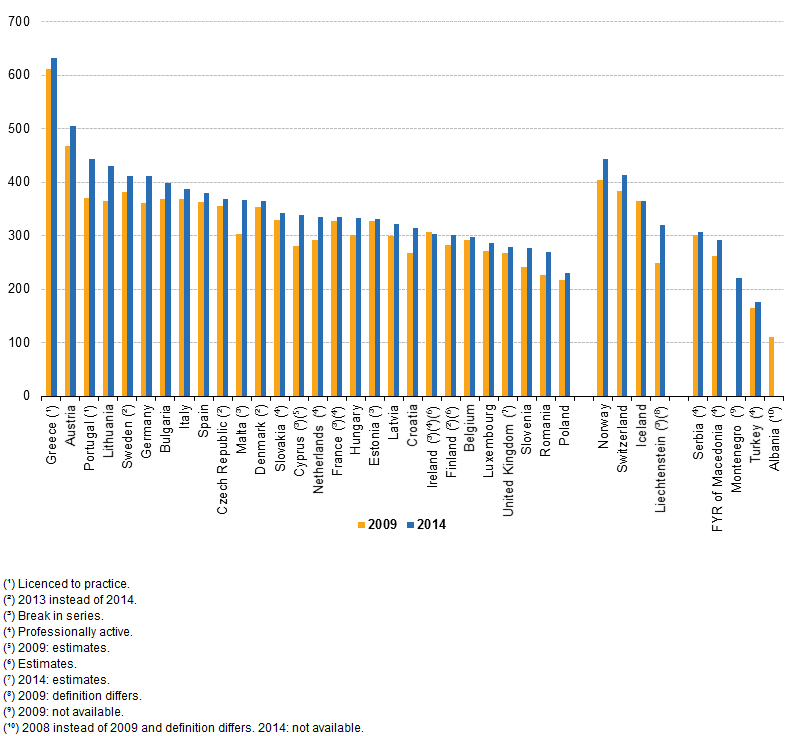
By 2014, France had circa 330 practicing physicians per 100,000 inhabitants.  Romania had just 270; Poland had only 230.  According to an academic study
“The brain drain of Romanian doctors constitutes […] a dramatic loss for the national healthcare provision”
Life expectancy in France is currently 82 years – and significantly longer if you happen to be white.  In Romania, it’s just 75 years…

In Pakistan, there are just 81 physicians per 100,000 inhabitants; in India, just 73.  Yet many Pakistani and Indian doctors work in the British NHS – which takes pride in its enlightened, ‘progressive’ diversity.

This Romanian doctor looks happy: he practices in Northern France.  His
compatriots, however, were left with even poorer health care.

It requires many years and a lot of money to train a doctor.  And if that physician ends up working in oh-so excitingly multicultural London or Paris – rather than in native Bucharest (or Karachi or Mumbai or Kinshasa) – then that celebrated diversity comes at a heavy cost in ‘diverse’ life and limb.
And it’s not just about healthcare or economics.  By uprooting talented people away from their own language, customs, identity – the rich countries perpetrate something akin to cultural genocide.  There is nothing ‘progressive’ in that.

It is ‘progressive’, charitable and simply humane to give to the poor – not take away even the little they have; so why are we taking doctors away from Pakistan and Romania – rather than sending doctors and nurses there??

Whether in Europe or USA, Australia, Canada and Israel, ‘pro-migration’ ideologues feel inherently superior to those ‘populist’ cavemen who object to unrestricted migration.  As I sit writing this, a cohort of self-proclaimed idealists use ships bought with donors’ money to ‘rescue’ migrants.  They pick them up from just outside Libyan waters, lift them from the overcrowded and shabby boats provided by people-smugglers and drop them on the nearest European beach.  There is ‘instant gratification’ in that – at zero risk to the ‘idealists’.  But this free ferry service also causes more and more pauper Africans to take the risk – to pay more and more money to board increasingly overcrowded, ever-shabbier boats.  In so doing, the ‘idealists’ probably end up killing more people than they ever ‘save’ (more than 8,000 would-be migrants drowned in the Mediterranean Sea in just two years!)  The idealists’ enthusiasm would be put to much better use persuading people not to take this route and instead help them improve their lives in-situ.  But that is much more difficult, onerous and risky.

Smuggler boats off the coast of Libya. Unseaworthy, yes; but then the hope
is not to reach Europe in this boat -- just to get a lift on a 'charity ferry'.

If your real purpose is to feel good about yourself for helping a few migrants land on a European beach, at no cost to yourself, then knock yourself out.  But if you truly care about people – rather than pandering to your own narcissism – then you will recognise that the problem of abject poverty isn’t solved by bringing a few people (those more proactive, who had the money to pay a people-smuggler and were lucky enough not to drown) from Zaire to Belgium, or from Romania to France.  That kind of selective ‘assistance’ just makes the rich richer and the poor poorer.

You cannot air-lift all Zaire’s population to Belgium; but you can (although not easily and immediately, but eventually and with great difficulty) hand-lift, heart-lift and soul-lift Zairians out of their poverty in Zaire.  If you’re French and thirsty for justice – then draining Cameroon of talent really isn’t the way to go; shouldn’t you instead pit your own talents to help fix their country – the one your ancestors broke?

 
;