Showing posts with label ethnic minorities. Show all posts

Sunday, 17 April 2022

Russia & Ukraine: the smartened-up story – Chapter II

 In the first chapter of this series, I argued that (on one hand) nothing mitigates Russia’s aggression against Ukraine; on the other hand, We The Public (especially in the West) are being fed a shallow, overly simplistic version of reality, which – while correctly identifying Russia and its leader as the main culprits – seeks to whitewash the many and grave errors committed by Ukrainian and Western leaders.

In this series of articles, I attempt to expose the dumbed-down story; and present a smartened-up account, in all its nuances and intricacy.

No paragon of virtue

In the current conflict, Ukraine is unequivocally the victim of Russian aggression.  But that does not mean we should take as gospel the picture drawn by Western governments and mainstream media.  To quote the Cato Institute:

"Statements from U.S. and other Western officials, as well as pervasive accounts in the news media, have created a stunningly misleading image of Ukraine. There has been a concerted effort to portray the country not only as a victim of brutal Russian aggression, but as a plucky and noble bulwark of freedom and democracy. The conventional narrative would have us believe that Ukraine is an Eastern European version of Denmark."

Ukraine may be (hopefully will be!) on its way to embrace liberal democracy.  But, make no mistake, it is a long way from that lofty ideal.

The 2022 report published by the Freedom House classes Ukraine as ‘Partly free’, with a score of 61 out of a possible 100.  Here’s the Cato Institute again:

"Interestingly, Hungary—which has been a target of vitriolic criticism among progressives in the West because of Prime Minister Viktor Orban’s conservative social policy—ranks eight points higher than Ukraine, which is the recipient of uncritical praise from the same Western ideological factions."

Israel, by the way (whom some of the same “progressives” accuse of nothing less than apartheid!), is ranked as ‘Free’ with a score of 76.


Map published by Freedom House (2020). Ukraine appears in yellow (partly free). So does EU member Hungary. Israel appears in green (free).

In its 2021 Corruption Perceptions Index, Transparency International awarded Ukraine a score of 32 – the lowest among European countries with the sole exception of Russia, which scored even lower (29).  Despite the well-publicised corruption scandals involving former Prime Minister Netanyahu, Israel (59) scored considerably better – in fact above many EU member states.

Ethnic strife

Since gaining independence in 1991, Ukraine’s political scene has been characterised by a struggle between the East and West of the country.  By way of simplification, the East is largely Russian-speaking (as are parts of the South) and tends to elect politicians favouring increased ‘friendship’ with Russia; the Western half of the country largely speaks Ukrainian, is suspicious of Russia and inclines to a closer relationship with the (global) West.

The struggle came to a head in 2010, with the election as President of Ukraine of Viktor Yanukovych. An ethnic Russian, Yanukovych defeated Yulia Tymoshenko by 49% to 45%, a result made possible primarily by voters in the Donbas and other regions with large ethnic Russian population.  International observers declared the elections ‘free and fair’ (but then, what do they know…)  Tymoshenko alleged extensive vote rigging and – while ultimately withdrawing her legal challenge – refused to accept Yanukovych as the legitimate winner.  She was soon accused of various misdeeds in a series of ‘anti-corruption’ legal cases and received a seven-year prison sentence.

All this did not deter the West from continuing to court Ukraine, dangling before it the coveted prize of close political and economic partnership, as well as, eventually, membership of NATO and the European Union.  Political convenience trumps moral principles.

Except that, although initially favourably disposed (at least apparently) to that courtship, in December 2013 Yanukovych ultimately refused to sign the Ukraine-EU Association Agreement – a document committing the parties to increased economic and political integration and meant to pave the way towards Ukraine’s accession to full EU membership.  Instead, he surprised everybody by opening negotiations towards a ‘strategic partnership treaty’ with Russia.  Many smelled a rat: Putin had applied months of economic and political pressure, urging Ukraine to ditch its EU-related plans and join instead a customs union with Russia, Belarus and Kazakhstan.  On the other hand, Yanukovych appeared to operate within the letter of the Ukrainian law – as the country’s constitution places the President in charge of negotiating and signing international treaties…

However technically legal, Yanukovych’s decision was followed by mass protests (later dubbed the ‘Euromaidan’ Revolution or the Revolution of Dignity), which descended into extreme violence and actual street fights between militants and police.  In January-February 2014, those clashes resulted in the death of more than 120 people (108 protesters, 13 police officers) and the wounding of a further 1,800.

Under pressure and following mediation by the EU and Russia, Yanukovych signed an Agreement on the Settlement of the Political Crisis with the leaders of Parliamentary opposition.  He agreed to a curtailment of presidential power, new presidential elections by the end of the year and withdrawal of security forces from central Kyiv.  In return, the opposition promised to cease any violent protest and surrender the weapons.  But while the police did withdraw, various armed groups refused to comply with the agreement and threatened to storm the presidential compound and the Parliament.  European politicians spoke in general terms 'against the violence', but they stopped short of condemning what was, in reality, a violation of the agreement they themselves mediated.

Yanukovych fled to Russia and was subsequently deposed by the Ukrainian parliament – though in a manner technically inconsistent with the impeachment process prescribed by the constitution.  He was eventually tried in absentia, found guilty of high treason and sentenced to 13 years in prison.

A new government was installed, which swiftly rolled back much of Yanukovych’s legacy.  All civil servants who served under the former president (up to one million people) were excluded from public office.  Again, these excesses did not result in the firm Western condemnations that we would expect, given our leaders’ much vaunted moral principles and democratic credentials.

Yanukovych’s departure may have brought about restored order in Kyiv.  But in Eastern and Southern Ukraine (and in other heavily Russian-speaking areas, such as Kharkiv) there were pro-Russian protests, which occasionally clashed with anti-Russian ones.  Several people were killed in sporadic bouts of violence.  In places (e.g. in the city of Luhansk), the pro-Russian protesters occupied public buildings and replaced the Ukrainian flag with the Russian one.  The violence soon intensified to civil war levels, with increasing use of heavy weaponry.

It is difficult to assess the extent to which these protests were native, rather than encouraged or even orchestrated by Russia.  I any case, Russia eagerly took advantage of them.

In March 2014, the de-facto leader of Crimea (not recognised by Kyiv) invited Putin to ‘assist with peace-keeping’.  The outcome is well-known: following a referendum (deemed illegal by Kyiv) Crimea was (re)annexed by Russia.

Putin attempted to follow a similar pattern in the Donbas, but there the Ukrainian resistance was more intense.  Using a strategy already tried and tested in places like Georgia and Moldova, Russia carved out two ‘republics’ (Donetsk People’s Republic, Luhansk People’s Republic) out of Ukrainian territory and used them as bases for further operations.

The West refused to recognise either the annexation of Crimea or the ‘independence’ declared by the two republics.  Economic and political sanctions were applied against Russia – even while the European Union continued to eagerly buy Russian coal, oil and gas (making no real effort to wean itself from the dependence on those Russian products).

On the other hand, Ukraine’s plans of acceding to full EU membership were not allowed to progress and the country was not admitted in the North Atlantic Treaty Organisation (NATO).

In other words, the West did what it does best: backed off when bullied, while pretending to be tough; and kicked the can down the road, in the forlorn hope that things will resolve themselves, rather than getting worse.

Nationalism, ultra-nationalism and neo-Nazism

One of Putin’s claims against Ukraine is the ‘Nazi’ nature of its government.  Indeed, the Russian dictator has made public his intention to ‘de-Nazify’ the country.  In the West, such claims are dismissed as ludicrous.  Often, the only ‘argument’ cited against this claim is that Ukraine’s president Zelenskyy is Jewish.

Of course, irrespective of Zelenskyy's ethnicity, Putin’s claim is indeed ludicrous.  He has not sent the Russian Army into Ukraine to fight Nazism.  But that does not mean, unfortunately, that he has not been offered grounds on which to build that spurious narrative.

Ukrainian nationalism was significant as a historical factor during World War II, when it tended to collaborate with the Nazis against the Soviet Union.  Harshly repressed by the latter during and after the war, it resurfaced with a vengeance once Ukraine gained its independence in 1991.  Many of the policies implemented by the Ukrainian state since then (such as the legislation on the use of Ukrainian, rather than the Russian language) can be described as nationalist.

Unlike many self-described ‘progressives’, I do not think that nationalism (moderate nationalism, that is) is necessarily something to be frowned upon.  I understand the desire to close ranks, to strengthen the national identity, in particular when it is perceived to be under existential attack.

But ‘est modus in rebus’: while I find moderate nationalism benign and often beneficial, I’ll have no truck with the extreme, xenophobic, exclusionary version of the phenomenon.  And in Ukraine, the two often not just coexisted, but collaborated; and, what’s more, extreme nationalistic factions were often included in and embraced by the state apparatus.

This was only exacerbated by Russia’s intervention in Ukraine’s internal ethno-linguistic conflict.  The armed conflict gave already existing far-right groups not just impetus, a popular role and access to weaponry – but also direct and often enthusiastic support from the state.  It transformed groups of extreme political activists into armed militias.

Arguably the most famous of them is the Azov Battalion.  It was founded by Andriy Biletsky – a far-right militant with a very chequered past.  He is reported to have said, in 2010 that Ukraine’s national mission was to:

"lead the white races of the world in a final crusade […] against Semite-led Untermenschen."

Biletsky has meanwhile toned down his rhetoric and now denies that he ever said that.  But few believe that he really changed his views.  In 2006, he assumed the leadership of the far-right organisation ‘Patriot of Ukraine’ – which many analysts view as a fascist, neo-Nazi group.  Suffice to say that it was formed by former members of the Social-National Party (!), who decided to leave it as it had become too moderate…


Flag of the Azov Battalion. The black symbol is called Wolfsangel. The Anti-Defamation League lists it as a hate and neo-Nazi symbol.  The round white symbol (referred to as Schwartze Sonne or Black Sun) was used by the German Nazis.

In 2015, a drill sergeant called Alex boasted (in an interview with USA today) that “no more than half” of his comrades were neo-Nazis – including himself.  He was, however, contradicted by the brigade spokesperson, who said that a more accurate proportion of neo-Nazis was ‘just’ 10-20%.

And here’s the problem: the battalion (later developed into a regiment) was integrated into the Ukrainian security forces (as a National Guard unit).  Which means that neo-Nazis (whether 10%, 20% or 50%) are being paid a salary by the Ukrainian state.

Again: this in no way justifies the Russian invasion.  But there is something else that isn’t justified: the complete silence of Western politicians (as well as most pundits and ‘human rights activists) when faced with the ultra-nationalist and neo-Nazi tendencies tolerated (and occasionally embraced) by the Ukrainian governments, especially since 2014.  The same ‘progressives’ that brazenly accuse Israel of ‘Judaizing Jerusalem’ seem utterly and eerily uninterested by the overt ‘Ukrainisation’ of a country where 30% of the citizens speak Russian as their mother tongue.


NATO

Yet another Putin complaint concerns Ukraine’s potential joining of NATO.  He sees the alliance’s expansion into Eastern Europe as constituting a direct threat to Russia.

That NATO expanded in the general direction of Russia is a fact.  Initially made up of North American and Western European countries (hence the ‘North Atlantic’ name), NATO was joined by Greece and Turkey in the midst of the Cod War.  The latter shared a border with the Soviet Union.  But after the demise of the USSR, NATO absorbed within its ranks the former ‘socialist’ countries of Eastern Europe: Czech Republic, Hungary and Poland in 1999; Bulgaria, Romania, Slovenia, Slovakia and the Baltic countries in 2004; Albania and Croatia in 2009, Montenegro in 2017 and, finally, North Macedonia in 2020.

NATO was conceived as a military alliance against a potential Soviet aggression. But it expand eastwards even after the Soviet Union broke up. How does NATO look, when seen from Moscow?

NATO declares itself a defensive pact.  But this is unlikely to allay Putin’s concerns.  And not without reason: the alliance fought in former Yugoslavia and in Afghanistan, for instance – despite the fact that neither country attacked one of its members.

It is also true that USA would likewise not react very well, were Mexico to join a hostile military alliance. The US certainly wasn’t cool with Cuba installing Soviet weaponry.

With all that in mind, one must question the wisdom of NATO’s expansion eastwards, at a time when the Cold War had already been won.  It isn’t unreasonable for a Russian leader to ask why NATO chose to consistently expand in one direction only: towards the Russian border.  What remains unreasonable, of course, is the military aggression as a means to resolve this situation.  Invasion is no way to make friends.

***

In the next episode of our Ukrainian saga, we will focus on the West’s response to Russia’s aggression.  Was it really, as we are being told, a brave-but-sensible reaction?  Was it in conformity with the West’s international obligations (or, to use that worn-out cliché, ‘international law’)?

Thursday, 14 April 2022

Russia & Ukraine: the smartened-up story - Chapter I

 Introduction

‘Two Jews – three opinions!’  Jews are often described as opinionated and argumentative.  Our ‘classic’ celebrities – from Abraham to Baal Shem Tov, to Tevie The Milkman – are known to have argued even with The Almighty Himself.  Does the Torah not call us the People of Israel – meaning the people that ‘struggles [even] with God’?  And what is the Talmud – if not a bunch of rabbis arguing with each other and with themselves?  Few things are more Jewish than questioning the ‘obvious’, challenging ‘received wisdom’ and killing sacred cows.

I guess that’s why I feel a bit uneasy these days.  As I write this, Russia’s invasion of Ukraine is already well into its second month.  And, no matter what mainstream news outlet you choose to follow – be it European or American – you hear the exact same story: Putin is the Devil Incarnate; the Ukrainians are martyrs and their government nothing short of heroic; they are not just fighting the Russians, but also winning.  As for the West, our oh-so-civilised leaders are all perched on the peak of Moral High Ground, from whence they attempt to selflessly help Ukraine without starting World War III.  To find a different story, one would have to listen to fringe, discredited far-left or far-right conspiracy theorists, or else venture into the realm of controversial, attention-seeking academics.

I abhor both the above categories.  And, as someone who grew up in the long shadow of the Soviet Union, I harbour deep rancour towards anyone who’s ever been a KGB officer – let alone any who wish to once again ride roughshod over their people and over their neighbours.  No, invading Ukraine did not make Putin a criminal – he’s been one all along.  And yes, Russia’s aggression against Ukraine is inexcusable – full stop.

But something else I abhor is groupthink.  And, while I love sand under my bare feet, I hate it when it’s thrown in my eyes.

Because there is a different story – a more complex story – to be told; not to justify Putin (he is, as mentioned, well beyond that), but to point out that nobody comes out of this smelling of roses.  Certainly not our sanctimonious, holier-than-thou leaders.

In this series of articles, I will attempt to do just that: expose the dumbed-down version of reality that is being fed to us; and propose a smartened-up account, complete with nuance and complexity.

Fair disclosure

Historically speaking, Jews have few reasons to feel warmth towards either Russia or Ukraine.  Russian tsars and Ukrainian Cossacks figure prominently even in our oh-so crowded Hall of Infamy.  Pogroms were not just instigated by the leaders, but also enthusiastically pursued by ordinary Russians and Ukrainians – including in the 20th century.  Many Ukrainians collaborated with the Nazis, including in the persecution and murder of Jews.

By the way, the Babi Yar memorial should not be turned into a political football.  It’s good to hear politicians condemning the Russians for bombing in the proximity of the Babi Yar memorial; but their outrage would look a lot more genuine, had they also protested when that same memorial was subjected to Ukrainian vandalism (at least 6 times in 2015 alone!) And, much as I resent the Russian bombs in March 2022, I can’t forget that, in September 1941, it was Ukrainian cudgels that ushered Jews on their way to the Nazi massacre.

And what about the relentless harassment and forced assimilation of Jews in the Soviet Union (which encompassed both Russia and Ukraine)?  That was but a different type of genocide.

No, it’s not just ‘ancient history’.  Modern-day Ukrainian coins and banknotes proudly display the effigy of Bohdan Khmelnytsky, whose hordes perpetrated untold atrocities against the local Jews.  Stepan Bandera (a virulent antisemite and Nazi collaborator) is nowadays celebrated as ‘national hero’ in Ukraine…

The statue of Bohdan Khmelnytsky adorns the centre of Kyiv.
His Cossacks murdered, pillaged and raped a valley of tears through Ukrainian Jewry.

So, I confess: I do not regard either Russia or Ukraine with particular sympathy.  While in the current military conflict Russia is clearly the aggressor and Ukraine the victim – in general neither side is populated by angels…

Frankenstein

Subduing the enemy may end a war; but to bring peace, enmity itself must be vanquished.

World War I victors imposed on Germany terms amounting not just to national humiliation, but also to economic pauperisation.  This short-sighted policy catalysed the Nazi phenomenon.

The Allies did not repeat the same mistake after World War II.  Quite the opposite: the ruined Germany (or more precisely, its Western part) became a major beneficiary of the Marshall Plan, which helped transform it into today’s paragon of economic prosperity and (not unrelatedly) of liberal democracy.  But, of course, it was neither wisdom nor generosity-in-triumph that drove that strategy.  The goal was not to bring peace, but to rebuild Germany as an asset for war – the ensuing Cold War.

A war that the West won – hands down.  The Soviet Union didn't just lose control over the ‘Socialist’ bloc; the Empire of Evil itself broke down into its component ‘republics,’ releasing them to become independent states.  What’s more, all those new nation states immediately shed any ‘socialist’ illusions and sought to embrace capitalism with gusto.  So far, so peachy…  But the transition from pauper Marxism to market economy was never going to be an easy one.  And, rather than instituting a new version of the Marshall Plan aimed at helping their fellow human beings in their hour of need, the (by then much richer, but just as selfish and dumb) West abandoned them to their own devices.  Which ‘devices’ happened to be abject poverty, misery and humiliation.  Generals became taxi drivers; scholars sought to make a living as janitors.  People struggled to achieve that basic dignity of a roof over their head and a loaf of bread on their table.  Russia in the 1990s resembled Germany in the 1920s.

Putin is an awful man – but Hitler he ain’t.  Still, his rise to power was based on some of the same economic and psychological phenomena.  Make no mistake: we stupidly, mindlessly, obliviously midwifed this monster.

Ancient history…

Putin’s claims that “there is no Ukraine” both sound and are ridiculous.  But it’s important to understand his thinking, based as it is on a twisted historical perspective.  The key to that is his other claim, that “[Ukraine’s capital city] Kiev is the mother of Russian cities”.  Historically speaking, there is a kernel of truth in the latter claim: what may be considered a predecessor of the Russian state did start in Kyiv, or in the city that Russians call Kiev.  Even the ethnonym Rus (which gave its name to the modern country) appears to have been born there.

The Kievan Rus, c. 11th century

But what Putin seems to forget is the ‘small detail’ of a whole millennium that passed since then.  If that gives Russia a claim on Ukraine as ‘part of Russia’ – then it is high time for Greece to reclaim most of the territory of modern-day Turkey.  After all, Istanbul (then called Constantinople) was the capital of a Greek-speaking empire, before its conquest by Turks in mid-15th century!

And no, don’t be tempted by facile (but false!) analogies with Jews reclaiming Jerusalem and Eretz Israel: Russians really have no need to ‘return’ to Kiev; far from being stateless and perpetual refugees, they have a state of their own: it happens to be the largest country on earth!  And, unlike Palestine in the 19th and early 20th century, Ukraine is actually a state – recognised as such by all other countries (including Russia, at least initially!) – and home to a people with a well-developed sense of national identity.  Putin’s goal is not the reconstitution of old Kievan Rus; it is Russia’s aggrandizement at the expense of another legitimate nation state.  This is imperialism par excellence – the very opposite of national emancipation.

Ukraine is a state and Ukrainians are a separate nation (with their own national culture, language, etc.).  As such, they are endowed with the natural right to national self-determination.  They have every right to choose (as they did) to exercise that right by establishing, maintaining and developing their own nation state – rather than becoming part of a revived Russian empire or of a pan-Slavic supra-national entity.

… and modern boundaries

But, while the right to self-determination in a separate nation state should nowadays be set in stone, it does not follow that the borders of that state should also be.  One of the things that leads to wars (or to longer and bloodier wars) is the newly found Western insistence that borders are sacrosanct.  That may be true of (some, but not all!) European borders: those that developed 'naturally' through centuries.  But, throughout Africa, Asia and the Middle East, state borders are often artificial contraptions drawn by Europeans on colonial maps.  These may be ‘international’ borders – but inter-national they aren't: empires tend to ignore demography in favour of geography.

The borders of modern-day Ukraine (as recognised by us in the West) are those of the Ukrainian Soviet Socialist Republic – as they were in 1991, when the Soviet Union disintegrated.  But those borders (initially and arbitrarily drawn by the Bolsheviks in 1922) had moved repeatedly.  Both before and after World War II, territories gained by the Soviet Union from Romania, Hungary and Poland were incorporated into the Ukrainian Soviet Socialist Republic – simply because it was convenient to do so.  Crimea (annexed in 1783 by the Russian Empire) was transferred by decree from Russia to Ukraine in 1954 – despite the fact that only about 1 in 5 inhabitants was Ukrainian.

'Immutable' boundaries

Needless to say, the Ukrainian Soviet Socialist Republic was not an independent state.  Nominally an autonomous entity within a federal country, it was in fact nothing more than a province, part and parcel of a hyper-centralised state run from Moscow.  The Soviet leaders paid very little attention to its borders – because in practice they meant little.

Soviet policies (based as they were on the Communist principles of proletariat supremacy), resulted among other things in the forced industrialisation of Ukraine – traditionally a largely agrarian territory.  This was especially true – and for obvious reasons – of the ‘Donbas’ region (Donbas being an abbreviation of ‘Donets River Coal Basin’).  The rapid industrialisation and bespoke government policies attracted large numbers of Russian miners and other workers, who settled in the area (and who, if they happened to do the same in a different part of the world, would have been dubbed “illegal settlers”).

On the other hand, brutal Soviet policies caused an enormous, murderous famine, which killed circa 4 million people (primarily Ukrainian peasants) between 1932 and 1933.

Moscow continued to encourage Russian settlement and acculturation in Ukraine (as they did in all other Soviet ‘republics’) until the rise to power of Gorbachev in 1985.

All these historical developments are relevant to our discussion insofar as they changed the demographic makeup of the population, causing a considerable increase in the proportion of ethnic Russians (while the previous annexations of territory brought in Romanian, Hungarian, Polish and Tatar minorities).

Some may find it tempting to conclude that – since this was done without the consent of the Ukrainian people (and arguably against its national interests) – the trend should now be reversed.  But two wrongs don’t make a right: one does not make up for historic wrongs by visiting injustice upon the heads of innocents.  Whether they descend from ‘settlers’ or from residents of gerrymandered territories, the ethnic Russian inhabitants of Ukraine are in no way responsible for policies (however unjust) enacted before they were even born.

Still: in politics, just like in physics, every action causes a reaction.  Upon gaining its independence in 1991, Ukraine found itself ‘saddled’ with a large Russian minority, plus a significant layer of ‘Russicised’ population.  The reaction was a more-or-less overt policy of Ukrainisation: the preferential promotion of the Ukrainian language and culture – primarily in opposition to their Russian counterparts.  And the process only accelerated with the rise to power of Putin and his policies – which were (not without justification) perceived as an existential threat to Ukrainian peoplehood, let alone self-determination.

An ever-more-restrictive string of laws regulated the use of language, in practice all-but-excluding Russian from education, from the media and from much of the public sphere, despite it being the mother tongue of 1 in 3 Ukrainian citizens.

Imagine, for a moment, that Israel would outlaw Arabic in schools – thus forcing the children of her ethnic Arab citizens to learn Maths, Physics and Geography in Hebrew.  I say ‘imagine’, but in fact the outrage that such measures would generate is hard to fathom.  Yet ‘for some reason’ (ahem!) no such outrage was manifest in the case of Ukraine.  Very few of our politicians and distinguished members of the media profession even cared to comment.  Let alone rage.

But many an ethnic Russian did rage.  If Russian is your mother tongue (even more so, if it was the language of your parents and grandparents) you want your children to be taught in that language; you want them to absorb, cherish and further develop the Russian culture – not the Ukrainian one.  And while those feeling may be pervasive, it’s always easier to act on them in areas where ethnic Russians are a large minority, or even a majority.

This was the case in the Donbas.  A 1994 referendum asked a series of ‘constitutional’ questions.  Should Russian be a second official language in Ukraine?  Should it be the language of administration in the Donbas region?  Should Ukraine be a federal state (i.e., should the Donbas be autonomous)?  Circa 90% of the population of the Donetsk and Lugansk regions voted in favour.  But their vote was ignored by the central government.

Ukraine and the Donbas

Cohabitation of two ethnic groups is somewhat similar to that of two individuals.  It can only be successful through mutual accommodation.  A desideratum that is made no easier by the intervention of one side’s relatives – in this case Russia.  Not even when that intervention is well-meaning – and Russia’s certainly was not.

A reasonable solution to unsuccessful cohabitation is separation.  But that would have meant that (Heaven forfend!) borders would need to change.  That the Donbas inhabitants would be allowed to decide, in a referendum, whether they wished to continue to be part of Ukraine – or go their own separate way.

The Scots, of course, were given just such an opportunity in 2014.  But the Catalans were not – nor are Basques or the Corsicans, to give just a few examples.  It seems that many in the ‘civilised’ West have yet to learn the difference between democracy and tyranny of the majority.

Corsican protesters calling for independence from France

As for Ukraine and its large Russian minority: rather than preaching accommodation or amicable divorce, the West chose to support forced cohabitation – something that, as we know, is never conducive of harmony and happiness.  And, following cues from the West, the Ukrainian government placed the alleged ‘immutability’ of borders above the sanctity of peace.

Not that this provides any sort of justification for Putin’s past and current aggressions.  It’s a naïve person indeed that believes the man is animated by love for his ‘oppressed’ Russian brothers – rather than using them as a convenient excuse.  But, conversely, Putin’s malevolence should not render us blind to the grave errors of judgment committed by both Ukraine and the West.

***

In the next instalment of our story, we will analyse the political repercussions of this ethnic tension.  Or, in other words, how East and West came together to make a bad situation worse.

Saturday, 31 August 2019

Israelis, Palestinians and ‘Love Island’

I have a confession to make: I am one of those few weirdos who never bothered to watch an episode of Love Island.  Which is why my knowledge of this TV show is second-hand at best; and why using this metaphor is – I have to admit – a bit of a cheap trick to get you hooked, dear reader.

I understand the attractions of love – but why on an island?  Perhaps because islands have that strange allure: they are constrained geographies suggestive of enforced isolation from without and imposed intimacy within.

From Gauguin to Attenborough, from Defoe to Swift, we’re all fascinated by islands.  They are world’s quintessential test tubes: riveting experiments in natural and social eccentricity.


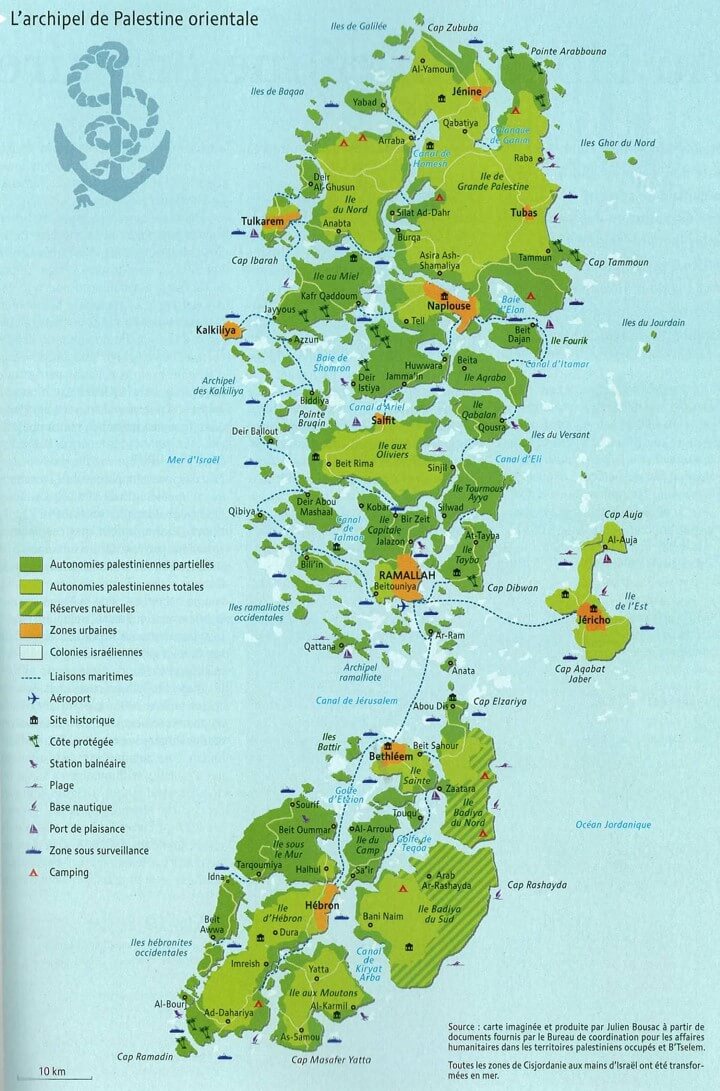
With their rich, often over-the-top imagination, ‘pro-Palestinian’ activists could not possibly have missed the metaphoric potential of islands.  They harnessed that potential ‘for the cause’ by portraying the Palestinian Authority-governed areas of the West Bank (defined in the Oslo Accords) as an ‘archipelago’ of small islands in a ‘sea’ of Israeli ‘settlements’.  Such allegoric maps travel far and reach wide; their message is clear: a patchwork of Palestinian ‘islands’ cannot be turned into a viable state.


Not satisfied with the mere allegory, some activists are shouting that message in full-throated, indignant, moralising voice: it is too late for the two state solution.  Often, they blame Netanyahu and ‘his settlements’; but Seumas Milne (a former journalist and currently top courtier to Labour Party leader Jeremy Corbyn) suggested, even 15 years ago, that the two-state solution was no longer achievable.

Among certain ‘pro-Israel’ activists (and even among some Israelis), such suggestions are a source of dread and despair.  In the absence of a Palestinian state, they say, Israel’s choices are grim: either ‘one-state’ in which Jews will be (or will quickly become) a minority; or else an apartheid state – in which the Palestinians won’t possess full political rights.

A recent Jewish Chronicle article quotes Tal Keinan, an American-Israeli businessman and former Israeli fighter pilot, who argues that there are “only three possible endgames” for Israel:
"The first is that Israel could annex the West Bank and give its Arab residents citizenship – which would mean Israel ‘opening itself to the prospect of demographic suicide’. […]
The second option would be to annex the Palestinian territories without granting the Palestinians citizenship – imposing sovereignty on a large number of people without representation. […]
The final option […] is for Israel to withdraw from most of the territories, with or without an agreement with the Palestinians. If the Palestinians build a state, there will be a state, but if not, the West Bank ‘will likely become another rocket base’."


So there you are: the options are oblivion, apartheid or being bombed to smithereens.  As the current British Prime Minister would put it, doom or gloom!

There’s a debate to be had on whether it is indeed too late for the ‘two state solution’; and whether lack of ‘full political rights’ equals ‘apartheid’.  But I do not wish to go there now.  My question is: are those ‘3 choices’ really the only possible ‘endgames’?  Or are the prophets of doom merely demonstrating their own stale thought processes, their own lack of imagination and creativity?

I am fascinated by islands.  They are such interesting places!  Let’s let our minds travel to a few islands – and see what we can learn.

A ‘Great’ Britain with some little ‘dependencies’

To start with, I won’t have to travel too far: I live on the island of Britain, which some (both on and outside it) still sometimes call ‘England’.  But it isn’t ‘England’ – the island of Britain is part of a sovereign state called the United Kingdom of Great Britain and Northern Ireland.  Although it is not formally called a federation, this is in fact a federal state made up of four ‘countries’: England, Scotland, Wales and Northern Ireland – each of them endowed with a great deal of political, economic and cultural autonomy.  Nonetheless, there are nationalist movements in each of these ‘countries’, aspiring to more autonomy and even to outright secession from the federation. 

I have recently travelled to Scotland, where great efforts are being made to revive and expand the use of Scottish Gaelic.  Upon return to London, I discovered that I still had a pocketful of Scottish banknotes.  The ‘Scottish pound sterling’ is worth exactly as much as the ‘British (not English!) pound sterling’; but the banknotes are underwritten by the Royal Bank of Scotland and bear different images from their ‘British’ counterparts.  Those strange-looking banknotes may be legal tender throughout the UK; but they are, let me tell you, viewed with suspicion by London retailers, many of whom seem to see them for the first time.

Another ‘country’ – Wales – occupies a peninsula in the West of Britain.  Wales is very similar in size to Israel, but it is less densely populated.  The vast majority of its inhabitants speak English and only one in five has Welsh as their mother tongue.  Still, Welsh is an official language in Wales, on a par with English; no expenses are spared – everything (from road signs to court summons) is written in both languages.  And children have to study Welsh in school, whether they have any use for it or not.

But ‘Great’ Britain is not as interesting as some of the smaller islands off its coast.  Take for instance the Isle of Man, a territory just one-and-a-half times the size of Gaza Strip.  The Isle isn’t part of the United Kingdom; nor is it a sovereign, independent state.  It is, instead, defined as a ‘British Crown Dependency’.  If you think that this means ‘owned by the Queen’ – think again: Queen Elizabeth the Second could not sell off that piece of real estate to – say – Donald Trump; even if he was interested and however much Her Majesty wanted to oblige!

Most Isle of Man inhabitants have the status of ‘Manxmen’ (and Manxwomen?)  Manxmen are ‘in principle’ British citizens; in principle only, because they cannot, for instance, vote in UK national elections and are hence not represented in the UK Parliament.  Although decisions made in that Parliament can have a huge impact upon their lives.  For instance, Manxmen could not vote in the 2016 Brexit referendum.  But, although the island is not part of the United Kingdom – and also not part of the European Union – its economy is strongly affected by the trade between the two…

Manxmen do elect the 24 members of the House of Keys – the lower chamber of the local ‘Parliament’, which deals with most internal matters.  Issues pertaining to defence, international relations, as well as the final say on matters of ‘good governance’, however, are the competence of the UK government and parliament.

Fiercely dependent:
Manxmen are proud citizens of a British Crown 'Dependency'
Upon application, Manxmen are issued with specially printed  British passports.  But instead of ‘United Kingdom’, those passports declare their bearers citizens of a strange entity called ‘British Islands – the Isle of Man’.  Such passports allow Manxmen to travel to – for instance – EU countries; but, unlike ‘regular’ British citizens, they are not entitled to work there.  Nor are EU nationals entitled to work on the Isle of Man, although they (still) can work in the UK.


The British Crown possesses also other ‘Dependencies’ – including several islands in the English Channel/La Manche: Jersey, Guernsey, Alderney and Sark.  Each island is governed separately, according to its own traditional system, mostly originating in the early Middle Ages.  Their combined population is estimated at around 165,000.  None of the Channel Islands is represented in the UK Parliament and, as a rule, their ‘citizens’ cannot vote in UK national elections and referenda.  Their status is, roughly speaking, similar to that of Manxmen.

Something is rotten in the state of Denmark


If we let our mind fly north-west of Britain, across the North Atlantic ocean, we come across Donald Trump’s latest real-estate project: Greenland.  It is the world’s most sparsely populated ‘country’ – with just one inhabitant on average per 10 square miles of territory; but it is also the world’s largest island: circa 10 times larger than Great Britain and 100 times larger than Tiny Israel.

Politically, Greenland is defined as an ‘autonomous region’ of the Kingdom of Denmark – a ‘region’ 50 times larger than Denmark-proper.  Some call it a ‘constituent country’ – similar in principle to the status of Scotland or Wales within the UK.

Happy Greenlanders

The majority of Greenland’s population (circa 88%) belongs to the indigenous Inuit (a.k.a. Eskimo) ethnicity, akin to the natives of North Canada and Alaska.  They speak their own language.  The balance consists of Danish settlers.

Greenlanders elect 2 representatives to Denmark’s parliament, out of a total of 179.  They also elect the 31 members of Greenland’s own parliament, which in turn elects a local government with a high degree of internal autonomy.  However, the Danish government sitting in Copenhagen is responsible for decisions pertaining to defence and international relations; even for those that directly affect the inhabitants of the ‘constituent country’ of Greenland – such as the permission to locate nuclear weapons on the island.

In 1973, the Kingdom of Denmark (including Greenland) became a member state of the European Community – precursor to the European Union.  But, using its greater autonomy achieved in 1979, Greenland voted in 1982 to leave the economic block – and completed that exit by 1985.  It is no longer part of the European Union; but it is still part of the Kingdom of Denmark, a member state of the European Union…

Economically, Greenland has long been highly dependent on Denmark.  However, for the past decade or so, the Greenlandic government has worked steadily to gradually reduce the economic dependence, with the ultimate goal of attaining political independence.

The Kingdom of Denmark ‘owns’ also another ‘constituent country’: the Faroe Islands.  Their status is roughly similar to that of Greenland: the Faroese elect 2 members of the Danish Parliament, as well as all 33 members of the local parliament.  Just like in Greenland, there is a local government, led by a Prime Minister; there is also a strong movement demanding political independence.  A separate Faroese Constitution drafted in 2011 has been rejected by the Danish government of the time, as ‘incompatible’ and ‘cannot co-exist’ with the Danish Constitution.

The poor ‘rich harbour’

By now, you probably think that ‘special status’ islands are but vestiges of medieval kingdoms, bizarre anachronisms somehow preserved into modernity.  Well, not exactly: some of them are part of relatively young republics.

One such island is Puerto Rico.  ‘Discovered’ by Columbus, it was incorporated into the Spanish Empire and colonised by (mainly) Spanish settlers, who wiped out the indigenous population and culture.  But in 1898, it was conquered by the United States.

The term ‘colony’ is not en-vogue any more; but Puerto Rico is not a federal US state, nor is it part of a state.  It is, therefore, defined these days as a ‘United States unincorporated territory’.  In this context, ‘unincorporated’ means that the US Constitution does not apply in full: only ‘fundamental rights’ are protected, other constitutional rights are not.  As a consequence, although the Puerto Ricans are ‘in principle’ US citizens (since 1917), they cannot vote in US presidential elections and do not have senators or voting representatives in the US Congress.  Instead, the 3.2 million Puerto Ricans elect a local Governor and a bi-cameral parliament.  However, the head of state is the President of the United States.  The jurisdiction and sovereignty belongs to the United States of America and the ultimate power is vested in the US Congress.  Laws adopted by the latter apply to Puerto Rico by default.  Many US federal agencies (notably the FBI) are active in Puerto Rico.


A very lonely star...
Puerto Rico calls itself Estado Libre (Free State). But it is neither an independent state, nor a US state.

As US citizens, Puerto Ricans can serve in the US military – in fact they were historically forced to serve whenever the US adopted compulsory military draft.  However, Puerto Rico also has its own National Guard, distinct from the US National Guard.  The commander-in-chief of the Puerto Rican National Guard is… the President of the United States.

On average, Puerto Ricans are significantly poorer than the citizens of the State of Mississippi – the poorest of US states.

US controls a few other ‘unincorporated territories’ with roughly similar regimes – and they happen to also be islands: Guam, Northern Mariana Islands, U.S. Virgin Islands and American Samoa.

And a ‘fragrant’ harbour

I never noticed any particularly pleasant smell when I visited Hong Kong, but many believe that ‘Fragrant Harbour’ (hēung gong in Cantonese) is the origin of the modern name.
Hong Kong consists of the eponymous island, plus an archipelago of some 200 other islands and two small pieces of territory on the coast of Southern China.  In total, it is not much larger than the Gaza Strip – but it is more densely populated: more than 17,500 inhabitants per square mile, compared to Gaza’s 13,000.


How to live on an archipelago:
one can travel among the main islands of Hong Kong by underground train.

In theory, Hong Kong is part and parcel of the sovereign territory of the People’s Republic of China.  But it certainly does not feel that way.  And it’s not just a matter of a different flag, state symbols and anthem.

The official language of China is Mandarin – written with simplified Chinese characters.  In Hong Kong, it is Cantonese, inscribed with traditional characters.  Which render anything spoken or written in Hong Kong unintelligible to most people in China.

Cars cling to the left side of the road in Hong Kong, still following the British tradition; but they are driven on the right in China.

Five years ago, I travelled to China via Hong Kong.  To start with, I had to apply for a Chinese visa; but when I finally got it, was told that it’s not valid in Hong Kong – where one needs a separate visa; or, in the case of my Israeli passport, no visa for Hong Kong, yes visa for China.

Flights from Hong Kong to Beijing are expensive, as they are considered international flights.  I was advised, instead, to buy a seat on one of the many cars and coaches ferrying passengers from Hong Kong Airport to Shenzhen Airport just across the border with China.  I do not use the term ‘border’ lightly: en-route to Shenzhen, my passport was checked twice, within a 50 yards stretch of road: first by the border police of Hong Kong, then by Chinese border officials.

Once at Shenzhen Airport, I boarded a much cheaper, probably subsidised ‘domestic’ flight to Beijing.

I paid for the transfer from Hong Kong to Shenzhen with Hong Kong dollars, but they’re not legal tender in China; so I had to buy the flight ticket Beijing with Chinese ‘renmimbi’, not accepted in Hong Kong.

All this may sound and feel strange, given that Hong Kong is not an independent state.  Officially, Hong Kong is called a ‘Special Administrative Region of the People's Republic of China’.  But in this case, ‘special’ is an understatement.

As I am writing this, there are widespread protests in Hong Kong against Chinese ‘interference’ – protests triggered by a change in law allowing certain offenders to be ‘extradited’ from Hong Kong to... another part of China’s ‘sovereign territory’.  Go figure!

So what?

By now, I can hear quite a few of you grumbling: what do all these islands have to do with anything?  Israel has occasionally been called ‘an island’ – as in ‘an island of freedom in a sea of tyranny’; but geographically it certainly is no island.

Well, I’m afraid I used the ‘islands’ allegory only as a crafty rhetorical device.  This isn’t just about islands, there are many other, ‘continental’ examples.

The point is that the ‘sovereign state/no state’ paradigm is based on a false dichotomy.  Reality is much more complex than that; there are almost-states, states-within-states, incorporated ‘unincorporated territories’, ‘constituent countries’, ‘special administrative regions’ and a myriad other ‘unconventional’ political constructs.

It may be that none of the existing models described above precisely fits the requirements of a future Israel-Palestinian Arabs accommodation.  But what these ‘islands’ prove is that there’s a huge breadth of possibilities – rather than a binary option.

Human beings are endowed with imagination, creativity and problem-solving abilities.  They are also ‘tribal’ and seek self-determination: the right to control their destiny, while organising themselves along ‘tribal’ identities that both unite and divide.  And, as a result of all that, human communities have evolved and are evolving in many complex, unusual, original ways.  Because no man is an island; not even on the Isle of Man.


The conflict between Jews and Arabs – or between ‘Israelis’ and ‘Palestinians’ – is a conflict between right and right.  Not a dilemma, or even a multiple-choice question; but an art project, a piece of blank canvas.

We live in a world of endless possibilities.  There are no slim choices, just narrow minds; mankind doesn't inhabit rigid, tidy little boxes – only some men do.

Tuesday, 2 October 2018

'Anti-Zionism’ is about the Joos, stupid!


Raised and educated in the UK, Prof. Ian Almond teaches World Literature at Georgetown University in Qatar.  So, when I heard that he took to the Qatari-based Al-Jazeera to write about antisemitism, I was hopeful. I thought he was going to write about the high incidence of antisemitism (including Holocaust-denial) in the Arab world.  But no: Prof. Almond chose to warn us all of ‘The danger of conflating anti-Zionism with anti-Semitism’.

Still, I remained hopeful while reading the first few sentences.  Says Prof. Almond:
"I still remember the shock I felt when, at the age of 12, my teacher told me the word ‘joo’ I had just spoken, which I had thought to mean to lie or cheat, was actually ‘Jew’ and was anti-Semitic.  Throughout my British childhood, I had used that word casually and frequently, without ever knowing what it really meant."
Almond goes on to analyse the reasons for his childish mistake:
"I start with this example to make a simple point: anti-Semitism is so entrenched in our society, so depressingly persistent, that to trivialise it is to trivialise the blueprint of prejudice itself. It is a barometer of moral cowardice: when someone doesn’t want to take responsibility for their own faults or problems, they blame the Jews."
Prof. Almond is right to use the present tense in the sentence above: this is not ‘historic’, but contemporaneous antisemitism; the future Professor was 12 at the time (Jeremy Corbyn, by the way,  was 32), so that’s a mere 37 years ago.  We may wish to believe that one man’s character – say Brett Kavanaugh’s! – can change in that stretch of time; but deeply entrenched prejudice does not just disappear from an entire society in less than a generation.

Of course, things did change since the 1980s.  We are much more ‘politically-correct’ these days.  School children are less likely to refer to cheating as ‘jewing someone’; if they do, they will be told that they should not use the word in that sense.  But it’s not about a childish word – it’s about the societal prejudice it reveals.  The word may rarely be used with that meaning these days; but the prejudice is still there.  If you want proof, just surf Twitter.  Or listen to the many Labour Party supporters who seem to say that, when African Caribbeans, Muslims or Asians complain about racism, they have a point; but when Jews complain about antisemitism, there must be some dishonest motive behind it.

Prof. Almond’s childhood story is revealing – and his subsequent analysis is correct.  Too bad they are employed to excuse, rather than inform, the rest of his 'learned article'.

After declaring that “anti-Semitism is so entrenched in our society, so depressingly persistent, that to trivialise it is to trivialise the blueprint of prejudice itself”, Prof. Almond proceeds to do exactly that – trivialise it:
"There are definitely some voices who claim to support the Labour Party, and who allow their anti-Zionism to spill over mindlessly into anti-Semitism."
“There are […] some voices who claim…”???  Professor, don’t “some voices” include the very Leader of the Party, who rose to the defence of blood-libellers, conspiracy theorists and ‘artists’ who depict hooked-nosed ‘oppressors’?  Don’t “some voices” include ’illustrious’ members of the Party top brass (and good friends of the Leader), who implied that Jews conspired with their own genocidal persecutors?  Don’t they include a well-attended recent meeting at the Party Conference, where people chanted ‘From the River to the Sea, Palestine will be free’ – a call to pogrom on 6.5 million Israeli Jews?  Are these really“some voices who claim to support the Labour Party”???

But that’s not the only place where Prof. Almond’s argument lacks internal logic – not to mention moral clarity.  We are all, in fact, lucky that the good Professor teaches literature, rather than medical science; because – bluntly put – his diagnosis suffers from terminal idiocy, in view of the symptoms that he himself described in the previous paragraphs.

Indeed, Prof. Almond’s judgement of “some voices” is that “their anti-Zionism […] spill[s] over mindlessly into anti-Semitism”.  So anti-Zionism comes first and “some voices” are guilty only of taking it a bit too far.  But, since (as he himself explained) “anti-Semitism is so entrenched in our society, so depressingly persistent”, isn’t it much more likely that anti-Zionism is the outcome of that deeply entrenched prejudice?  Indeed, that it is just a new symptom of that entrenched disease?  If – God forbid – I suffered from “entrenched” and “depressingly persistent” lung cancer and developed a nasty cough – chances are it’s because of the cancer, not because I sang too loudly in church!

What ‘Costa’ means, of course, is 'the Zionists jew the Palestinians’.

Isn’t that “entrenched [… and] depressingly persistent” antisemitism a much more likely explanation for the visceral animus, unique in its nature and intensity, that “some voices” exhibit towards the Jewish state – and only towards the Jewish state?  Isn’t this why the oppression of Palestinians was so often and emotionally cited at the Labour Conference, while none of the ‘progressive’ leaders cared to mention the plight of Saudi women – those 51% of the country’s population that had to wait until 2018 (2018!) to be allowed to drive (by law, though still not in practice)?

Prof. Almond views as outrageous that
"The IHRA code considers any description of the Israeli State as a ‘racist’ institution to be anti-Semitic."
But – leaving aside the fact that his interpretation of “The IHRA code” is tendentious – which other state is called “a ‘racist’ institution”?  The Labour Party claims that Hungary’s current government is antisemitic and Islamophobic – yet it does not call Hungary “a ‘racist’ institution”.  Jeremy Corbyn politely frowned at Myanmar’s ethnic cleansing of hundreds of thousands of Rohingya; yet he did not call the former British colony of Burma ‘a racist endeavour’ as a result.

But Prof. Almond appears convinced that Israel should be called a racist institution.  He explains why:
"[I]n 1948, three-quarters of a million Palestinian Arabs were forcibly evicted, with British backing, off their own land. To recognise this as racist, in the words of the IHRA code, would be ‘anti-semitic’."
That the “Palestinian Arabs were forcibly evicted, with British backing” would be shocking news to the 1948 British Mandate officials, as well as to the Jewish inhabitants of Kibbutz Ein Hamifratz, bombed by British artillery, apparently in order to ‘assist’ the Arab town of Acre.  But that’s by-the-by.

However, you know what?  Let’s be generous with Prof. Almond: let’s adopt his version of history – however specious.  Let’s assume that indeed the “Palestinian Arabs were forcibly evicted” – though the reality was considerably more complex than that; let’s ignore that that ‘eviction’ occurred in the midst of a civil war that soon morphed into a war of survival against attack by all neighbouring states; let’s even forget that the Arab side perpetrated their own ‘evictions’ – in fact more thorough ‘evictions,’ since no living Jew remained in the territory they even temporarily controlled.

But what I fail to understand, even after all those assumptions, is why and how is that ‘Jewish misbehaviour’ more terrible than dozens of other cases of ‘forced eviction’ that occurred elsewhere, both before and after the establishment of the State of Israel.  ‘Evictions’ that are very rarely – if ever – described as ‘racist’.

Immediately after the defeat of Nazi Germany, borders were re-drawn – and accounts settled.  The ethnic German population of Poland, Czechoslovakia and Hungary (people that had lived there for centuries) was driven out.  So was the population of territories that had been part of Germany, but were now ‘given’ to the USSR and Poland.  In total, 14 million ethnic Germans were driven out of their homes and lands, with the agreement and connivance of the victorious powers.  Circa 1 million died in the process: some at the hands of local soldiers, policemen and civilian vigilantes; others, due to exposure and exhaustion; many died of starvation either before or after reaching war-ravaged Germany (or, rather, territories of the former German Reich, now occupied and governed by the Allies).  The 13 million survivors – and their descendants, accounting these days for almost a quarter of Germany’s population – were never allowed to return and were never granted any compensation.

Ethnic German refugees fleeing westwards 

Ethnic Germans were not the only population ‘evicted’ at the time: so were ethnic Poles living in Ukraine – many of whom were Soviet citizens.  Hundreds of thousands of ethnic Ukrainians and Lemkos were forcibly expelled from Poland into the Soviet Union; and when the latter closed its border, the remaining Ukrainian and Lemkos villagers were forced to ‘resettle’ in the west of the country, in the former German provinces ‘transferred’ to Poland.  Conditions were harsh and human life was cheap – so many died or were killed on the way; molested women and girls had nobody to complain to: they typically picked up the small children or younger siblings and continued their journey – that is, whenever they and their families escaped being murdered out of sheer sadism and gratuitous brutality.  Those Ukrainians and Lemkos who survived this ‘resettlement’ ordeal were forcibly dispersed, with no regard to family and community ties; the Polish authorities forbade any expression of native language and culture, in a deliberate attempt to assimilate them into the prevalent Polish ethnicity.  (To those wishing to learn more of the terrible history of Europe in the immediate aftermath of World War II, I recommend Keith Lowe’s excellent book ‘Savage Continent’.)

All of the above (and much, much more) happened in what was by then peacetime.  The allied armies ruled in Berlin and over a subdued Europe.  Those 'evicted' did not pose any security risk to the remaining population.  In Czechoslovakia and Hungary, they did not even endanger the demographic supremacy of the majority population.  It can be argued, on the other hand, that this was the making of the new Poland: historically, Poland had been a geographic and demographic patchwork whose existence as an independent nation between the German and Russian ‘spheres of influence’ had been intermittent; the post-war bout of ruthless viciousness gave birth to a completely different country — a Poland with utterly changed borders and a demographic eerily uniform from an ethnic perspective.


The making of modern Poland: new borders and homogeneous ethnicity

Europe isn’t the only ‘savage continent’.  In 1947, even while the newly-formed United Nations was debating the fate of the Mandate of Palestine, an additional former 'British' territory was being partitioned: the former Jewel of the Crown – the British Raj.  Like most colonies, this was not a country – but an artificial contraption made up of numerous faiths and ethnicities, held together (but often also set against each other) by colonial interests.  There was, however, one major fault line, between the Hindu population and the Muslim one.  Both groaned under the British colonial yoke, but also resented and feared each other.  To ‘pacify’ the place long enough to wash its hands of it, the British government implemented a territorial partition into two states.  It was hardly a fair deal: the Hindu-majority state – India – incorporated the vast majority of industrial assets and agricultural land; it also ‘inherited’ most of the former colony’s financial reserves.  The Muslim-majority state – Pakistan – initially comprised just one fifth of the former colony (the Muslim population accounted in 1947 for circa 30%).  Even that consisted of two non-contiguous pieces of territory – West Pakistan and East Pakistan (later to become Bangladesh) – separated by 1,000 miles of Indian territory.

Nations may draw borders, but borders don’t create nations.  Despite the partition, inter-communal violence continued and intensified.  When all is said and done, circa 1 million people are estimated to have lost their life.  15 million were forced to leave their ancestral homes and lands and go into exile – never to return.

A convoy of refugees fleeing West Pakistan in 1947. 
Not even that was enough to defuse the tensions: India and Pakistan have since fought several wars and continue to face each other with relentless suspicion and barely contained hostility.  Since both are armed to the teeth – including nuclear arsenals – this remains a potential source of catastrophic conflagration.

Pakistan officially calls itself an Islamic Republic (Article 1 of the Constitution) – and is recognised under that name by the United Kingdom.  Article 2 proclaims:
"Islam shall be the State religion of Pakistan."
Yet I have yet to hear protests from Prof. Almond or from other Corbynites.  Why aren’t they worried about the impact of such constitutional arrangements upon the status of Pakistan’s non-Muslim minorities (Hindus, Christians, Sikhs, etc.)?  And by the way, the official languages of Pakistan are Urdu and English, despite the fact that Punjabi is the native tongue for more than 40% of the population.

As for India, the Muslim minority in the predominantly Hindu country has long complained of discrimination – and independent reports tend to support those claims.  If anything, complaints of oppression and marginalisation have intensified under Narendra Modi’s Hindu nationalist government.

I would assume that Prof. Almond is familiar with the birth of India and Pakistan – after all he claims Post-Colonial Studies as one of his specialisms.  Unless the good Professor is one of those ‘progressives’ for whom the study of post-colonialism always boils down to one small country in the Middle East…

Despite Prof. Almond’s protestations, the Labour Party did adopt the IHRA Definition – after numerous subterfuges and under huge public pressure.  But Jeremy Corbyn attempted to ‘supplement it’ (read: subvert it) with a proviso ‘protecting’ those who regard
"the circumstances around [Israel’s] foundation as racist."
But why?  How were those “circumstances” different from those that led to the formation of Pakistan?  Or of India?  Or of modern-day Poland?  Or of Croatia – the latest addition to the European Union – the “circumstances”of whose “foundation” included the ethnic cleansing of circa 400,000 Serbs?  Why is it that Corbyn and his supporters never call those countries ‘racist endeavours’?

The list of unpleasant “circumstances”, of course, is not limited to the countries mentioned above.  In fact, such “circumstances” are the rule, rather than the exception: more often than not, countries are born in conflict and strife; frequently, that strife includes numerous deaths, injuries, displacement and suffering of innocents.  That is (to use a British understatement) very unfortunate; but unusual it ain’t.  What's unusual – unique actually! – is the attempt to deny a country its legitimacy in the present and its existence in the future, because of “circumstances” in its past.  What's uncommon – extraordinary actually! – is calling an entire country ‘a racist institution’.  Hey, what an astonishing coincidence: the state subjected to this type of unique and extraordinary assault just ‘happens’ to be the Jewish state!  Surprising, 'innit?? (Note the attempt at English irony!)

No, Prof. Almond: I am not worried about “conflating anti-Zionism with antisemitism”: they are one and the same.  You must have learned the wrong lesson from your childhood experience: singling Jews out for 'special attention' is just as wrong, even when you use politically-correct words.  Dear Professor of World Literature, antisemitism is not a matter of vocabulary; it’s not the words you utter – it’s the prejudice you harbour.  You see, the “IHRA code” is more than just a definition.  It’s a test – and you failed.


Sunday, 29 July 2018

Israel’s Nation State Law: drink driving vs. sober analysis

Recently, the Israeli Parliament (the Knesset) has adopted a piece of legislation entitled ‘Basic Law: Israel – the Nation State of the Jewish People’.  Pretty much everything that happens in Israel can be described as ‘controversial’ if one follows traditional news outlets (let alone the social media).  But this new law is certainly even more ‘controversial’ than usual.  It has been criticised by many in Israel and by most Jewish organisations in the Diaspora.  Others, of course, have defended it.
There are three main ‘strains’ of criticism: the first basically accuses the Israeli legislators of unnecessarily ‘rocking the boat’.  Indeed, despite the brouhaha, the new law does not ‘do’ anything; it has no practical effect, it does not change the reality on the ground one iota.
A second type of criticism is that the law is poorly designed and drafted: it includes superfluous articles, while leaving out important principles.
I confess that I feel a lot of sympathy towards both these criticisms.  But then there is a third category – those who claim that the law is terribly wrong, even utterly evil.  The degree of ‘wrong’ varies between ‘incompatible with democratic principles’ and ‘profoundly racist’ – depending mainly on the critic’s own ideological inclinations.
Confronted with this new development in Israel, most commentators did what they always do – they quoted other pundits.  I’m otherwise inclined – rather than playing the pointless ‘X said/Y said’ game, I suggest taking a look at the actual text and analysing it, article by article.  Tedious – I know; but also meaningful.  Those who have no patience for such things are invited to let journalists tell them what they should see and think.
If you are still with me, let’s see what we have:
1a. The Land of Israel is the historical homeland of the Jewish people, in which the State of Israel was established.
This is only controversial among Israel’s enemies.  It’s also hardly new: Israel’s Declaration of Independence famously stated:
The Land of Israel was the birthplace of the Jewish people. Here their spiritual, religious and political identity was shaped. Here they first attained to statehood, created cultural values of national and universal significance and gave to the world the eternal Book of Books.
 The League of Nations Mandate also declared
[R]ecognition has thereby been given to the historical connection of the Jewish people with Palestine and to the grounds for reconstituting their national home in that country;
Let’s move on:
1b. The State of Israel is the national home of the Jewish people, in which it fulfils its natural, cultural, religious and historical right to self-determination.
This is nothing else than ‘Zionism in a nutshell’.
The next article is much more controversial:
1c. The right to exercise national self-determination in the State of Israel is unique to the Jewish people.
I’ve heard a lot of criticism that points (without actually quoting it) to this particular article.  What I haven’t heard is a counter-proposal.  If we’re not saying that, what are we saying?
Are we saying that the Palestinian people also “has the right to exercise national self-determination in the State of Israel”?  One can say that, if one is so disposed – but one cannot say that and militate for the two-state solution.  If the Palestinian people can exercise self-determination in Israel, then what’s the point of a Palestinian state?
Are we then saying that anyone who’s an Israeli citizen “has the right to exercise national self-determination in the State of Israel”?  Again, one can say that – but how then is Israel “the national home of the Jewish people”?  How does one justify the Law of Return, which gives any member of the Jewish people (but not to non-Jews) the almost unconditional right to become an Israeli citizen?  How does one justify the Jewish character of the state – the flag, the symbols, the holidays, etc.?
Let me quote again from the League of Nations Mandate:
the Principal Allied Powers have also agreed that the Mandatory should be responsible for putting into effect the declaration originally made on November 2nd, 1917, by the Government of His Britannic Majesty, and adopted by the said Powers, in favor of the establishment in Palestine of a national home for the Jewish people, it being clearly understood that nothing should be done which might prejudice the civil and religious rights of existing non-Jewish communities in Palestine, or the rights and political status enjoyed by Jews in any other country.
It seems rather obvious: the League recognises that the ‘national rights’ belong to the Jewish people; when it comes to “the existing non-Jewish communities in Palestine”, it sees only “civil and religious [but not national]rights”.
This is further strengthened in Article 4 of the Mandate:
An appropriate Jewish agency shall be recognised as a public body for the purpose of advising and co-operating with the Administration of Palestine in such economic, social and other matters as may affect the establishment of the Jewish national home and the interests of the Jewish population in Palestine, and, subject always to the control of the Administration to assist and take part in the development of the country.
… and Article 7:
The Administration of Palestine shall be responsible for enacting a nationality law. There shall be included in this law provisions framed so as to facilitate the acquisition of Palestinian citizenship by Jews who take up their permanent residence in Palestine.
No equivalent provisions were envisaged for the non-Jewish communities.
Nor was that view abandoned with the dissolution of the League of Nations and its replacement by the United Nations.  UN General Assembly Resolution 181(II)/29 Nov. 1948 called for the establishment of two states and it referred to them as “the Jewish state” and “the Arab state” – although both states were to include minorities belonging to the other ethnicity.  In each state, the Resolution called for:
Guaranteeing to all persons equal and non-discriminatory rights in civil, political, economic and religious matters and the enjoyment of human rights and fundamental freedoms, including freedom of religion, language, speech and publication, education, assembly and association;
Again, the reference is to “civil, political, economic and religious [rights] […] and fundamental freedoms”, but not to ‘national rights’, or ‘national self-determination’.  To the authors of the Resolution, it seemed obvious that the ‘national’ rights in the Jewish state belonged to Jews – why else would they define it as “the Jewish state”?
Finally, Israel’s Declaration of Independence proclaimed
the natural right of the Jewish people to be masters of their own fate, like all other nations, in their own sovereign State.
The Declaration also states:
The State of Israel […] will ensure complete equality of social and political rights to all its inhabitants irrespective of religion, race or sex; it will guarantee freedom of religion, conscience, language, education and culture;
Just like the previous documents, the Declaration differentiates between on one hand ‘national rights’ (which it assigns to the Jewish people); and on the other hand other individual and collective rights, as well as basic freedoms, which are to be enjoyed by all inhabitants of the State, without discrimination.
Still, to people coming from a certain ideological environment, all this does not sound right.  In a recent Jewish Chronicle article, Jonathan Freedland fulminates:
Israel has explicitly granted collective rights to one group of citizens and denied them to another.
The article implies that this is inherently racist; it even hints that Israel may now be accused of apartheid – with more justification than before.  The author then goes on to claim that Israel is no longer a democratic country:
Those used to shouting that ‘Israel is the only democracy in the Middle East’ will need to find another slogan — because this is not how democracies behave.
Except that Freedland’s own country recognises Christmas and Easter as official state holidays (‘bank’ holidays).  Neither Rosh Hashanah, nor Eid-El-Fittr (or indeed Diwali, the Chinese New Year, etc.) enjoy that status.  The Christian cross (but not the Star of David or the Islamic Crescent) features on the national flag.   The Church of England is UK’s Established Church and no other faith has that status; the Head of State is also the Head of the Church, etc.  It would seem that – on some level at least – the UK has “granted collective rights to one group of citizens and denied them to another.”
UK does not have a constitution, so that ‘granting’ is done in practice.  But other countries do it explicitly – in fact at least as explicitly as Israel did.
Let’s have a look, for instance, at the Slovak Constitution.  Its Preamble proclaims:
We, the Slovak nation, mindful of the political and cultural heritage of our forebears, and of the centuries of experience from the struggle for national existence and our own statehood, in the sense of the spiritual heritage of Cyril and Methodius and the historical legacy of the Great Moravian Empire, proceeding from the natural right of nations to self-determination, together with members of national minorities and ethnic groups living on the territory of the Slovak Republic, in the interest of lasting peaceful cooperation with other democratic states, seeking the application of the democratic form of government and the guarantees of a free life and the development of spiritual culture and economic prosperity, that is, we, citizens of the Slovak Republic, adopt through our representatives the following Constitution.
Note that the Preamble postulates a “Slovak nation” acting “together with members of national minorities and ethnic groups”.  The term “together with”unites, but also divides.  It clearly says that “members of national minorities and ethnic groups” are not part of the “the Slovak nation”, though they arepart of the citizenry of the Slovak Republic.  In fact, the Preamble establishes two kinds of “we” – two collectives:
  • “We, the Slovak nation”, and
  • “we, citizens of the Slovak Republic”.
The equation it draws is: “We, the Slovak nation” + “national minorities and ethnic groups” = “we, citizens of the Slovak Republic”
How is this fundamentally different from ‘Jewish people’ and ‘Israeli citizens’?
Crucially, the Slovak Constitution talks about “the natural right of nations to self-determination” – a discussion included in the “Slovak nation” term of the equation and not in the ‘minorities/citizenry’ one.
This is not mere semantics.  Slovakia is home (but obviously not ‘national home’) to a sizable – circa 10% –  ethnic Magyar (Hungarian) minority, which has lived in the country for many centuries.
Demographics of Slovakia: the yellow areas have majority Magyar population.
Yet the Preamble to the Slovak Constitution is designed in ethnic terms.  References to “the spiritual heritage of Cyril and Methodius and the historical legacy of the Great Moravian Empire” are no doubt very meaningful to the (West-Slavic) “Slovak nation”; but the (non-Slavic) Magyar minority may find it hard to identify with such symbols of Slavic character.  In fact, they may be decidedly underwhelmed by “the historical legacy of the Great Moravian Empire” (830-907 CE) and prefer to remember the Kingdom of Hungary, which – from circa 1000 CE until after World War I – included the territory of modern-day Slovakia.
The Slovak Constitution is not some outdated document, preserved merely by tradition: it was adopted in 1992.
Has Jonathan Freedland read the Slovak Constitution?  Would he say that it “has explicitly granted collective rights to one group of citizens and denied them to another”?  Would he say that it justifies claims of ‘apartheid’?
Yet Slovakia acceded to the European Union in 2004.  The accession process involves punctilious verification that the country fulfils the Accession Criteria, the first of which is:
political criteria: stability of institutions guaranteeing democracy, the rule of law, human rights and respect for and protection of minorities;
The European Union has judged Slovakia (with the Constitution I quoted from above) to fulfil the criterion above.

But let us return to the Israeli Nation State Law.  Paragraph 3 says:
3. The capital of the state: Jerusalem, complete and united, is the capital of Israel.
In the case of Israel (and only in the case of Israel!) this is seen by many as controversial.  But it isn’t new: it is nothing but ‘copy and paste’ from another Israeli law – ‘Basic Law: Jerusalem, Capital of Israel’, adopted in 1980!  Paragraph 1 of that law states:
Jerusalem, complete and united, is the capital of Israel.
Another controversial provision of the Nation Law states:
4a. The state’s language is Hebrew.
4b. The Arabic language has a special status in the state; Regulating the use of Arabic in state institutions or by them will be set in law.
4c. This clause does not harm the status given to the Arabic language before this law came into effect.
The BBC claims that the
so-called Jewish nation state bill […] downgrades Arabic from official language status
Except that Arabic has never been an official language in the State of Israel.  It has been (along with Hebrew and English) an official language in the British Mandate of Palestine.  While the State of Israel never declared Arabic (or English) an official language, it did enshrine in its laws and regulations the obligation of state institutions to provide services in Arabic, as well as Hebrew.  Articles 4b and 4c of the new law in effect guarantee the continuation of that obligation.
But is that (to borrow Jonathan Freedland’s expression) “how democracies behave”?  Let’s start with Jonny’s own country: it may surprise him to learn that the official language of the United Kingdom is English and… English.  Of course, the UK government provides services in Welsh (and occasionally in Hindi, Punjabi, Gujarati, Bengali, etc.) – but these are not official languages in the UK.
The official language of Sweden is Swedish, notwithstanding the fact that a sizable proportion of Sweden’s population has Finnish as their mother tongue.
When it comes to language, Slovakia is infinitely harsher than Israel: a 2009 amendment to the ‘Language Law’ not only establishes Slovak as the only ‘state language’ throughout the country’s territory, but severely restricts the use of Hungarian – even among ethnic Magyars.
According to EU Observer:
The Law […] seeks to regulate any and all meetings, gatherings, associations and other forms of communication by insisting on the parallel use of the ‘state language’, Slovak, whenever and wherever members of the minority get together in public, and ‘public’ is very broadly defined. Thus, if a group of Hungarian-speakers establish a literary circle, say, their proceedings would have to have a parallel Slovak translation, whether anyone actually needed this or not.  Minority-language schools are obliged to run their administration and documentation in Slovak and the same applies to the health service. The armed forces, the police and the fire service are to be monolingually Slovak. This last, by way of example, creates interesting scenarios – thus in a Hungarian-speaking area, the firemen are very likely to be all Hungarian-speakers, but when putting out a fire, they must speak Slovak to each other and also, of course, to the owner of the house where the fire is.
Violating the Slovak Language Law is punishable by a fine of EUR 5,000 (equivalent to 5-6 months’ average wages in Slovakia).

But let’s go back to Israel’s newly adopted Nation State Law:
2a. The name of the state is ‘Israel.’
2b. The state flag is white with two blue stripes near the edges and a blue Star of David in the center.
2c. The state emblem is a seven-branched menorah with olive leaves on both sides and the word “Israel” beneath it.
2d. The state anthem is “Hatikvah.”
Details regarding state symbols will be determined by the law.

Jonathan Freedland might see these provisions as less controversial.  He would be wrong again, however.  It’s in the eye of the beholder, apparently.
Adalah is a foreign-funded Israeli Arab organisation which set as its mission
to promote human rights in Israel in general and the rights of the Palestinian minority, citizens of Israel, in particular.
Among other projects, Adalah compiled a database of Israeli ‘racist laws’ – laws that, in the organisation’s view, discriminate against the Arab minority.  This includes, for instance, the Flag and Emblem Law (adopted by the Knesset in 1949).  Adalah explains that the law
Adopts the flag of the First Zionist Congress and the Zionist Movement [which Adalah considers a colonial enterprise], a combination of a prayer shawl and the Shield of David, as the official flag of Israel.  The emblem of the State of Israel is a candelabrum, one of the symbols of the Temple era in Jewish history.
The Constitution of (EU member) Malta proclaims in Chapter 2: “The religion of Malta is the Roman Catholic Apostolic Religion. […] Religious teaching of the Roman Catholic Apostolic Faith shall be provided in all State schools as part of compulsory education.”
 Back to the Nation State Law:
5. Ingathering of the exiles: The state will be open for Jewish immigration and the ingathering of exiles
6. Connection to the Jewish people
6a. The state will strive to ensure the safety of the members of the Jewish people in trouble or in captivity due to the fact of their Jewishness or their citizenship.
6b. The state shall act within the Diaspora to strengthen the affinity between the state and members of the Jewish people.
6c. The state shall act to preserve the cultural, historical and religious heritage of the Jewish people among Jews in the Diaspora.
Jonathan Freedland appears to object less to these provisions.  Frankly, I can’t understand why.  If Israel is the embodiment of the Jewish right of self-determination, then they are easy to understand as expressions of that right; but if Israel embodies the right of self-determination of its Arab (or Palestinian Arab) citizens, then how does Freedland justify them?  Surely, that position should imply that Israel is obligated to rise to the defence of Palestinian besieged in the Yarmouk refugee camp – just as it would do if Yarmouk’s inhabitants were Jewish?  And why should the state “be open for Jewish immigration”, but not for Palestinian Arab immigration (or indeed for the ‘return’ of Palestinian refugees and their descendants)?  Freedland’s (unstated, but implied) views necessarily lead to the position of Adalah, which postulates that Israel’s preferential immigration law is discriminatory and racist.
7. Jewish settlement: The state views the development of Jewish settlement as a national value and will act to encourage and promote its establishment and consolidation.
Here, a tedious linguistic explanation is necessary: the English word 'settlement' is likely to be misinterpreted, because it’s been intensively used (and abused) in relation to Israeli towns and villages beyond the Green Line.  But that would be a mistranslation.  The Hebrew word for ‘settling beyond the Green Line’ is ‘hitnahalut’.  But the law talks about “hityiashvut” – which is the word used for Jewish settlement before the establishment of the State (the term Yishuv – used to refer to the Jewish community in the British Mandate of Palestine – comes from the same root).  So no – this has nothing to do with the ‘illegal settlements’.
In fact, this paragraph of the law mimics the language of the League of Nations mandate, which called on the Administration of Palestine to “encourage […] close settlement by Jews on the land”.
Back to the Nation Law again:
8. Official calendar: The Hebrew calendar is the official calendar of the state and alongside it the Gregorian calendar will be used as an official calendar. Use of the Hebrew calendar and the Gregorian calendar will be determined by law.
9. Independence Day and memorial days
9a. Independence Day is the official national holiday of the state.
9b. Memorial Day for the Fallen in Israel’s Wars and Holocaust and Heroism Remembrance Day are official memorial days of the State.
10. Days of rest and Sabbath: The Sabbath and the festivals of Israel are the established days of rest in the state; Non-Jews have a right to maintain days of rest on their Sabbaths and festivals; Details of this issue will be determined by law.

These paragraphs sketch the Jewish character of the state.  Once more, they might look less controversial to Jonathan Freedland – but these aspects are listed in Adalah’s database of ‘discriminatory laws in Israel’.
The national anthem of Cyprus praises the “Greeks of old”. Which might not impress the country’s ethnic Turkish citizens. 
Finally:
11. Immutability: This Basic Law shall not be amended, unless by another Basic Law passed by a majority of Knesset members.
Which says that the Nation State Law can only be amended by another Basic Law – and not by ‘just any old law’.
***
When all is said and done, the crux of the matter remains paragraph 1c, which makes “national self-determination in the State of Israel” a unique prerogative of the Jewish people.
Jonathan Freedland believes that this is inherently undemocratic and racist; that it turns Arab Israelis into ‘second-class citizens’.
As I’ve shown, if this is true of Arab Israelis, it is also true of Slovak Magyars and other minorities.  But is it?  Well, it depends on the ideology one chooses to subscribe to.  More precisely, it depends on where one chooses to position oneself on the universalism-vs.-particularism scale (I’ve touched briefly on this subject here).
For extreme universalists, states (viewed at best as a temporary and necessary evil) exist as artificial constructs, aimed at placing barriers between people.  For extreme particularists, they are exclusive ethnic fortresses, to be fiercely defended against any foreign trespassers.  In-between, however, there is a wide range of legitimate opinions.
Sadly, in Jonathan Freedland’s world, there is but one ‘good’ opinion (indeed, just one legitimate world view) – the one he subscribes to.  Anyone who dares disagree is automatically placed outside what David Hirsch calls ‘the community of the Good’; s/he is racist, undemocratic, etc.  Well, I’m afraid, Jonny dear, that this in itself smacks of intolerance and bigotry.
I resent ethnic exclusivism and despise ethnic supremacism; but I also view the state as repository of a people’s historical and cultural heritage, a ‘safe space’ for a particular flavour of humanity to develop and grow.  Complemented and enriched by others – yes; overwhelmed by others – no.
In its most profound sense, ‘national self-determination’ means the right of a people to impart to their state its distinct, unique, ‘national’ character.  It’s about flavour and texture Jonny – not power and subjugation.
I strongly believe that Arab Israelis should have equal political, civil, economic and social rights, as well as personal and collective freedoms.  They should be free to use their own language, to develop, enjoy and pass on to future generations their own culture.  Israel is their home – in every sense but one.  Physically, politically, legally, economically and socially Arab Israelis fully ‘belong’ in the State of Israel – just like Slovak Magyars ‘belong’ in Slovakia.  But we also need to understand that Arab Israelis will always look to the Arab world (and – one day if they so desire – to a Palestinian Arab state) as their cultural and ‘national’ home.  Just like Slovak Magyars will look to Hungary; just like Swedish Finns look to Finland; and – dare I say – just like British Jews look to Israel.  There is nothing wrong with that; nothing untoward or illegitimate.  That makes them neither a ‘fifth column’, nor ‘second class citizens’.
These are my views.  Jonathan Freeland is, of course, welcome to his opinions – as long as they are logical and consistent.  But there is a huge internal contradiction in his world view: even while railing against Israel’s Nation Law, Mr. Freedland is asking the UK Labour Party to adopt in full the IHRA Definition of Antisemitism.  Jonathan objects to the fact that Labour has excluded from their Code of Conduct some of the examples of antisemitism – including
Denying the Jewish people their right to self-determination, e.g., by claiming that the existence of a State of Israel is a racist endeavo[u]r.
But if Jonathan claims that the right of self-determination of Palestinian citizens of Israel should be satisfied in Israel, then it follows that the right of self-determination of British Jews should be satisfied in Britain (and that of Russian Jews in Russia, etc.)  How, then, does Jonathan Freedland justify his other claim, that the right of self-determination of Jews is embodied by the State of Israel and that denying that right (i.e. denying Israel’s right to exist as the State of the Jews) is an antisemitic prejudice?  And how does he justify his demand for a separate Palestinian state?
Ideology is like alcohol: it affects people’s ability to think straight and constrains their peripheral vision.  One should neither drive a car, nor write a political article while ‘under the influence’!
 
;