Showing posts with label Poland. Show all posts

Saturday, 25 May 2019

Give peace a chance!


Trump’s ‘Deal of the Century’ between Israelis and Palestinians may yet prove to be the Flop of the Century.  But its architects have been amazingly successful at keeping mum: I can’t remember any other political programme that has been kept so secret for so long, in the face of such keen curiosity from journalists, pundits and political adversaries.  Nobody knows what the plan is; no details have leaked, no positions have transpired.  Unheard of!

No wonder, then, that everybody is jittery: Israelis and Palestinians, Jews and Arabs, left-wingers and right-wingers… Kept in the dark, they are reduced to… well… guessing.

One understands this; it’s human nature.  Guessing is one way to try and gain some control in a world plagued by uncertainty.  But assuming the worst when knowing the least is not mere guessing – it’s something else.

It may be distressing to see the Palestinian Authority rejecting the new peace plan before even knowing what it contains; but a surprise it ain’t: after all, that Authority is made up of people who make a nice living out of the status-quo; from their point of view, any change (whether led by Trump, Obama or Clinton) risks being a change for the worse.

Waaay more surprising is the deluge of negative reactions from the ranks of the self-proclaimed 'progressive', 'pro-peace' camp.  Granted, these people don’t like Trump (I’m being a bit British here: they hate his guts, actually).  But hey: God (or the forces of Dialectical Materialism) moves in mysterious ways.  After all, those same self-proclaimed 'progressive', 'pro-peace' activists like the Egypt-Israel Peace Treaty; which was signed not by doves, but by right-wingers Menachem Begin and Anwar Sadat.  So why not wait until a few details have been revealed about the Trump plan?  It’s likely to happen in a matter of weeks, if not days.

I find it disturbing to see so many 'pro-peace' activists ranting against a peace plan – any peace plan.  And in particular one that they (along with everybody else) know nothing about.

"Pro-peace" – but only if it's the "correct" peace.
Writing in the Times of Israel, former Knesset Member Ksenia Svetlova attacks the ‘Deal of the Century’ for trying to offer economic benefits, rather than political solutions:
“So what is left of Trump’s peace plan if we take out the whole matter of an independent Palestinian state? Only the ‘economic peace’ that Prime Minister Benjamin Netanyahu has been talking about for so many years."
Following a well-known activist’s gambit (when your argument is thin or dishonest, bring up a ‘human story’ to stir up readers’ emotions), Ms. Svetlova goes on to describe the plight of… Palestinian ice-cream manufacturers.  Apparently, Israel does not allow one such manufacturer in Gaza to export its products, claiming that “it [i.e. Israel] has not yet set up the required supervisory [i.e. security] mechanisms”.  An excuse that Mr. Svetlova derides:
“The State of Israel, which has pioneered advanced technological and human capabilities to detect whether the mother of an American Jewish tourist has friends in B’tselem, has no technological solutions to enable it to inspect goods from Gaza.”
In fairness, I tend to agree with her: I’m sure a technological solution can be developed, which would allow soldiers to detect explosive material, weaponry or parts thereof frozen inside a box of ice-cream.  What is, however, less clear to me is: why would Israel use its taxpayers’ money to develop and implement such a solution in order to enable exports from a hostile territory – when the most likely outcome would be that the resulting profits (or parts thereof, at least) would end up financing Hamas’s rocket capabilities, tunnels, attempts to break into Israel and other such goals?
But it’s not just Gaza – there are apparently also ice-cream manufacturers in the West Bank.  And, while Israel in principle allows the West Bank to export its products, Ms. Svetlova tells us that in practice
“The owners of the Al-Araz ice cream plant in Nablus would also be happy to reap the economic benefits of peace. But ice cream is a delicate and fragile product, and long waits at the checkpoints do it no good."
Upon reaching that passage, I’m sure that some of Ms. Svetlova’s readers will be wiping a tear: despite their occupation-induced misery, the poor-but-brave Palestinians manage to produce a bit of ice-cream – enough to export even!  But those nasty Israelis make them wait at the checkpoints, causing the ice-cream to melt, along with the readers’ tender hearts.

Except that, in the very next sentence, we learn that the same Palestinian ice-cream manufacturer
“whose ice cream is every bit as good as its Israeli counterparts, markets to the West Bank and to Jordan, and a bit to Dubai."
Now, that’s surprising.  Because, to sell in the West Bank and Jordan, the Palestinian ice-cream has to cross checkpoints manned by the same nasty Israelis.  As for shipping to Dubai (about 1,500 miles away from Nablus), surely that takes longer than crossing even the most vicious Israeli checkpoint?
When the tears are wiped off and the brain gears engaged, one finds more than a hint of dishonesty in Ms. Svetlova’s story: ice-cream is indeed a “delicate and fragile product”; which is why it is always moved around (even in frigid Scandinavia, let alone in the torrid Middle East!) in frigorific road trucks, railway cars and shipping containers – designed to keep that product from melting, whether en-route to Dubai, Jordan, Israel  or South Patagonia.  So, whatever it is that’s preventing Al-Araz from exporting ice-cream to Israel, it is not “long waits at the checkpoints”.

But a closer look at the primary thrust of Ms. Svetlova’s article reveals that it, too, is fatally tainted by dishonesty.  After all, she describes the – yet unpublished and unknown – “Trump’s peace plan” as merely an attempt to bribe the Palestinians:
“It’s supposedly a simple idea. We’ll give the Palestinians financial incentives so that they can develop their economy, create factories and jobs, and in exchange they will cease their military and political struggle and stop dreaming of freedom and sovereignty. In exchange, the economic flourishing will bring stability and quiet to the entire region."
Having ‘established’ that, she goes on to teach us how “real life” works:
“The problem is that in real life, the economic, the military, and the political cannot be separated from one another.”
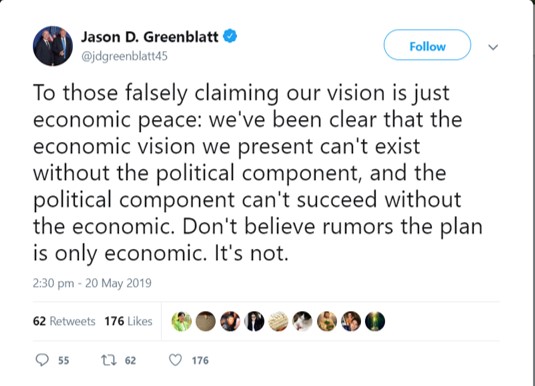
That’s a cogent argument – if one ignores the fact that it’s based on a lie.  In fact, the new peace plan’s architects have been very clear that, while the plan included economic incentives, those are designed to come alongside – not instead of – political solutions.  In fact, Jason Greenblatt – one of the plan’s main architects and, in consequence, one of the very few people who really know what it contains – made that clear repeatedly; including on 20 May, two days before Ms. Svetlova penned her diatribe.

One can argue against the ‘Trump plan’ (if one is inclined to argue against anything ‘Trump’) without resorting to dishonesty.  It would be more than legitimate to doubt, for instance, whether either economic incentives or political solutions can be delivered in practice, given that both the Palestinian Authority and Hamas have already rejected them out of hand.  One can argue that, in the face of that rejection, the ‘Trump plan’ is doomed to fail.

But then, decades of two-state-solution negotiations – including those led by Ms. Svetlova’s own party – have also failed.  It is difficult to see why the same approach that failed umpteen times in the past would succeed this (umpteen + 1) time.  And it is difficult to understand what's to be gained by rejecting a new approach out of hand – before even learning what that approach actually is.

Among the cohort of critics of the yet-unpublished peace plan is the British-Jewish organisation Yachad, which describes itself as “pro-Israel, pro-peace”.  The group is so keen to attack that peace plan, that it even promoted an article from Al-Monitor, a ‘news’ website accused of being a mouthpiece for the Assad regime.

Yachad added their own view:
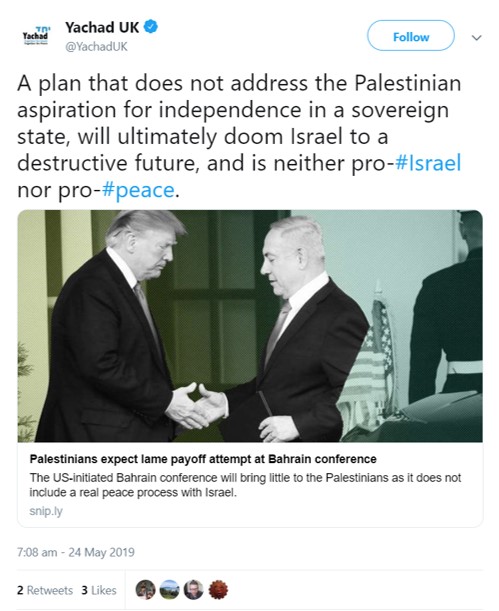

Once I got over my awe at the stentorian tone, I asked myself: how do Yachad activists know what the “Palestinian aspiration“ is?  Beyond the rather neo-colonialist tendency of attributing to other cultures our own ‘way of doing things’?  Of course, the Palestinian Authority/PLO/Fatah screams that aspiration to the entire world.  But what does that count for?  The last (and only) time Palestinians in West Bank, Gaza and E. Jerusalem had something remotely resembling free elections, a plurality voted for Hamas – whose declared goal is certainly not a sovereign state living in peace alongside Israel.

Yachad activists have visited the West Bank and met Palestinians – typically those that are themselves activists on behalf of the same Palestinian Authority/PLO/Fatah.  I have no doubt that, when queried by some starry-eyed Yachad activist, those Palestinians delivered the ‘correct message’.  But, again, what does that count for?

The 'peace activists' will tell you a tale of across-the-board Palestinian rejection of
Trump's plan.  But, as usual, the picture is more nuanced...

As I wrote elsewhere, the Palestinians are certainly entitled to their aspirations.  But what these aspirations actually are, it’s hard to know.  If anything, the more trustworthy opinion polls show them as ambivalent at best on the issue of ‘two-states’.

In fact, I would suggest that, leaving aside the corrupt political class, the Palestinian Arab masses are yet to make up their collective mind as to how their future should look like.  And why would it be any different?  The same can be said about Arab masses at large.  The fact is that Palestinians (like other Arabs) live under dictatorial regimes, with no freedom of speech and political debate.  It does not help that they also live in an ultra-conservative society rife with taboos, in which dissent is frowned upon and worse.

Unlike certain 'peace activists', I do not think Palestinians are stupid.  Why would they 'aspire' to a "sovereign state", if that just means exchanging Israeli occupation for the local brand of corruption-cum-tyranny?  For decades, foreigners and their local allies have tried to tell Palestinian Arabs what they should 'aspire' to: pan-Arabism, Islamism, or perhaps Western-style nationalism...  The one voice we have not heard is that of the Palestinians themselves.  But that does not seem to bother self-proclaimed ‘progressives’ who feel that they know what’s good for ‘the natives’.

Doesn’t it make sense, that, in order to formulate their collective “aspiration”, Palestinian Arab masses (and Arab masses in general) need to have the tools of free expression and the economic wherewithal that would allow them to think beyond tomorrow’s meal?

***
For decades now, ‘peace activists’ have been yelling at me: “Give peace a chance”.  Well, I listened.  And I did: I supported the two-state solution; the Oslo Accords; the withdrawal from Lebanon; the ‘disengagement’ from Gaza.  I rooted for Barak’s proposal, for Clinton’s parameters, for Olmert’s offer.

“You failed”, I tell the ‘peace activists’.  “But no matter, I will still give peace a chance.”
“Not this one”, they respond.  “This one’s different.  It’s wrong.”
“How the hell do you know?” I blurt, befuddled.  “And what’s ‘wrong’ with ‘different’, anyway?”
“Don’t you understand?” they yell, exasperation growing into shrill hysteria.  “This is coming from TRUMP!!!”
I shrug.

Friday, 9 February 2018

Poles apart: Poland, Israel and the Holocaust

If you were a 10-year-old in 1943, you’d now be 85.  Fewer and fewer Holocaust survivors are still alive; there’s just a handful of old people still around, whose testimony has that irreplaceable aura of personal experience.  And – because of that, if nothing else – it’s becoming easier and easier to deny, to trivialise, to distort... Or just to forget.

There’s unique value in remembrance and commemoration: the pain of repeated memory diminishes the danger of the pain repeating itself.

But arguably the most dangerous form of Holocaust revisionism has been silently perpetrated in Europe – for decades now – away from serious scrutiny.

The ultimate, most ‘sophisticated’ Holocaust revisionists do not deny that ‘it’ happened; they might not even deny that ‘it’ represented a unique, unprecedented episode of barbarism.  They just deny responsibility.

Like everything to do with history, the Holocaust is a complex phenomenon.  It brought out the worst in the human race – but also the best.  Unimaginable savagery – and also sublime heroism.

It is a fact that, during the Holocaust, tens of thousands of people – belonging to many nations, including Germans – risked their lives to save Jews.  26,513 of them (belonging to 51 different nations) were recognised as Righteous Among the Nations; and about 6,700 of them were Poles.

It is also a fact that, throughout Europe, Jews have been hunted down, persecuted, tortured and murdered in almost unimaginable numbers with single-minded purposefulness, for a period of time measured in years.  And not just by Nazis or by Germans.

The fact is that the Holocaust was perpetrated by the nations of Europe.  There is hardly a nation on the blood-drenched continent that can claim immaculate innocence: some took active part in the crime, more or less enthusiastically, more or less willingly; others just obeyed orders; a third category profited and a forth just closed their eyes and their ears, their minds and their hearts.

There may be a hierarchy of guilt; but I’m not interested in it.  My point is that the Holocaust is unique not just because so much innocent blood has been spilt; but also, because so many hands are tainted by that blood.

But we live in morally relativistic times and some people don’t deal in facts – they deal in ‘narratives’.  And an insidious narrative is gradually being propagated: the Holocaust happened; we are even going to commemorate it.  But, ‘of course’, it was never ‘our’ responsibility – it was ‘theirs’.  It was the Germans, ‘they’ did it – not ‘us’.

And, of course, it’s not even ‘the Germans’ – they cannot be collectively blamed; it’s just ‘the Nazis’.  And not even everybody who joined the National Socialist Party – more or less willingly; after all, some of them were just small fry obeying orders.

So – there you are – the ultimate Holocaust-denying ‘narrative’: the most horrible crime in history has been perpetrated by a guy with a funny moustache and a small bunch of crazies surrounding him.  It’s ‘their’ fault – not ours.  And those guilty Nazi leaders happen to be all conveniently dead; so no need to do anything special here: no remorse, no introspection, no soul searching, no hands wringing, no heart wrenching – and no moral lesson to be learned.  Let’s just ‘commemorate’ and get it over with.

Let’s be fair here: this ‘narrative’ can be found across the entire continent and beyond; not just in Poland.  The latter’s current government is – at most – guilty of clumsiness in trying to convert the ‘narrative’ into accepted fact – by means of the blunt instrument of legislation.  We should probably be grateful for their clumsiness, for that lack of finesse.  Their ‘elephant-in-china-shop’ moment brought the limelight on a form of Holocaust revisionism that was already thriving in the shadows, carefully nurtured by more experienced, far more skilful operators.

And now it’s in the open.  And it is interesting to analyse the reactions. 

Shocked, mainstream Israeli politicians reacted with equal clumsiness.  Relatively inexperienced opposition leaders like Yair Lapid may be forgiven for expressing outrage on Twitter – though not for gratuitously offering offence.  Yes, Yair Lapid: Poles (like most other nations in Europe) have murdered Jews, persecuted Jews and caused Jews to be murdered.  But no, the death camps in Poland were not ‘Polish’.
Tweet by Yair Lapid

Less forgivable, however, was the knee-jerk reaction of an experienced hand like Benjamin Netanyahu.  He first tweeted something that can be (and probably was) interpreted as a broad accusation of Holocaust denial against the Polish government, if not the Polish nation as a whole; only later did he pick up the phone to try and smooth things over diplomatically.  Now, I’m hardly a handyman myself, but somehow I feel that, if one wants to fix a delicate piece of clockwork, hitting it first with a big hammer tends to be rather unhelpful.
Tweet by Benjamin Netanyahu

Next, an army of Polish and non-Polish antisemites came out of the woodwork.  They flooded the mailbox of Israel’s Embassy in Warsaw and much of the social media with their ‘valuable contributions’: Jews are themselves to blame for the Holocaust, Jews have murdered Poles, Jews are doing to Palestinians what Nazis did to Jews – and other such sweet comments.  You get the picture...

Into the fray jumps Germany’s idiotic Foreign Minister Sigmar Gabriel; who felt it was helpful to declare that Germany – "and no one else" – is responsible for the Holocaust.  It is not clear what makes Mr. Gabriel such an expert on the Holocaust; being the son of a dyed-in-the-wool Nazi is not – in my humble opinion – sufficient qualification.

Some self-appointed ‘liberal Jews’ then felt obliged to put in their tuppence.  Guardian columnist Jonathan Freedland, for instance, starts his contribution by criticising the Polish legislative initiative and proceeds to give a fair and balanced historical account.  Unfortunately, he then gets enmeshed in his own ideological cobwebs: he blames ‘Polish nationalists’ (i.e., the current right-of-centre government) for not owning up to Poland’s Holocaust responsibility – although the policy of whitewashing that responsibility had been initiated decades ago by the country’s then Communist (so ‘internationalist’) rulers.  And then, perhaps in the name of ‘balance’ (read: moral relativism), or just out of habit, Freedland ends up… criticising Israel.
“Predictably, Israel has sought to hit back with a draft law of its own, making it a crime punishable by jail to deny or diminish the role played by those who connived with the Nazis in persecuting Jews.”
Clearly, Jonathan Freedland does not wish to be accused – by the Guardian’s oh-so-non-antisemitic readership – of practicing some form of ‘identity journalism’.  Hence he draws up an equivalence between the Polish and Israeli ‘laws’:
“I am against both the new Polish and Israeli laws…”
Of course, “Israel” hasn’t “sought to hit back”.  The Israeli draft bill that Freedland refers to – a draft which hasn’t even been formally debated, so it’s certainly no ‘new law’ –  wasn’t initiated by “Israel”.  It wasn’t even an initiative of the Israeli government (or of ‘Israeli nationalists’, as Freedland would probably put it): it’s actually been proposed by a left-of-centre legislator.

I don’t blame Freedland’s intentions as much as I fault his intellect; but, whatever the reason, after browsing through his learned article about Poland, what a large proportion of the readers will take away is yet another instance of “Israel” aggressively “hitting back”.

One can dismiss the stupidity of self-enthroned ‘liberals’ with a sigh or a resigned shrug; but the self-hatred of far-left activists makes my blood boil.

Uri Avnery is not just any far-left activist – he is a political dinosaur whose biography makes for entertaining – if somewhat embarrassing – reading.  Avnery is Israeli and very much alive – but only because nobody ever took his proposals seriously.  For instance, the one he made in 1947, which would have seen the establishment not of the State of Israel, but of a grand ‘Semitic Union’ made up of Palestine, Transjordan, Lebanon, Syria and Iraq.  One can only imagine how well a tiny Jewish minority would have faired in that ‘Grand Union’; but the fate of other ethno-religious minorities (Christians, Kurds, Yazidis) provides some helpful clues to help our imagination…

Avnery has always considered himself ‘progressive’; which is why, by 1952, he enthusiastically called for ‘preventive war’ against Egypt’s ‘reactionary regime’.  A few years later, however, that regime made friends with the Soviet Union; so Avnery turned to advocating war against a new ‘reactionary’ adversary: the Hashemite dynasty of Jordan.

If ‘reactionaries’ incurred Avnery’s ire, he had a soft spot for the ‘progressive’ PLO Chairman Yasser Arafat, whom he embraced personally long before the latter renounced – however reluctantly and insincerely – the path of terrorism.

With such an ‘illustrious’ track record, Avnery does not have much of a constituency in Israel – but he writes for foreigners less aware of his ‘past achievements’.

His latest article addressed the Polish Holocaust Law controversy by… bashing Polish Jews:
“Rachel happened to enter a clothes shop and hear the female owner talking with a customer in Polish. Still full of her discovery, Rachel asked the owner: ‘Did you know that the Nazis also killed a million and half non-Jewish Poles?’The woman answered ‘Not enough!’Rachel was amazed. So was I.We knew, of course, that many Polish Jews did not like the Polish people, but we were not aware of the intensity of this hatred.THIS HATRED reappeared in full force this week.”
Needless to say, the shop-owner’s remark is beyond contempt.  But one Polish Jew’s disgusting words should hardly be sufficient reason for anyone (let alone someone as ‘progressive’ as Avnery) to sling mud at an entire community.  If I heard one black person saying that all white people deserved to die, I wouldn’t interpret that as meaning that ‘many black people’ hate whites.

Well, I guess I’m not ‘progressive’ enough.  Because, when it comes to Jews and Israel, self-described ‘progressives’ undergo a strange metamorphosis: they actually resort to racism, rather than combatting it; they employ sweeping generalisations based on handpicked anecdotal evidence; and they find themselves defending positions that – theoretically at least – should thunderously collide with any progressive’s world view.

Avnery finds himself defending the Polish law; a law which, irrespective of one’s reading of history, amounts to criminalising opinion and penalising free speech. 

Avnery, of course, was a fierce critic of Israel’s so called ‘anti-boycott law’.  If anything, however, the Israeli law is much more liberal: it does not criminalise dissent, it does not seek to send people to prison for whatever they think or say; it is a tort law: it only makes people responsible for the financial losses they may cause by promoting boycotts.  So why does Avnery defend the draconic Polish law, while condemning the comparatively tolerant Israeli law?  Because condemning Israel and defending whoever appears to be anti-Israel has become part of the far-left’s gut instinct, of its DNA.


But what’s the right answer?  How should Poland confront its Holocaust ghosts – with realism and dignity?  Well, I found a model – a good example to follow.

It’s a document published by the Ministry of Local Government and Modernisation of Norway and entitled ‘Action plan against antisemitism 2016–2020’.  To be honest, the plan itself is worthless – just a load of empty words.  But the introduction includes a short section entitled ‘The Holocaust in Norway’.  It’s very short, very dry and frigid like the Norwegian winter – but also happens to be very true.  I reproduce it here in its entirety:
“During the Second World War, 773 Jews were deported from Norway to Nazi mass extermination camps.  Only 38 of those who were deported survived.  Almost one-third of the Jewish population in Norway was brutally murdered during the Nazi genocide – simply because they were Jews.  The order to deport Jews came from the German authorities in Norway.  The Nazified State Police initiated the order, registered and arrested the Jews.  The Norwegian police also participated in the arrests, along with members of the paramilitary unit of the Norwegian Nazi Party “Quisling’s Hird” and Germanic SS Norway.  The police action against the Jews on 26 November 1942 was the largest in the history of Norway.  All Jewish assets and property were confiscated, on the initiative of the Norwegian Nazi party “Nasjonal Samling”.  Members of the civil service, taxi drivers and civilians were also involved in the actions.  Around 1,200 Jews managed to escape arrest, most by fleeing to Sweden.  The majority of the Jews who fled were assisted by groups affiliated with the Norwegian organised resistance movement, but friends and neighbours also helped them escape.  When the Jews who survived the Holocaust returned to Norway after the Second World War, they encountered a bureaucracy that did not take their human or material losses into account.  For many of them, it was very difficult to reclaim lost assets, businesses and homes.  The state refused to pay out inheritances unless a death certificate was presented, which was impossible for the Jews who had lost family members in the concentration camps to obtain.  Some people had to go to court to get their property and assets back.  The restitution settlement – compensation to the Jewish minority – was paid in 1999 on the basis of a recommendation in Official Norwegian Report NOU 1997: 22 The confiscation of Jewish property in Norway during World War II.  The settlement was both collective and individual.  980 individuals received compensation.  The collective settlement has been divided between three main causes: a fund whose return will be used to safeguard Jewish culture and presence in Norway; international support for the revival of Jewish cultures; and to create a centre of knowledge, education and documentation about the Holocaust and the situation of Jews and other minorities.  The Norwegian Centre for Studies of the Holocaust and Religious Minorities was established in 2001.  In 2012 the then Norwegian Prime Minister Jens Stoltenberg issued an apology for the role played by Norwegian police officers and other Norwegians in the arrest and deportation of Jews.  The National Police Commissioner and the Norwegian State Railways (NSB), whose trains were used to transport the arrested Jews, have also officially expressed their regret that this could happen.”
And that’s all: ‘during the Holocaust, Jews were killed in Norway; some Norwegians helped kill them; some Norwegians saved Jews.  The Norwegian state was incredibly unsympathetic towards survivors.  Apologies were uttered – better late than never.’  The Norwegian document spells it all out – in less than 500 words: the good, the bad and the ugly; the Truth.

Of course, what happened in Poland is not exactly the same as what happened in Norway.  But there is enough similarity for the Norwegian text to provide a helpful template for a Polish one.  The document did not besmirch Norway’s dignity; it saved it.  It did not provide consolation, let alone restitution; but it delivered at least a measure of symbolic justice.


Rather than attempting to legislate away a guilty conscience, the Polish government – nay, the Polish state – should produce a similar type of precis.  For the sake of my dead relatives – may they rest in peace in their unmarked, unknown graves; for the sake of your own humanity: let God’s Truth be spoken, written, proclaimed, screamed from the rooftops.  And may it be Thy will, our God and God of our forefathers – Whose name is Truth – that the Truth shall set us all free: of guilt, of bitterness and of hate.
 
;