Showing posts with label European Union. Show all posts

Wednesday, 9 December 2020

The real 'oven-ready' deal

 As I write this, UK Prime Minister Boris Johnson is on his way to Brussels, there to meet EU Commission President Ursula von der Leyen.  The two ‘principals’ are supposed to do their darndest to undo the plonter in the bilateral negotiations and find a ‘creative’ compromise towards a deal.  This is the latest move in an intricate dance that – everybody knows – will only end when it absolutely needs to.

In the run-up to this ‘crucial meeting’, the two sides did what they do best: jockeyed for positions.  As for us, the public, we are being told (by countless journalists and politicians) that the negotiations now boiled down to resolving three issues:

  • - EU fishing quotas in UK waters;
  • -; ‘Level playing field’ rules;
  • - Who/what will police the deal.

It is the same story: whichever paper you read, whichever channel you tune into, you’ll read or hear journalists and politicians parroting what they heard from others – adding to it only their own ideological slant and their sense of self-importance.  Most of these journalists and politicians don’t know what they’re talking about; the others are just lying to us.  The truth is that these ‘issues’ are either unimportant or very easy to solve.  They are (or can be, given the political will) non-issues.  Here is why.

The fishy issue

As long as UK was a member state (and in the transition period following Brexit) EU fishing rules – the so-called ‘Common Fisheries Policy – applied.  This sets quotas for each member state and per each species of fish.  Currently, it allows both British and EU boats to fish in British waters – up to the set quota.  In practice, this means that EU boats catch much more fish in UK waters than British boats catch in EU waters.  Come 1 January 2021 and in the absence of a deal, the UK could in principle keep all the fish for itself and not allow anyone else access to what is, legally speaking, a national resource.  This would negatively affect EU fishermen, especially those from neighbouring countries: France, Belgium, Netherlands, Denmark…

Nah, those fish cannot be saved.  They'll go into the pan...

That much is true.  But, when the Economist calls the issue “political dynamite,” that’s bollocks; when French President Emmanuel Macron threatens to scupper the deal over the percentage of fish available to the EU – that is posturing.

For both EU and UK, fishing is a minor economic issue.  We are talking truly ridiculous numbers: the total value of fish caught by EU boats in UK waters is somewhere around $0.6 billion.  For comparison, EU’s total economic output is estimated at $18,000 billion.  In other words, we are talking about 0.0033% of EU’s ‘GDP’!  In terms of employment, fishing provides a means of livelihood for just under 100,000 EU ‘nationals’.  This is almost 0.05% of the entire EU workforce, but only a small fraction of those fishermen ply their trade in British waters.  Measured in FTE (Full-Time Equivalents), France boasts an ‘army’ of 6,623 fishermen – some of whom may even vote for Macron, provided he displays enough Gallic belligerency on their behalf...

‘Level playing field’

If fishing is “political dynamite,” this one’s the equivalent of a nuclear bomb.  Currently, British and EU regulation is practically the same, ensuring that British and European countries can compete fairly in both markets.  Come 1 January 2021, the UK would, in principle, be able to change the rules, reducing the costs and/or boosting the profitability of British firms.  The British government may reduce environment protection obligations; it may improve productivity by forcing employees to work longer hours; it may reduce consumer protection standards; it may even decide to subsidise certain industries.

We must ensure a level playing field forever!

Let’s say that British and European firms both make a particular widget, which is currently priced at €100 per widget.  To manufacture it, companies have to buy Raw Material – also manufactured in the EU and costing €50 per widget.  Raw material is also available from Chinese suppliers at €30 per widget, but such Raw Material contravenes EU’s strict environmental policies and is hence verboten in Europe.  Post-Brexit, however, the British government can in principle decide that the environmental issue isn’t that important, or that it can be mitigated.  If it allows them to buy Chinese Raw Material, British firms would be able to undercut EU companies, potentially pushing them out of the market.

It’s not just about China; in fact, the EU more worried about potential supply of cheaper products from the US.  The European powers that be have worked for decades to keep certain US industries out of the common market – not because they are more littering, but because they are more efficient and can therefore supply cheaper products.

EU’s proposed ‘solution’ to this was that the UK pledges to use the same rules as the EU.  But that would make a mockery of Brexit and would constitutes a particularly painful form of political suicide for any Conservative government.

The British concession was the so-called ‘non-regression’: as part of the deal, the UK would pledge not to lower the regulatory requirements below the current levels – which are aligned with those of the EU.  But European politicians were quick to point out that the EU constantly raises its standards.  So accepting merely ‘non-regression’ may, in the future, still result in a competitive advantage for British firms.  In the words of German Chancellor Angela Merkel:

“We need to have a level playing field not only for today, but for tomorrow, and the day after that.  Otherwise the result will be unfair terms of competition, which we cannot impose upon our businesses.”

Mrs. Merkel’s ‘offer’ was that the deal should include provisions allowing the EU, in the event of ‘unfair’ British regulation, an ‘automatic right’ to retaliate – for instance by curtailing access to certain markets for British goods and services.  But, beyond being unpalatable to any ‘sovereign’ British government, such provisions would be exceedingly complex to design and implement.  What constitutes an ‘unfair’ change in regulation?  Who will determine what is or isn’t ‘unfair’ as opposed to just ‘different’?

This seems like an insoluble conundrum.  In fact, an Irish politician called it an attempt to “square the circle”.

But it’s all just smoke and mirrors.  There is a very straightforward solution: rather than attempting to be restrictive or prescriptive in terms of ‘level playing field’, the deal should simply allow either side to unconditionally terminate the agreement (in its totality, not partially), with – say – one year notice.  This means that, if it feels that the agreement does it more harm than good (for instance, that British firms are enjoying an unfair advantage and are therefore undermining the ‘health’ of the single market), the EU would be able to bail out long before that vaunted single market sustains significant damage.  The one year transition period would allow government agencies and companies to adapt to the new reality.  And, if the agreement is terminated, we would all be no better and no worse than with no deal in the first place.  But the risk of termination would be – I dare say – exceedingly small: the two parties would be more likely to negotiate away small hiccups and weigh eventual drawbacks against broader advantages.  What’s more, any issues would be assessed for their real impact – rather than for the imagined future risks.  From afar, the shadow of an anthill can often be mistaken for a steep mountain!

An unconditional right of termination would ensure that this will always be a relationship between two willing partners; it would defuse the suspicion that it may at some point turn into an unhappy catholic marriage.  And this brings me to the next ‘major area of disagreement’…

Who/what would police the deal

What happens if one of the signatories believes that the other has violated the terms of the deal?  Who is going to interpret what’s been agreed – and make a determination as to what constitutes ‘the terms’?

The EU wanted its own ‘Court of Justice’ to make those determinations.  ‘Keep dreaming!’ responded the Brits.

There are, of course, solutions – international treaties often include complex clauses designing bespoke processes of conflict resolution.

But here’s the thing: international treaties are extremely difficult (and often impossible) to enforce.  If you want an example, look no further than the ‘transition deal’ between EU and UK.  The ink has hardly managed to dry on those pieces of paper, before the UK government introduced a bill aimed at ‘clarifying’ its obligations and ‘protecting the UK’ from ‘extreme EU interpretations’ of what’s been agreed.  Government officials have serenely admitted that the draft bill violated international law, albeit only in a “specific and limited way” (rather than in a general and unbounded manner, presumably!)

This may sound unpleasant to certain hypocrites and wishful thinkers; but the reality is that a sovereign state cannot – except in the most extreme circumstances – be forced to comply with ‘international law’, or with treaties it signed.

So the best – nay, the only – guarantee that an agreement will be complied with is making sure that it is and remains in the best interest of its signatories.

Luckily, he is protected by International Law...


An unconditional termination clause would make ‘policing the deal’ and ‘conflict resolution processes’ superfluous.  It is catholic marriages that account for the most acrimonious divorces – just ask Henry VIII!

So why are they fighting?

But, if the ‘major areas of disagreement’ are actually non-issues, why this prolonged, painful ‘process’?  Why the rancour, the recriminations, the bitterness?

To understand this, one has to appreciate that the European Union has long ceased to be about economics.  In the 1975 referendum, the UK voted to enter the Common Market – an economic bloc; in 2016 it voted to leave the European Union – a political project.

Consequently, the conflict between the UK and EU isn’t about the economy, as we are being led to believe; it is about ideology.  Nothing exemplifies this better than a recent Twitter-facilitated ‘conversation’.  On 2 December 2020, UK Secretary of State for Business, Energy and Industrial Strategy Alok Sharma posted:

“The UK was the first country to sign a deal with Pfizer/BioNTech - now we will be the first to deploy their vaccine

To everyone involved in this breakthrough: thank you

In years to come, we will remember this moment as the day the UK led humanity’s charge against this disease”

I’m no fan of the Rt. Honourable Sharma; one can dispute the taste he displayed in an official tweet that sounded like the boastful cheering of a football fan.  But that’s not what he was criticised for.  No, Mr. Sharma’s tweet was criticised for being nationalistic.  Within 3 hours (which is warp speed in diplomatic terms), a certain Andreas Michaelis, Germany’s Ambassador to the Court of St. James, weighed in – also on Twitter:

“Why is it so difficult to recognize this important step forward as a great international effort and success. I really don't think this is a national story. In spite of the German company BioNTech having made a crucial contribution this is European and transatlantic.”

Listen to the music: the German envoy wasn’t objecting because Mr. Sharma omitted to give credit to the vaccine’s ‘German connection’.  No, he was annoyed by Sharma’s expression of national pride.


And therein lies the difference: born as a sensible economic alliance, the European ‘Union’ is now an ideological movement – one that aims to gradually wipe out the nation states in favour of a new (some would say ‘artificial’) European identity and its political manifestation: a supra-national entity (some would call it an empire).  Hence the relentless push against any trace of ‘nationalism’ – even the mild, benign form that many would call ‘patriotism’; hence the instinctive, knee-jerk reaction against manifestations of such ‘nationalism’ – whether in the UK, in USA, or elsewhere; hence the hostility towards Israel – the embodiment of such ‘nationalist’ aspirations.


The problem the EU has is that this ideological push does not really have much to show in terms of popular support; it is the dream of a political, economic and intellectual elite, which is promoting it without much consultation with those they seek to re-educate and re-mould.  Consequently, as the push towards ‘multilateralism’ and ‘European identity’ advanced, so did the (generally hostile) popular reaction to it.  What’s worse, from the point of view of the promoters of ‘the European project’ is that the initially diffuse popular reaction soon drew the attention of politicians eager to ride that ‘populist wave’.  There is, within the EU itself, a rising ‘Euro-sceptic’ sentiment, a centrifugal tendency that worries the ‘internationalists’.

Brexit was, of course, by far the most powerful manifestation of that tendency – and it has shocked and shaken the ‘Union’ to the core.  The worst nightmare of the ‘Europeans’ is another ‘exit’, a second member state that would decide to contradict the ‘EU line’ ideologically and cross it politically.  That would be, from the point of view of the ‘European project’ a disaster.  The ‘Unionists’ must avoid it at all costs and ‘sell’ Brexit as a complete outlier, a regrettable setback and – most of all – as an unmitigated mistake.

Hence, from EU’s point of view, Brexit must be (or at least must look like it is) very painful for the UK; and if pragmatic interests (economic and political) have to be sacrificed in the pursuit of that ideological imperative – so be it.  On the other hand, they cannot go too far: EU’s economy is already on its knees; and a spurned UK would be a loose cannon aimed at the European prow.

My conclusion is that a EU-UK deal is not just a possibility – it’s the only possibility.  The ‘solutions’ to all the ‘major disagreements’ are simple; a deal could have been signed months ago.  But that’s not to say it will be signed today, tomorrow or by 31 December.  It might indeed; or it might not – if the EU powers that be feel that they can afford to postpone it to 2021.  Paradoxically, Biden’s election makes the latter outcome more likely.  But postponing has a price – and not just an economic one: once the UK absorbs the ‘birth pangs’ of the new situation, the British government’ desire to do the deal will go down a notch, with the result being a stiffening of its position in the ensuing negotiations.  Meanwhile, the EU will have to absorb a few pangs of its own; and, since they will not be equally felt by the various member states (Ireland, for instance, will feel more pain than Austria), the vaunted ‘European unity’ may start to fray at the seamline of opposing interests.

As for us… We the People will continue to be misinformed by lazy and incompetent journalists; deceived by scruple-less politicians; and generally treated with contempt by arrogant fools with a superiority complex and a sense of entitlement.  Until (not unless!) we do something about it.

Friday, 10 April 2020

Epidem-ideology: how political dogma affected the response to Covid-19

According to an opinion poll published on 15 March by NBC/Wall Street Journal

I just looked up the data: worldwide, the number of deaths caused by Covid-19 is fast approaching 100,000.  It will probably run past that heart-breaking milestone, by the time I finish writing this.

Italy is (still) the country most affected: with a population of 60 million, it registered more than 18,000 Coronavirus deaths – that’s 300 per million inhabitants.  Italians have already spent weeks in lockdown.  The Italian economy – not very healthy to start with – is in intensive care and may never completely recover.

South Korea has a somewhat smaller population: 51 million.  But its death toll currently stands at just 208 – 4 deaths per million inhabitants.

Why this huge difference – no less than two orders of magnitude in mortality rates?  I could tell you that there are many reasons, that they are complex, that we are studying them carefully…  But I’m not a politician and – even more so under the current circumstances – am disinclined to muddy the waters.

We find a hint about the reasons for the Italian-Korean disparity in a recent interview with Italy’s Prime Minister Giuseppe Conte.  Asked whether his government’s response had not been ‘too little, too late’, Mr. Conte doubled down:
"We have a completely different system to China. For us to severely limit constitutional freedoms was a critical decision that we had to consider very carefully.  If I had suggested a lockdown or limits on constitutional rights at the start, when there were the first clusters, people would have taken me for a madman."
Mr. Conte is probably right: some people, perhaps many people, would have taken him for a power-grabbing madman, had he imposed “limits on constitutional rights” too early in the process.  But then, isn’t this what a leader is expected to do – make unpopular, but timely and efficacious decisions in an emergency?  Spot the iceberg ahead before it becomes obvious to the naked eye – and veer hard to avoid it, even if it rocks the boat and nauseates the passengers?  Otherwise, Mr. Conte, nobody needs you: let’s have governance by opinion poll!

The cruel, brutal, heart-wrenching irony is that Giuseppe Conte has not protected constitutional rights: his government ended up imposing a tougher, longer and more painful lockdown than the South Koreans ever experienced.  In the process, he trampled the most important constitutional right of all: the right to live.

In South Korea, legislation allows the government – in times of emergency only – to access essential information, such as the telemeter data from mobile phones, the location of credit card transactions, etc.  Some may see it as a ‘Big Brother’ invasion of privacy.  But that information is collected anyway – in the databanks of telecom companies and financial firms.  And access to it is crucial to containing the pandemics, by locating and isolating early people who came in contact with already identified virus carriers.  In Israel, there is even an app for that: one can register on that app and check for him/herself whether they have been in the immediate proximity of a known virus carrier.

Of course, this does not provide full-proof (or even fool-proof) protection; it does not kill the infection – but it prevents it from killing too many people.  Would you suspend for a while – just for a while – your oh-so-dear right to perfect privacy, if you knew it may save one life?  Or 10?  Or thousands?  I know I would!

Of course, I know the dangers: ‘it’s a slippery slope…’, ‘once there’s a precedent…’, ‘ give them one finger…’, etc. etc.  But hey: as Mr. Conte said, we do not live in China.  We are lucky enough to live in countries with a tradition of democracy, with governments that are elected and accountable.  The risks are there, yes, but so are the solutions; we can deal with those risks after we save those old and vulnerable (or just unlucky) among us.  Denying ourselves the means to save people’s lives in an emergency, just because those means may be misused later?  That’s like not calling armed officers during a terrorist attack – to pre-empt the risk of future police brutality against peaceful protesters.

But it’s not just about accessing data – there is more misplaced ideological ballast that should have been thrown overboard, once that iceberg first appeared onto the radar screens.

Italian Prime Minister Giuseppe Conte and
President of the European Commission Ursula von der Leyen.
No, they do not congratulate each other for their response to Covid-19. 
For a certain tinge of politicians, political activists and just loud-mouthed scatter-brains, ‘freedom of movement’ has morphed from a desideratum to be considered and adopted where beneficial – into the be-all and end-all of ‘progressiveness’ and political correctness.  To the point where they now see it as an immovable principle – circumstances be damned.

As early as 24 January 2020, France had identified three cases of Covid-19 on its territory – all three imported from China.  A month later, Italy had announced its third Covid-19 death.  Yet on 29 February, as the infection was expanding like fire in a pile of dead wood, the pompously named – but poorly led – World Health Organisation was issuing the following ‘wise’ recommendation:
“WHO continues to advise against the application of travel or trade restrictions to countries experiencing COVID-19 outbreaks.”
Needless to say, the European Union bureaucrats were only too happy to comply with – and reinforce – that mind-boggling advice.  As late as 2 March 2020, as no less than 66 countries were reporting Covid-19 cases, the European Centre for Disease Prevention and Control was serenely assessing:
“The risk of acquiring the disease for people from the EU/EEA and the UK travelling/resident in areas with no cases, or multiple imported cases, or limited local transmission, is currently considered low to moderate.”
In blissful accordance with the EU ‘multilateral’ and legalistic approach, ECDC also advised that
“Travel and trade restrictions during a public health event of international concern (PHEIC) are regulated under the International Health Regulations (IHR), part III.”
Well, this is what ‘the experts’ said, but what about the politicians?  The ones elected to keep us all safe?  The captains charged with steering us away from death and misery?

On 22 January 2020, the annual World Economic Forum was taking place, as usual, in the beautiful, tranquil ski resort of Davos.  Defying that tranquility, some experts chose that posh gathering of international figures to ring the alarm bells about a strange pandemic that was already devastating Wuhan.  A former US disease control czar named Dr. Richard Hatchett was among the first to spot the approaching iceberg:
“China was unfortunate in that that’s where the epidemic started, but it is now a global problem.”
Few of the politicians paid attention.  The newly-elected (appointed?) European Commission President Ursula von der Leyen did not even mention the pandemics in her hour-long speech.  The address was, instead, laden with all the formulaic niceties politicians use when they have nothing particularly interesting to say.

Of course, European politicians are not stupid enough to rely on EU Commission’s clairvoyance at the best of times – let alone when flying excrement hits the proverbial fan.  Give it a bit of strain (let alone a global pandemic) and the ‘Union’ dis-unites into national governments driven by the good ol’ ‘each man for himself’ attitude.

So on 31 January, the Italian government banned flights to and from China.  Of course, to describe this as ‘closing the stable door after the horse has bolted’ would be charitable.  In fact, while people could no longer fly directly from Beijing to Milan, they could still fly there via Berlin, Paris or Vienna; they could even drive or train it across the beautiful Alps – and the Schengen Area’s non-borders.  No, this was definitely a case of closing the door of a stable that had no walls.  If you, dear reader, think that this is particularly stupid… well… I can’t really blame you.  But then, you must remember that the Italian prime minister’s main concern was not keeping his people healthy – but keeping them from doubting his own mental health.  He needed to accomplish that difficult task – while also being seen as ‘doing something’.

On 25 February, a gaggle of European health ministers met in… Rome.  Where they sagely decided that imposing a travel ban within the EU would be “disproportionate and ineffective”.

It’s not that the EU Commission was oblivious; no, they were widely awake to the danger posed by Covid-19… to Africa’s weak healthcare facilities.  On 13 February, they attended a presentation by World Health Organisation officials, who warned that the entire African continent had only two laboratories able to test for Coronavirus.  Consequently, on 24 February, EU commissioners announced a donation of €114 million to WHO and €15 million earmarked for African lab facilities.  An ample Commission delegation flew to Addis Ababa on 26 February, for a series of meetings with African Union officials.  (The only thing that the European Union and the African Union have in common is the word ‘Union’; but hey: it’s such a powerful word!)

At the time (and still today) Africa was the least affected continent.  No, not because of the abundance of testing labs and ventilators – far from it; just because… most Africans don’t travel that much, and not that many people travel to Africa.

Why, then, you may ask – the focus on Africa?  Well, it’s just another instance of ideological – rather than logical – decision-making: a large part of the European political class is constantly on the look for ‘weak and oppressed’ to save; even when they don’t particularly need saving.  That admirable attitude comes with quite a pinch of racism: Africans are seen as the eternal victims, the world’s quintessential ‘weak and oppressed’.  It’s the new ‘white man’s burden’; but also a well-tried way for a ‘privileged white person’ to feel good about him/herself.

And it’s not just career politicians – the same frame of mind has infected the layer of professional political activists who like to – rather pompously – refer to themselves as ‘civil society’ or ‘human rights organisations’.  By the beginning of April, the number of Covid-19 deaths in the UK was edging towards 3,000; the country had already spent a week under lockdown.  An even tougher (and earlier) lockdown had been declared in Israel, where there were already dozens of deaths.

Yet two ‘pro-Israel’ outfits decided to convene a (virtual, because of the lockdown) ‘emergency briefing’ on… the dire Coronavirus situation in the Gaza Strip (which, ironically thanks to the Israeli-Egyptian blockade, had 9 already isolated cases and – fortunately – no deaths).  I read their advert twice, to make sure this was no April Fools joke.


It wasn’t – it was dead serious.  Yachad UK and New Israel Fund UK had entrusted the ‘emergency briefing’ to a couple of ‘civil society’ representatives from Israel and Gaza, chaired by Donald Mcintyre – a journalist/political activist with The Independent with a history of very harsh anti-Israel ‘criticism’.  Mr. Mcintyre had also in the past blamed the failures of British foreign policy (revoltingly pro-Israel in his opinion) on “Jewish party donors”.  But hey: why should valiant builders of the ‘New Israel’ disqualify someone for chairing their briefing, merely because he is suspect of harbouring antisemitic prejudice?

Anyway, I was interested to learn from that most absorbing briefing that, according to international law, Israel is responsible for everything that happens (or might happen, or could conceivably happen) in Gaza.  I must admit that my knowledge of international law cannot compete with the expertise of those civil society luminaries.  Still, I was wondering how exactly was Israel supposed to discharge that clear responsibility – given that any Israeli who ventures onto the Strip is imprisoned – if not immediately killed?

By the way, I tend to focus on the failures of European leaders and ‘civil society’ simply because I happen to live in what is – only arguably by now – Europe.

Not that the US administration – which comes from a rather different ideological neck of the woods – did much better.  Trump started by dismissing the whole thing as leftist exaggeration – if not outright fake news designed to hurt the great American economy and his own chances of re-election as President.  After all, no sensible virus would take on the might of the United States – now would it?  

But, by 12 March, with South-Western Europe claiming a rather inglorious leadership in Coronavirus pandemics, the US imposed a 30-day travel ban on the entire European Schengen Area.  With hindsight, this was a modest and very, very belated step in the right direction.  But one that immediately attracted the bitter ire of European freedom-of-movement ideologues.  Indeed, EU officials condemned the new Trumpian heresy in the strongest terms.  A prominent Belgian MEP (from the Green Party) called Trump’s decision “irresponsible”.  A physician by training, she delivered that sage verdict in a TV studio, while sitting face-to-face with her interviewer.  Then she turned her attention to more burning issues: the (harsh, in her opinion) EU asylum policy; and the bloc’s far-from-sufficient cuts in carbon emissions.

But only 5 days later (17 March) the EU chiefs were imposing a ban on travel into the Schengen Area.  By then, however, they were just desperately trying to board a train that was already moving away – as several Schengen countries had already re-instituted border checks…

On 23 March, Italy reported 602 Coronavirus deaths in just 24 hours; the total number had exceeded 6,000.  On the same day, EU foreign policy chief Josep Borell announced that the bloc would send €20 million in humanitarian aid to I… no, not I-taly, but I-ran!  Which had just announced 127 new deaths in 24 hours, bringing the official count to 1,812.

No doubt, the Italian prime minister (whose mental sanity must by now be well-established with his co-nationals) had that little Iran detail in mind when he bitterly declared, in a recent interview, that the “European project” might fail over its response to the pandemic.  But I’m positive Mr. Borell will reassure him that it’s nothing personal: helping Iran, rather than Italy, is just deep-seated EU ideological impulse.

As for myself, I'd like to reassure Mr. Giuseppe Conte that he is not alone: I, too, am most concerned about our “constitutional rights”.  I think we have the right to be led by people endowed with leadership qualities and a sense of civic responsibility.  We have the right to demand that those leaders (politicians, civil servants and ‘experts’) wean themselves from the intoxicating political dogma; that they check their ideological baggage in at the gate – before they start making decisions about our life and death.  Because, if they keep betraying their oaths of office; if they get it wrong by placing ideology before epidemiology – I say we have the right to demand a reckoning.

Saturday, 31 August 2019

Israelis, Palestinians and ‘Love Island’

I have a confession to make: I am one of those few weirdos who never bothered to watch an episode of Love Island.  Which is why my knowledge of this TV show is second-hand at best; and why using this metaphor is – I have to admit – a bit of a cheap trick to get you hooked, dear reader.

I understand the attractions of love – but why on an island?  Perhaps because islands have that strange allure: they are constrained geographies suggestive of enforced isolation from without and imposed intimacy within.

From Gauguin to Attenborough, from Defoe to Swift, we’re all fascinated by islands.  They are world’s quintessential test tubes: riveting experiments in natural and social eccentricity.


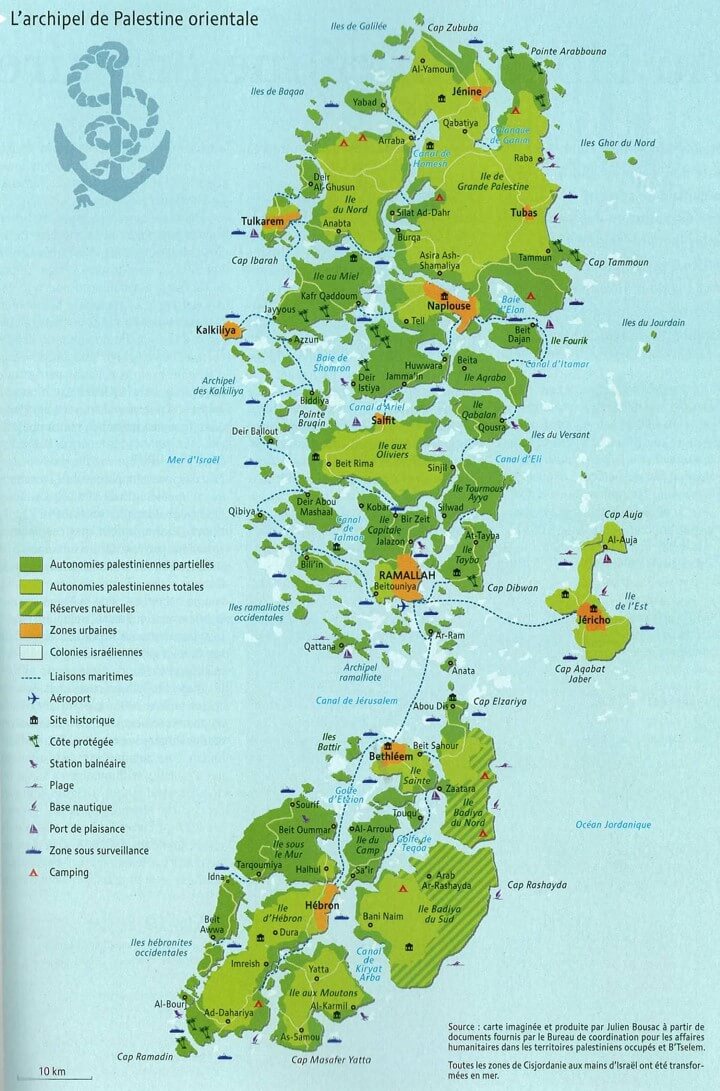
With their rich, often over-the-top imagination, ‘pro-Palestinian’ activists could not possibly have missed the metaphoric potential of islands.  They harnessed that potential ‘for the cause’ by portraying the Palestinian Authority-governed areas of the West Bank (defined in the Oslo Accords) as an ‘archipelago’ of small islands in a ‘sea’ of Israeli ‘settlements’.  Such allegoric maps travel far and reach wide; their message is clear: a patchwork of Palestinian ‘islands’ cannot be turned into a viable state.


Not satisfied with the mere allegory, some activists are shouting that message in full-throated, indignant, moralising voice: it is too late for the two state solution.  Often, they blame Netanyahu and ‘his settlements’; but Seumas Milne (a former journalist and currently top courtier to Labour Party leader Jeremy Corbyn) suggested, even 15 years ago, that the two-state solution was no longer achievable.

Among certain ‘pro-Israel’ activists (and even among some Israelis), such suggestions are a source of dread and despair.  In the absence of a Palestinian state, they say, Israel’s choices are grim: either ‘one-state’ in which Jews will be (or will quickly become) a minority; or else an apartheid state – in which the Palestinians won’t possess full political rights.

A recent Jewish Chronicle article quotes Tal Keinan, an American-Israeli businessman and former Israeli fighter pilot, who argues that there are “only three possible endgames” for Israel:
"The first is that Israel could annex the West Bank and give its Arab residents citizenship – which would mean Israel ‘opening itself to the prospect of demographic suicide’. […]
The second option would be to annex the Palestinian territories without granting the Palestinians citizenship – imposing sovereignty on a large number of people without representation. […]
The final option […] is for Israel to withdraw from most of the territories, with or without an agreement with the Palestinians. If the Palestinians build a state, there will be a state, but if not, the West Bank ‘will likely become another rocket base’."


So there you are: the options are oblivion, apartheid or being bombed to smithereens.  As the current British Prime Minister would put it, doom or gloom!

There’s a debate to be had on whether it is indeed too late for the ‘two state solution’; and whether lack of ‘full political rights’ equals ‘apartheid’.  But I do not wish to go there now.  My question is: are those ‘3 choices’ really the only possible ‘endgames’?  Or are the prophets of doom merely demonstrating their own stale thought processes, their own lack of imagination and creativity?

I am fascinated by islands.  They are such interesting places!  Let’s let our minds travel to a few islands – and see what we can learn.

A ‘Great’ Britain with some little ‘dependencies’

To start with, I won’t have to travel too far: I live on the island of Britain, which some (both on and outside it) still sometimes call ‘England’.  But it isn’t ‘England’ – the island of Britain is part of a sovereign state called the United Kingdom of Great Britain and Northern Ireland.  Although it is not formally called a federation, this is in fact a federal state made up of four ‘countries’: England, Scotland, Wales and Northern Ireland – each of them endowed with a great deal of political, economic and cultural autonomy.  Nonetheless, there are nationalist movements in each of these ‘countries’, aspiring to more autonomy and even to outright secession from the federation. 

I have recently travelled to Scotland, where great efforts are being made to revive and expand the use of Scottish Gaelic.  Upon return to London, I discovered that I still had a pocketful of Scottish banknotes.  The ‘Scottish pound sterling’ is worth exactly as much as the ‘British (not English!) pound sterling’; but the banknotes are underwritten by the Royal Bank of Scotland and bear different images from their ‘British’ counterparts.  Those strange-looking banknotes may be legal tender throughout the UK; but they are, let me tell you, viewed with suspicion by London retailers, many of whom seem to see them for the first time.

Another ‘country’ – Wales – occupies a peninsula in the West of Britain.  Wales is very similar in size to Israel, but it is less densely populated.  The vast majority of its inhabitants speak English and only one in five has Welsh as their mother tongue.  Still, Welsh is an official language in Wales, on a par with English; no expenses are spared – everything (from road signs to court summons) is written in both languages.  And children have to study Welsh in school, whether they have any use for it or not.

But ‘Great’ Britain is not as interesting as some of the smaller islands off its coast.  Take for instance the Isle of Man, a territory just one-and-a-half times the size of Gaza Strip.  The Isle isn’t part of the United Kingdom; nor is it a sovereign, independent state.  It is, instead, defined as a ‘British Crown Dependency’.  If you think that this means ‘owned by the Queen’ – think again: Queen Elizabeth the Second could not sell off that piece of real estate to – say – Donald Trump; even if he was interested and however much Her Majesty wanted to oblige!

Most Isle of Man inhabitants have the status of ‘Manxmen’ (and Manxwomen?)  Manxmen are ‘in principle’ British citizens; in principle only, because they cannot, for instance, vote in UK national elections and are hence not represented in the UK Parliament.  Although decisions made in that Parliament can have a huge impact upon their lives.  For instance, Manxmen could not vote in the 2016 Brexit referendum.  But, although the island is not part of the United Kingdom – and also not part of the European Union – its economy is strongly affected by the trade between the two…

Manxmen do elect the 24 members of the House of Keys – the lower chamber of the local ‘Parliament’, which deals with most internal matters.  Issues pertaining to defence, international relations, as well as the final say on matters of ‘good governance’, however, are the competence of the UK government and parliament.

Fiercely dependent:
Manxmen are proud citizens of a British Crown 'Dependency'
Upon application, Manxmen are issued with specially printed  British passports.  But instead of ‘United Kingdom’, those passports declare their bearers citizens of a strange entity called ‘British Islands – the Isle of Man’.  Such passports allow Manxmen to travel to – for instance – EU countries; but, unlike ‘regular’ British citizens, they are not entitled to work there.  Nor are EU nationals entitled to work on the Isle of Man, although they (still) can work in the UK.


The British Crown possesses also other ‘Dependencies’ – including several islands in the English Channel/La Manche: Jersey, Guernsey, Alderney and Sark.  Each island is governed separately, according to its own traditional system, mostly originating in the early Middle Ages.  Their combined population is estimated at around 165,000.  None of the Channel Islands is represented in the UK Parliament and, as a rule, their ‘citizens’ cannot vote in UK national elections and referenda.  Their status is, roughly speaking, similar to that of Manxmen.

Something is rotten in the state of Denmark


If we let our mind fly north-west of Britain, across the North Atlantic ocean, we come across Donald Trump’s latest real-estate project: Greenland.  It is the world’s most sparsely populated ‘country’ – with just one inhabitant on average per 10 square miles of territory; but it is also the world’s largest island: circa 10 times larger than Great Britain and 100 times larger than Tiny Israel.

Politically, Greenland is defined as an ‘autonomous region’ of the Kingdom of Denmark – a ‘region’ 50 times larger than Denmark-proper.  Some call it a ‘constituent country’ – similar in principle to the status of Scotland or Wales within the UK.

Happy Greenlanders

The majority of Greenland’s population (circa 88%) belongs to the indigenous Inuit (a.k.a. Eskimo) ethnicity, akin to the natives of North Canada and Alaska.  They speak their own language.  The balance consists of Danish settlers.

Greenlanders elect 2 representatives to Denmark’s parliament, out of a total of 179.  They also elect the 31 members of Greenland’s own parliament, which in turn elects a local government with a high degree of internal autonomy.  However, the Danish government sitting in Copenhagen is responsible for decisions pertaining to defence and international relations; even for those that directly affect the inhabitants of the ‘constituent country’ of Greenland – such as the permission to locate nuclear weapons on the island.

In 1973, the Kingdom of Denmark (including Greenland) became a member state of the European Community – precursor to the European Union.  But, using its greater autonomy achieved in 1979, Greenland voted in 1982 to leave the economic block – and completed that exit by 1985.  It is no longer part of the European Union; but it is still part of the Kingdom of Denmark, a member state of the European Union…

Economically, Greenland has long been highly dependent on Denmark.  However, for the past decade or so, the Greenlandic government has worked steadily to gradually reduce the economic dependence, with the ultimate goal of attaining political independence.

The Kingdom of Denmark ‘owns’ also another ‘constituent country’: the Faroe Islands.  Their status is roughly similar to that of Greenland: the Faroese elect 2 members of the Danish Parliament, as well as all 33 members of the local parliament.  Just like in Greenland, there is a local government, led by a Prime Minister; there is also a strong movement demanding political independence.  A separate Faroese Constitution drafted in 2011 has been rejected by the Danish government of the time, as ‘incompatible’ and ‘cannot co-exist’ with the Danish Constitution.

The poor ‘rich harbour’

By now, you probably think that ‘special status’ islands are but vestiges of medieval kingdoms, bizarre anachronisms somehow preserved into modernity.  Well, not exactly: some of them are part of relatively young republics.

One such island is Puerto Rico.  ‘Discovered’ by Columbus, it was incorporated into the Spanish Empire and colonised by (mainly) Spanish settlers, who wiped out the indigenous population and culture.  But in 1898, it was conquered by the United States.

The term ‘colony’ is not en-vogue any more; but Puerto Rico is not a federal US state, nor is it part of a state.  It is, therefore, defined these days as a ‘United States unincorporated territory’.  In this context, ‘unincorporated’ means that the US Constitution does not apply in full: only ‘fundamental rights’ are protected, other constitutional rights are not.  As a consequence, although the Puerto Ricans are ‘in principle’ US citizens (since 1917), they cannot vote in US presidential elections and do not have senators or voting representatives in the US Congress.  Instead, the 3.2 million Puerto Ricans elect a local Governor and a bi-cameral parliament.  However, the head of state is the President of the United States.  The jurisdiction and sovereignty belongs to the United States of America and the ultimate power is vested in the US Congress.  Laws adopted by the latter apply to Puerto Rico by default.  Many US federal agencies (notably the FBI) are active in Puerto Rico.


A very lonely star...
Puerto Rico calls itself Estado Libre (Free State). But it is neither an independent state, nor a US state.

As US citizens, Puerto Ricans can serve in the US military – in fact they were historically forced to serve whenever the US adopted compulsory military draft.  However, Puerto Rico also has its own National Guard, distinct from the US National Guard.  The commander-in-chief of the Puerto Rican National Guard is… the President of the United States.

On average, Puerto Ricans are significantly poorer than the citizens of the State of Mississippi – the poorest of US states.

US controls a few other ‘unincorporated territories’ with roughly similar regimes – and they happen to also be islands: Guam, Northern Mariana Islands, U.S. Virgin Islands and American Samoa.

And a ‘fragrant’ harbour

I never noticed any particularly pleasant smell when I visited Hong Kong, but many believe that ‘Fragrant Harbour’ (hēung gong in Cantonese) is the origin of the modern name.
Hong Kong consists of the eponymous island, plus an archipelago of some 200 other islands and two small pieces of territory on the coast of Southern China.  In total, it is not much larger than the Gaza Strip – but it is more densely populated: more than 17,500 inhabitants per square mile, compared to Gaza’s 13,000.


How to live on an archipelago:
one can travel among the main islands of Hong Kong by underground train.

In theory, Hong Kong is part and parcel of the sovereign territory of the People’s Republic of China.  But it certainly does not feel that way.  And it’s not just a matter of a different flag, state symbols and anthem.

The official language of China is Mandarin – written with simplified Chinese characters.  In Hong Kong, it is Cantonese, inscribed with traditional characters.  Which render anything spoken or written in Hong Kong unintelligible to most people in China.

Cars cling to the left side of the road in Hong Kong, still following the British tradition; but they are driven on the right in China.

Five years ago, I travelled to China via Hong Kong.  To start with, I had to apply for a Chinese visa; but when I finally got it, was told that it’s not valid in Hong Kong – where one needs a separate visa; or, in the case of my Israeli passport, no visa for Hong Kong, yes visa for China.

Flights from Hong Kong to Beijing are expensive, as they are considered international flights.  I was advised, instead, to buy a seat on one of the many cars and coaches ferrying passengers from Hong Kong Airport to Shenzhen Airport just across the border with China.  I do not use the term ‘border’ lightly: en-route to Shenzhen, my passport was checked twice, within a 50 yards stretch of road: first by the border police of Hong Kong, then by Chinese border officials.

Once at Shenzhen Airport, I boarded a much cheaper, probably subsidised ‘domestic’ flight to Beijing.

I paid for the transfer from Hong Kong to Shenzhen with Hong Kong dollars, but they’re not legal tender in China; so I had to buy the flight ticket Beijing with Chinese ‘renmimbi’, not accepted in Hong Kong.

All this may sound and feel strange, given that Hong Kong is not an independent state.  Officially, Hong Kong is called a ‘Special Administrative Region of the People's Republic of China’.  But in this case, ‘special’ is an understatement.

As I am writing this, there are widespread protests in Hong Kong against Chinese ‘interference’ – protests triggered by a change in law allowing certain offenders to be ‘extradited’ from Hong Kong to... another part of China’s ‘sovereign territory’.  Go figure!

So what?

By now, I can hear quite a few of you grumbling: what do all these islands have to do with anything?  Israel has occasionally been called ‘an island’ – as in ‘an island of freedom in a sea of tyranny’; but geographically it certainly is no island.

Well, I’m afraid I used the ‘islands’ allegory only as a crafty rhetorical device.  This isn’t just about islands, there are many other, ‘continental’ examples.

The point is that the ‘sovereign state/no state’ paradigm is based on a false dichotomy.  Reality is much more complex than that; there are almost-states, states-within-states, incorporated ‘unincorporated territories’, ‘constituent countries’, ‘special administrative regions’ and a myriad other ‘unconventional’ political constructs.

It may be that none of the existing models described above precisely fits the requirements of a future Israel-Palestinian Arabs accommodation.  But what these ‘islands’ prove is that there’s a huge breadth of possibilities – rather than a binary option.

Human beings are endowed with imagination, creativity and problem-solving abilities.  They are also ‘tribal’ and seek self-determination: the right to control their destiny, while organising themselves along ‘tribal’ identities that both unite and divide.  And, as a result of all that, human communities have evolved and are evolving in many complex, unusual, original ways.  Because no man is an island; not even on the Isle of Man.


The conflict between Jews and Arabs – or between ‘Israelis’ and ‘Palestinians’ – is a conflict between right and right.  Not a dilemma, or even a multiple-choice question; but an art project, a piece of blank canvas.

We live in a world of endless possibilities.  There are no slim choices, just narrow minds; mankind doesn't inhabit rigid, tidy little boxes – only some men do.

Friday, 13 July 2018

Football and other forms of ‘progressive’ colonialism


Two European (and global) football powerhouses clashed recently in Sankt Petersburg.  France ultimately beat Belgium 1-0, through a goal scored in the 51st minute by Samuel Umtiti.  But many would argue that the star of the match was another French player, 20-years-old Kylian Mbappé.  Kylian was born in Paris, but both his parents hail from Africa – and both are talented sportsmen in their own right: his Algerian mother is a former handball player; his father originates from Cameroon and is a football coach.  Cameroon, by the way, is also the birth place of French goal-scorer Umtiti.  The country’s national squad, unfortunately, failed to qualify for this year’s World Cup.

Kylian Mbappé's mother was a talented handball player inconservative
Morocco, where women rarely get a chance to shine.

Most spectators would agree that among the best Belgian players were Marouane Fellaini and Nacer Chadli – both born in Belgium to Moroccan parents.  A third Belgian player – Romelu Lukaku – is often cited as the national squad’s star player.  He was also born in Belgium, but to parents who had migrated from Zaire.  All three hail from ‘sportsy’ families; there’s clearly a strong component of ‘nature’ in the ‘nature + nurture’ mix that produced these outstanding footballers.
They are not the only ones.  Another Belgian player (Carrasco) has a Portuguese father and a Spanish mother; Vincent Kompany’s parents are Congolese; Kevin De Bruyne’s mother was born in Burundi…

On the French side, Lucas Hernández was born to a Spanish father; Antoine Griezmann – to a German father and a Portuguese mother.  Besides Umtiti and Mbappé, at least three other French players are of African descent: N'Golo Kanté’s parents from Mali; Paul Pogba’s from Guinea; and Blaise Matuidi’s from Angola and Congo.

These are interesting observations, especially at a time when migration to ‘the rich world’ (or indeed ‘the free world’ or ‘the safe world’) is becoming a top political issue in Europe and North America.
The footballers mentioned above are living proof that migration can be a success story – and that its effect on the host country can be very positive.  Indeed, without those talented players, it is doubtful that France and Belgium would be as strong as they are.

There is, however, a dark side to this success – one that pro-migration ideologues pretend not to see: France and Belgium’s gain is also the loss of countries like Morocco, Cameroon, Zaire, Congo, Mali, Angola and Burundi – all of them former European colonies.  And all of them able to field much poorer football national teams, compared to their former colonisers.  Only one of the list of African countries above – Morocco – qualified for the World Cup; and even Morocco was forced to pack their bags early, after two defeats and a draw in the groups stage.

No, this is not Samuel Umtiti; they are Cameroon's children -- those that
didn't make it to Europe.

It’s not just football players, of course: it’s doctors, engineers, scientists, artists, entrepreneurs from former European colonies in Africa and Asia.  Having robbed those countries of their natural resources – for decades or even centuries – Europe now drain them of their most precious asset: their best, brightest, most talented people.  And no, not every one of them gets to be a football star or a university professor; most migrants end up eking out a living by doing the jobs Europeans can’t be bothered to do themselves – a ‘modern’ form of exploitation that borders on slavery.  If you don’t believe this – go out there and look who’s cleaning public toilets in Paris and Brussels.  Or indeed in London!

Who is cleaning your street?
It’s not just former colonies: it’s poorer countries, in general.  Romania, for instance, is one of those poor countries – the poorest in the European Union; maybe not quite as pauper as Cameroon and Zaire, but certainly poorer than France and Belgium.

Poverty destroys everything – but arguably nothing as much as healthcare.  There is a huge healthcare gap between France and Romania (let alone France and Cameroon!)  But healthcare is not an easy profession: training a doctor involves many years of study followed by even more years of hard graft leading to – at best – mediocre pay.

That’s in recent times in France, for instance, the medical profession has been attracting few ‘native’ Frenchmen and women.

So the French authorities invited foreign doctors (primarily Romanian) to apply for jobs in the French healthcare system.  And the applicants were so numerous, that the French could afford to be really choosey: they employed the best of the bunch.  Between 2008 and 2013, the number of foreign doctors working in France shot up by 43%.  According to the president of Romania’s College of Physicians, between 13,000 and 14,000 Romanian doctors work abroad, 4,000 of them in France.
Says Prof. Vasile Astarastoae, president of the Romanian College of Physicians:
"There is a major crisis in Romania when it comes to having enough doctors. In 2011 there were 21,400 doctors working in Romanian hospitals. On 1 November 2013 there were only 14,400."
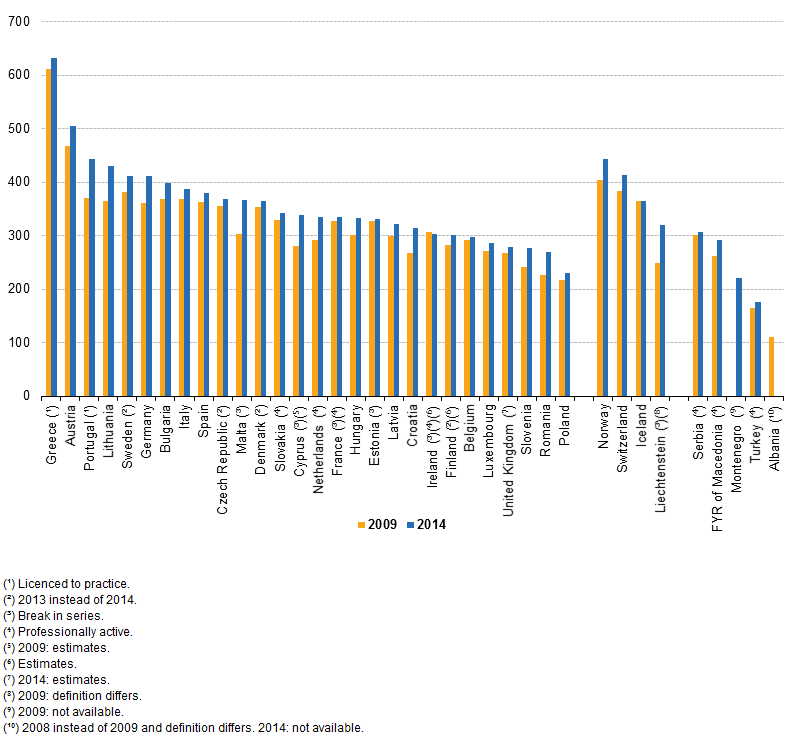
By 2014, France had circa 330 practicing physicians per 100,000 inhabitants.  Romania had just 270; Poland had only 230.  According to an academic study
“The brain drain of Romanian doctors constitutes […] a dramatic loss for the national healthcare provision”
Life expectancy in France is currently 82 years – and significantly longer if you happen to be white.  In Romania, it’s just 75 years…

In Pakistan, there are just 81 physicians per 100,000 inhabitants; in India, just 73.  Yet many Pakistani and Indian doctors work in the British NHS – which takes pride in its enlightened, ‘progressive’ diversity.

This Romanian doctor looks happy: he practices in Northern France.  His
compatriots, however, were left with even poorer health care.

It requires many years and a lot of money to train a doctor.  And if that physician ends up working in oh-so excitingly multicultural London or Paris – rather than in native Bucharest (or Karachi or Mumbai or Kinshasa) – then that celebrated diversity comes at a heavy cost in ‘diverse’ life and limb.
And it’s not just about healthcare or economics.  By uprooting talented people away from their own language, customs, identity – the rich countries perpetrate something akin to cultural genocide.  There is nothing ‘progressive’ in that.

It is ‘progressive’, charitable and simply humane to give to the poor – not take away even the little they have; so why are we taking doctors away from Pakistan and Romania – rather than sending doctors and nurses there??

Whether in Europe or USA, Australia, Canada and Israel, ‘pro-migration’ ideologues feel inherently superior to those ‘populist’ cavemen who object to unrestricted migration.  As I sit writing this, a cohort of self-proclaimed idealists use ships bought with donors’ money to ‘rescue’ migrants.  They pick them up from just outside Libyan waters, lift them from the overcrowded and shabby boats provided by people-smugglers and drop them on the nearest European beach.  There is ‘instant gratification’ in that – at zero risk to the ‘idealists’.  But this free ferry service also causes more and more pauper Africans to take the risk – to pay more and more money to board increasingly overcrowded, ever-shabbier boats.  In so doing, the ‘idealists’ probably end up killing more people than they ever ‘save’ (more than 8,000 would-be migrants drowned in the Mediterranean Sea in just two years!)  The idealists’ enthusiasm would be put to much better use persuading people not to take this route and instead help them improve their lives in-situ.  But that is much more difficult, onerous and risky.

Smuggler boats off the coast of Libya. Unseaworthy, yes; but then the hope
is not to reach Europe in this boat -- just to get a lift on a 'charity ferry'.

If your real purpose is to feel good about yourself for helping a few migrants land on a European beach, at no cost to yourself, then knock yourself out.  But if you truly care about people – rather than pandering to your own narcissism – then you will recognise that the problem of abject poverty isn’t solved by bringing a few people (those more proactive, who had the money to pay a people-smuggler and were lucky enough not to drown) from Zaire to Belgium, or from Romania to France.  That kind of selective ‘assistance’ just makes the rich richer and the poor poorer.

You cannot air-lift all Zaire’s population to Belgium; but you can (although not easily and immediately, but eventually and with great difficulty) hand-lift, heart-lift and soul-lift Zairians out of their poverty in Zaire.  If you’re French and thirsty for justice – then draining Cameroon of talent really isn’t the way to go; shouldn’t you instead pit your own talents to help fix their country – the one your ancestors broke?

Thursday, 17 May 2018

Gaza, Daniel and The Hatchet Job

According to Hamas officials, on Monday 14 May 2018 Israel Defence Forces have killed 62 Palestinians – all of them during peaceful protests at the border with Gaza Strip.

Most Western media outlets attributed the flare-up (either expressly or implicitly) to that pair of right-wing extremists: Trump and Netanyahu.  Who, we are led to believe, had engineered that dastardly act of moving the US Embassy from Tel Aviv to Jerusalem.  For instance, under the inspired title ‘What happened in Gaza on Tuesday [sic!’], the BBC writes:
“Monday also marked the opening of the US embassy in Jerusalem, a move that has incensed Palestinians.”
It is not clear to me whether the distinguished BBC journalists are affected by superficiality, by amnesia or by sheer stupidity. Leaving aside the fact that ‘The Great March of Return’ has been going on for weeks, those of us who are not BBC journalists may wonder why is it that the Palestinians in Gaza were so much more “incensed” than those in the West Bank?  And – if we are to impute the 62 fatalities to Trump’s arsonism, then are we also to blame the circa 2,000 Palestinian deaths of the 2014 conflagration to… Obama’s pacifism?

It wasn’t just the media; Israel’s brave Western European allies queued up to deliver kicks in the Jewish state’s shin.  The severity of those “diplomatic” rebukes varied – but in my view the record of silliness was broken by Theresa May: the British Prime Minister chose to chastise Israel while standing alongside President Recep Tayyip Erdoğan.  The Turkish dictator has a less-than-brilliant record of dealing with popular protests: during the 2013 demonstrations in Istanbul, 22 unarmed Turks were killed under his enlightened leadership.  More recently (January-March 2018), Erdoğan has ordered the Turkish army to ‘exercise legitimate defence of the country’s borders by… first bombing and ultimately conquering the Afrin province in Syria; at the cost, one should add, of between 290 and 500 Syrian civilians (since they were mostly Syrian Kurds, rather than Palestinians, people didn’t seem to count so precisely).

Breaking the world record of chutzpah
Meanwhile, a Hamas official has admitted (it is, after all, a matter of pride and Iranian subsidies for them) that 50 out of the 62 ‘peaceful protesters’ were members of his ‘illustrious’ organisation; we are still waiting for Islamic Jihad and the other, smaller ‘factions’ in Gaza to claim their own share of ‘martyrs’.

Naïves may argue that quite a few journalists, diplomats and politicians owe Israel some very humble apologies; but I’m not holding my breath…

What annoyed me more was the reaction of some Diaspora Jews.  And I’m not talking about the usual suspects like J-Street, New Israel Fund and Yachad UK; I’ve long written them off, along with their ‘pro-Israel’ pretences.  No, I am talking about the likes of Daniel Sugarman, a staff reporter with Jewish Chronicle. Daniel unequivocally declares himself a Zionist – and I believe him. (I also thank the Almighty that not all Zionists are as timid as good ol’ Dan; otherwise the State of Israel would probably encompass three tables in Golders Green’s Delisserie Restaurant. The ones closest to the toilets, I think).

On Tuesday morning, the IDF troops perched on the berm facing Gaza were grabbing their rifles; Mr. Sugarman also reached for the tool of his trade: no, not the pen – the hatchet!

Israel, declared Daniel off the pages of the venerable Jewish newspaper, “should be ashamed today”.

True, he adds
“the protests have been violent. Non-violent protestors do not throw rocks and Molotov cocktails. They do not launch flaming kites aimed at Israel with swastikas painted on them. The Hamas Prime Minister, Yahya Sinwar, described the stated aim of the attempts to breach the border as follows: ‘We will take down the border and we will tear out their hearts from their bodies.’”
But Daniel’s problem is not so much with Palestinian violence; or, indeed, with Palestinian violence masquerading as ‘peaceful protest’.  No, his problem is Israel’s counter-violence.  As he so poetically puts it:
“… the response from Israel has been death. Death and mutilation. A cloud of tear gas and a hail of bullets. Over fifty Palestinians were killed at the border yesterday, and well over a thousand wounded. Today, those numbers will likely be surpassed.”
Err… no, they were not.  In fact, Tuesday was a relatively calm day.  And so was Wednesday.

But while Daniel might not be very good at predicting the future, he seems to be knowledgeable about the past.  And understanding, too:
“I know that Hamas has orchestrated these attempts to breach the barrier. I know that Hamas has offered stipends to the families of those killed or wounded in these protests, in the same way that it gives stipends to the families of those who have died while carrying out terror attacks against Israelis. I understand why Israel cannot allow these protestors to cross the border.”
All those facts don’t matter much, though.  Because
“But every bullet Israel fires, every life Israel takes, makes this situation worse. There are ways to disperse crowds which do not include live fire. But the IDF has made an active choice to fire live rounds and kill scores of people.”
Now, I am rather familiar with “ways to disperse crowds”, from my days as an IDF soldier in the time of the intifada.  And if you don’t want to rely on my memory (admittedly, it isn’t that good anymore!), Wikipedia lists them as
“tear gas, pepper spray, rubber bullets, and electric tasers”.
On Monday, IDF has used copious amounts of tear gas, including in rather innovative ways – for instance sprayed from drones.

Thousands of non-lethal (but also not very effective) rubber bullets have been fired.

To the best of my knowledge, just the two other means (pepper spray and tasers) have not been used – and only because they only work at very short distance and are certainly not effective against large numbers of  'protesters'.

My understanding is that tear gas and rubber bullets were used, however – and used massively; and that live fire was employed because non-lethal means failed to stop attempts to breach the border.  But… “There are ways to disperse crowds which do not include live fire.” If Daniel Sugarman has discovered such “ways”, I urge him to call as soon as possible Lieutenant General Gadi Eizenkot, IDF’s Chief of Staff.  I’ll be happy to give you his mobile number, Daniel – he is very eager to learn those mysterious “ways”.  You might also want to offer your services as a consultant to all the police forces in the free world.  Trust me, they will pay top sterling for your “ways”.  But before all that, would you mind just updating that obsolete Wikipedia page – to avoid deceiving people like me?

In truth, it may seem that Daniel has achieved a humongous journalistic scoop.  After all, did he not reveal that
“IDF has made an active choice to fire live rounds and kill scores of people.” ?
I’d be so very grateful, however, if he could indicate the source of that riveting scoop.  (My friend Gadi Eizenkot knows nothing about such IDF decision – I checked).  I mean, I hope Daniel has a source – and a credible one at that.  Because otherwise, what he did was to libel a whole lot of people, by declaring them – off the pages of the Jewish Chronicle – war criminals.

Unfortunately, this does seem to be a case of libel.  Because, in his next sentence, Mr. Sugarman appears to call upon a rather unreliable witness: his own ‘logic’:
“You cannot tell me that Israel, a land of technological miracles which have to be seen to be truly believed, is incapable of coming up with a way of incapacitating protestors that does not include gunning dozens of them down.”
Oh, that sublime mixture of arrogance and ignorance – should we invent a new term for it?  How about ‘arrgnorance’??  Don’t you just looove it when a shallow schmuck says “you cannot tell me”?

Well, I can and I shall tell him a thing or two.  True, for a tiny country with lots of things on its collective plate, Israel has achieved some very impressive technological successes.  But they were not achieved by snapping fingers – not even the fingers that Sugarman stuck at it.

Daniel may have watched too much StarTrek; the amazing crew of the ‘Starship Enterprise’ had, I seem to remember, phasers that could be set on ‘stun’.

But in the real world…  It took more than a decade to find a (great, though still not perfect) solution to the threat of rockets launched from Gaza; more than 3 years passed before Israeli scientists devised a way to detect terror tunnels.

Attempting to breach the border fence with thousands of ‘protesters’ is a new Hamas tactic; we can only hope that Israeli wunderkids will soon devise (no doubt at the behest of Daniel Sugarman and using his generous donations) “a way of incapacitating protestors that does not include gunning dozens of them down”.  Though that might have to wait until the knowledge contained in those 100,000 pages of Iranian nuclear experiments is read and absorbed.

“You cannot tell me”…  Oh, but I can!  When they occur, Daniel my boy, “technological miracles” are an achievement to be admired – but not a duty to be demanded.  In bashing Israel for not coming up with miracles-on-order, you have just joined a long and very ignoble queue of individuals and organisations who hold the Jewish state to a different standard from that applied to everybody else.

You have entitled your piece, Daniel
“I love Israel – that’s why I’m criticising it today”
This reminds me of an abuser who, when confronted by the police officer, declared – hand on his heart and sanctimonious look in his eyes: ‘I love my wife; I only beat her when she does not live up to my expectations – so she can improve’.

I can and shall tell you, Daniel, that love should not hurt.

As a Jew and an “ardent Zionist”, Daniel Sugarman, you have no doubt often felt pride at Israel’s unusual achievements.  But one Tuesday morning you woke up embarrassed: the world was once again kicking the Quintessential Jew in the shin and it seemed to you, Daniel, that Israel’s behaviour reflected poorly on your good self.  And for that reason, on that Tuesday morning, you performed a hatchet job on my country, on the army I served in; on our children in khaki drill.  You called us all murderers.  But hey – I’m sure you felt like a good, moral, superior human being once you wrote that article.  And that’s what’s important after all, ‘innit?

Well done, Daniel, you’re the man!  May you grow up and become a mensch.

~~~~~~~~~~~~~~~~~~~~~~~~~~~~~~~~~~~~~~~~~~~~~~~~~~~~~~~~~

UPDATE

Good news!  The man has become a mensch.  I published the blog above on Wednesday evening, in response to Daniel Sugarman’s Tuesday article.  But – lo and behold – on Thursday Daniel wrote an apology – published on the Jewish Chronicle, the same newspaper that printed his initial article.  It is worth reading it in its entirety, but here are some salient parts:

“But the criticism I paid more attention to was from people who pointed out that it was absurd to deal in hypotheticals. I’d said that surely there must be a way the protestors could be stopped without shooting live ammunition at them – that Israel, with its incredible technological capabilities, must be capable of developing a way. That was a cry of anguish, but it was not an argument. If no such technology currently exists, then it was absurd of me to blame the IDF for not magically willing it into existence. The traditional crowd stopping technology would not have worked effectively. Rubber bullets are only short range. The same with water cannons. And with tens of thousands of people rushing the border, this would have been extremely unlikely to work effectively. The border would have been broken through. And then, without much of a doubt, a lot of people in Israel would have died.  That was, after all, Hamas’s stated aim.
But what really affected me the most was yesterday, when a Hamas operative went on television and claimed that, of the 62 people killed in the last two days, fifty were Hamas operatives. Islamic Jihad claimed three more, meaning that over 80 percent of the people who were killed while trying to breach the border were members of terrorist organisations whose direct aim is to bring death and suffering into Israel.
And I opened my eyes and saw what I had done.
[…]
I said that Israel should be ashamed of its actions. But today I am the one ashamed.”

We all make mistakes.  But we are not all equipped with hearts and balls big enough to admit those mistakes.

I forgive you, Daniel Sugarman.  And I respect you.  Shalom, brother!
 
;