Showing posts with label Arabs. Show all posts

Saturday, 6 March 2021

Explaining Yiddishkeit… in Arabic!

A few recent events have, once again, brought to the fore questions that have preoccupied people for (at least) the last couple of centuries: Who is a Jew? And who (or what) are the Jews?

Let me try to distil the significance of each of those events.

A kingdom of priests

A few days ago, Israel’s High Court of Justice issued a breakthrough decision: converts to Judaism, it said (even those ‘fast-tracked’ through non-Orthodox conversion processes — Reform and Conservative/Masorti) are Jews. It would seem that Jews are, therefore, a religion. After all, that’s what ‘conversion’ means — changing one’s faith. But here’s the catch: why has the High Court waded in what appears to be a religious issue, a matter for rabbis to debate? Because in Israel there are legal consequences: Jews — not Israeli citizens, but Jews wherever they come from — are covered by the provisions of the Law of Return: they are entitled almost automatically to reside in Israel and (if they so desire) to become Israeli citizens.

But what does religion have to do with the right of residence? Or with citizenship? Try explaining this to a Westerner and you’ll get — at best — a funny look. This brings me to the second recent event.

A majority of that minority…

On March 1, 2021, A BBC programme called ‘Politics Live’ asked a panel made up of four non-Jews to debate whether Jews should count as an ethnic minority. The only Jew who participated (as a guest) was outraged that the question was even asked; so were the vast majority of British Jews who heard about this ‘debate’. On the other hand, a lot of non-Jews (including the programme’s hapless editor Rob Burley) found the whole notion baffling. After all, the Jews (in their minds, at least) are white-skinned; their eyes are straight in their faces — and not slanted like those of Asians. How, then, can they possibly be ‘an ethnic minority’? And, even assuming they are a separate ethnicity, despite their similarity to white Brits in all but hard-to-perceive details, how come one can ‘convert’ to being a Jew at the say-so of a religious conclave? Can one ‘convert’ to being black, brown or Asian?


Sociopathic Political Sociology 

Bristol University's Prof. David Miller


Only a few days earlier, a Bristol University professor of Political Sociology had produced a rant against the Uni’s Jewish Society, accusing them of being “political pawns by a violent, racist foreign regime engaged in ethnic cleansing”. A.k.a. Israel — ‘the Jewish state’. This outraged those students, along with the vast majority of British Jews. Who — yes — are ‘British’, but also ‘Jews’; yes, their country is Britain, to which they are eminently loyal, though most of them are really fond of ‘the Jewish state’. Confusing? Wait, that’s not all!

Come, curse me Jacob…

A Jewish comedian of national fame (and by ‘national’ I mean in Britain, but mostly among British Jews) just published a book complaining about anti-Jewish racism — including those who claim that they don’t mind Jews, they only really hate the Jewish state. Well, to make things slightly clearer, the Jewish comedian solemnly declared in his book that he doesn’t give a rat’s about the Jewish state!  He even echoed some of those he had just complained about — by cursing ‘Fuck Israel!’  Which in itself drew the ire of those British Jews — the vast majority, according to opinion polls — who care a lot about the Jewish state; to the point of seeing it as an essential pillar of their Jewish identity…

David Baddiel

Their own country

I’m talking about recent events — but in truth this isn’t new: the Torah talks about ‘Am Yisrael’ — the People of Israel. A ‘people’ then, an ethnicity. Yes, but woe unto the People of Israel if it were to worship other Gods… So a religion, after all?

Around 1650, a certain Manasseh ben Israel was writing honey-tongued letters to Lord Protector Oliver Cromwell, pleading for him to remove the interdiction and allow Jews to once again live on the Island of Britain. A Sephardi Jew, Manasseh was born Manoel Dias Soeiro, scion to a family of ‘Marranos’ (Jews who had been forced to convert to Christianity, but secretly continued to cling to Judaism). Having fled their native Portugal to escape the Inquisition, the family found refuge in Amsterdam, in the Low Countries, where they could, at the time, overtly practice their religion and attempt to help other exiled Jews.  Yet when Manasseh — appealing to Cromwell’s humane feelings — described Jews as ‘banished from their own country’, he made it clear that he did not mean Portugal or Spain, but the Land of Israel; the land these Jews longed for was not the one they had to leave a few years earlier, but the one they lost many centuries before Manasseh was even born…  Odd, ‘innit?  Well, there you have it — the third dimension of Jewish identity: not just peoplehood and religion, but a strange longing for a country lost some time, somewhere.

Manasseh ben Israel
 

But why did I drag poor ol’ Manasseh ben Israel into all this? Well, he happens to be the main architect of the ‘return’ of Jews to England, some four centuries after the 1290 exile. One could even call him the founder of the modern British Jewish community…

Trial and Error

It’s not that Jews did not experiment with their identity. In the 19th century Germany, some Jews established the Reform Movement, which initially tried to do away with ethnicity, while maintaining the element of faith. Those Jews declared themselves ‘Germans of Mosaic faith’. ‘Their own country’ was definitely Germany — and none other.

Also in the 19th century, but to the east of Germany (in Lithuania, Poland and Russia), another group of Jews established a secular Jewish movement, the Bund. The Bundists had no interest in religion, but they somehow envisaged Jewishness as a type of distinct cultural ethnicity within the socialist brotherhood of peoples.

Neither group faired very well, however. The Reform Jews may have viewed themselves and each other as ‘Germans of Mosaic faith’; but the ‘real Germans’ still viewed them as… Jews — and murdered them along with their Orthodox brethren.

As for the Bundists, they lived as socialists but died as Jews: those who escaped the Shoa’h met their bitter fate during Stalin’s purges. Only a handful survived — and at the cost of selling their souls to the devil: they became the infamous ‘Yevsektsiya’, Stalin’s tiny group of Jewish enablers.

Bundists in Poland

While the Reforms chose religion and the Bundists cultural ethnicity, they both jettisoned the third aspect — ‘their own country’. But there was another movement that started (or at least got its name and fame) in the 19th century: the Zionists. Like the Bundists, initially the Zionists had no interest in religion; unlike both Bundists and Reforms, they were only really interested in ‘their own country’. This is ironic, given that these days roughly half of that country is made up of religious or ‘traditional’ Jews, a fifth of non-Jews and the balance of Jews who preach the importance of close ties with the Diaspora. Go figure!

Traduttore, traditore: translating identity

Here’s some more Zionist irony: I believe that the most serious contribution to the understanding of these concepts (Jews, Jewishness, Jewish identity) has just been made… by an Arab.

I must admit I never before heard about Hussein Aboubakr Mansour. On Twitter, he introduces himself as

"A freedom-loving Egyptian dissident and American citizen."

Also on Twitter, on 2 March 2021, he opined:

"I’m not Jewish but I want to throw my ring in the hat of the question of Jewish identity that a lot of people are fighting about. Is it a race? A religion? An ethnicity? Can we say Arab Jew? I see a lot of people fighting without being knowledgeable or humble enough to simply say ‘Idk’ [I don’t know]. Judaism is a unique Middle Eastern structure. Modern Western languages simply don’t have the analytical tools adequate to explain it. Judaism will never comfortably map on notions expressed in the English words of ‘religion, race, civilization, etc.’ Thats my opinion."


And a very astute, insightful opinion it is, too! Languages (words, sentences, verbal descriptions) are mirrors that reflect reality; but, like any imperfect mirror, a language can also deform, rendering an inaccurate, false image. Modern Western languages developed to express contemporary Western concepts, attitudes and realities; why do we expect them to accurately describe centuries-old Middle Eastern idiosyncrasies?

Even within that broad family of ‘Western’ (i.e. European) languages, there are significant differences. Most native speakers of the English language would understand the term ‘nationality’ as meaning something similar to ‘citizenship’. French speakers would probably feel the same about the term ‘nationalité’. But, for instance, in Russian (and other Eastern European languages), ‘natsionalnost’ (национальность) should really be translated ‘ethnicity’. It is fundamentally different from the concept of ‘citizenship’ — in Russian ‘grazhdanstvo’ (гражданство). Asked what his ‘natsionalnost’ is (and assuming s/he wanted to respond candidly), a Jew living in Russia would respond ‘Jewish’, rather than ‘Russian’. S/he would of course say that his/her ‘grazhdanstvo’ is ‘Russian’. The former refers to ‘tribal’ identity; the latter — to legal status.

Although in recent times the German concepts of ‘Nationalität’ and ‘Staatsbürgerschaft’ (citizenship) have often been used interchangeably, as their equivalents are in English or French, many native German speakers would perceive a difference between the two terms: the accurate English translation of the former is, I feel, ‘national origin,’ referring either to ethnicity (‘tribal’ identity) or, more often, to the country of one’s birth — irrespective of current citizenship status.

Back to English: the concepts of ‘race’ and ‘ethnicity’ are vague and not very well understood – as the above-mentioned BBC programme abundantly demonstrated.

Such terms change meaning with the passing of time: a century ago, ‘a race’ would’ve been understood to mean a people or an ethnicity. British Jews (and Jews in general) would definitely be seen as ‘a race’; they would not be subsumed into the ‘British race’. But these days the concept of ‘race’ most often refers to predominant physical characteristics such as skin colour or the shape of one’s eyes.

Even there, things are less than crystal-clear. People who originate on the Indian subcontinent tend to have dark skin colour (but not as dark as ‘black’ people), as well as other specific physical particularities. But they are seldom referred to as a separate ‘race’ these days.

Most Westerners view Jews these days as just a (rather weird) variety of ‘white people’; not a ‘race’ onto themselves. Nonetheless, they would call antisemitism or Islamophobia ‘forms of racism’, despite the fact that neither Jews nor Muslims are seen as ‘races’. Did I manage to confuse you completely, folks? Wait, there’s more!

What about ‘ethnicity’? What does that mean, actually? Jews (who come in many shades and shapes) would often refer to themselves as an ethnicity or, just as the Torah does, as ‘a people’. But they are also part of numerous ‘nations’.

When casually asked about their identity, many (most?) British Jews would say they’re ‘British’. A few times, when discussing this with friends and acquaintances, I commented that they don’t usually say they’re ‘English’. “It’s the same,” they typically react, as an afterthought. “Sure, I’m English”. But, of course, while ‘British’ and ‘English’ may be “the same” for a member of the dominant majority, I very much doubt that a Scot or a Welsh person would see things this way!

Nor is this type of identity embraced uniformly across the Jewish world. I am told that in Sweden, for instance, a Jew who marries out is said to have ‘married a Swede,’ notwithstanding the fact that the Jew him/herself is the proud holder of a Swedish passport. I remember well a similar attitude from my youth in Eastern Europe.

That’s, by the way, not an exclusive Jewish phenomenon: an ethnic Finn born in Sweden for many generations would most often say s/he is ‘from Sweden’ — rather than ‘Swedish’; members of the ethnic Magyar (Hungarian) minorities would most often say they are ‘from Romania’ or ‘from Slovakia’, rather than ‘Romanian’ or ‘Slovak’; and Arab Israelis would often describe themselves as ‘Arabs (or Palestinians), citizens of Israel’ — rather than ‘Israelis’.

Things change as we move along the time-space continuum. Once upon a time, the West defined itself as ‘Christendom’ — a moniker that bundled together religious, territorial and cultural identity. It had a somewhat equivalent term for Jews (albeit, of course, less sympathetic in tone and usage): Jewry in English, Judentum in German. Few people use these terms anymore; fewer still understand their complex meaning.

But let’s go back to Hussein Aboubakr Mansour. I would suggest, that his own sense of identity (an Egyptian Arab, now a US citizen) is what produced his astute remarks. Arabs are (speaking as an outsider) people who belong to a broadly-defined Arab culture — some define it as a nation — one of whose main expressions is the use of the Arab language. Development of a more clearly contoured Arab identity was actively discouraged for centuries, first by the Ottoman rulers, then by Western colonialism and finally by local despots keen on keeping their fat arses on the gilded thrones of arbitrarily-delineated fiefs. Since it gained autonomy — from the Ottomans and from the Western colonial powers — earlier than other Arab countries, Egypt boasts a more mature identity. (Geography and historic legacy also helped.)

If language remains a major identifier of ‘the Arab World’, it isn’t a very straightforward one. An Egyptian like Mr. Mansour will be, most likely, a speaker of the Egyptian (Masri) dialect. Should he want to have a conversation with a Palestinian or a Syrian (i.e. a speaker of the Levantine, a.k.a. Syrian or ‘Shami’ dialect of Arabic), they might understand each other, with some difficulty — perhaps like a Spaniard attempting to talk with a Portuguese-speaking Brazilian. If, however, he wanted to speak with a Moroccan (a speaker of the N. African — Maghrebi — dialect), he may experience a degree of difficulty similar to a German trying to communicate with a non-German speaking Dutch person. Assuming they are both educated people, Mr. Mansour and his Moroccan friend should be able to communicate better by using the literary or ‘Modern Standard’ Arabic — a language they would both have learned in school. MSA is often referred to as الفصحى (Al-Fusha or Eloquent Arabic); it is much closer to Classical Arabic, the language of the Qur’an.

Another Arab ‘identity glue’ is religion — Islam. But that’s also far from straightforward: there are Christian Arabs, too; there are plenty of non-Arab Muslims; and, as we know, there are several different Muslim denominations.

Not to mention that Arabs live in more than 20 different countries, each having (or trying to develop) its own national identity.

My point is that Arab identity is also very complex — which may have helped Mr. Mansour grasp the intricacies of Jewish identity.

Since it originated also in the Middle East, the Arabic tongue copes much better — in comparison with European languages — with dual or multi-faceted aspects of identity. There are, for instance, at least three different ways to convey the concept of ‘nation’ or ‘national’ in Arabic:

Qawm (قوم) comes from the word for ‘mother’ (umm). It refers to a relationship of mutual solidarity (identity) between people who are not necessarily bound to a particular geographic territory. It is to a certain extent (though not exactly) what we try to convey by saying ‘ethnicity’ in English. There is even a religious connection: a related word is Ummah (الأمة) — that’s what one calls the ‘nation’ of Islam, the global collectivity of Muslims; the Islamic equivalent of ‘Christendom’, if you wish.

Watan (وطن), on the other hand, has a strong territorial meaning: it has to do with home or homeland.

And then there is balad (بلد‎), which also has a strong territorial dimension, but has to do with the place (country, area or perhaps village) a person was born in. Just to show how rich the Arabic language is, ‘balad’ is also translated in English as ‘homeland’.

So Arabs can say ‘nation’ or ‘national’ in three different ways and convey slightly different meanings, somewhat distinct, nuanced aspects of their identity. This may be particularly poignant for someone like Hussein Aboubakr Mansour: a US citizen born in Egypt. With two places that are ‘homeland’ — only in different ways — which would be ‘his own country’, I wonder? That’s, perhaps, why he gets Jews…

Among Westerners, there are at least as many anti-Arab racists as there are antisemites. But, with the exception of the far-right fringe, anti-Arab animus is much more rarely expressed in public. After all, the wokeocracy has already made up its collective, narrow mind that, ‘unlike Jews,’ Arabs are indeed an ‘ethnic minority’; they are ‘people of colour’ and therefore oppressed by definition.

So, look… it sounds counter-intuitive, I know; but perhaps what we need to do is this: let’s all petition the Beeb, so that next time those conceited, closed-minded, arrogant and Western-centric people ask what Jewishness is, they interview Hussein Aboubakr Mansour. He gets it! And, as an Arab, they’ll at least listen and feign respect for his opinion…


Saturday, 24 October 2020

Hey, Mr. ‘Prominent British Jew’: be a mensch and say “I’m sorry!”

 I know, I know: we are way past Yom Kippur.  But who says it’s only on that one day a year that we must say “I’m sorry”?

As yet another Arab country (Sudan) agrees to normalise relations with the Jewish state, quite a few people owe us all (and to themselves) a heartfelt apology.

Journalists

The decay of journalism is one of the greatest challenges to 21st century democracy.  Real journalists (read: people who value objectivity, have respect for facts and are capable of insights) are becoming rare and far between; those depleting ranks are being filled with political activists for whom ‘journalism’ is a weapon, rather than a vocation.  And the saddest thing is that they can get away with not even having to admit they were wrong; mainly, perhaps, because most people did not pay attention to their pathetic screeches – in the first place.

Zvi Bar’el, for instance, would probably describe himself as a senior journalist.  He sports the rather serious-sounding title of Middle East Affairs Analyst for the Israeli newspaper Ha’aretz; he even has a PhD in the History of the Middle East.  One of his ‘analyses’ was published a few weeks ago (after the UAE deal announcement), under the assertive title:

“Israel's Deal With the UAE Spells New Conditions for Ties With Arab States”.

Some may say that’s only stating the obvious – and I couldn’t agree more.  But I’m not complaining about the lack of insight – I’ve come to expect that; the problem is that nowhere in his learned article does Analyst Bar’el utter the words: ‘I got it wrong, folks – I’m sorry!’

Because Mr. Bar’el’s previous ‘analyses’ (i.e. before the UAE announcement) were rather radically different.  For instance, the one he published under the no-less sententious title:

“Without Solution to Palestinian Issue, No Arab State Will Seek Relations With Israel”

Mr. Bar’el began that previous ‘analysis’ by quoting Netanyahu’s statement, delivered at the UN:

“Many have long assumed that an Israeli-Palestinian peace can help facilitate a broader rapprochement between Israel and the Arab World. But these days I think it may work the other way around: Namely that a broader rapprochement between Israel and the Arab world may help facilitate an Israeli-Palestinian peace. And therefore, to achieve that peace, we must look not only to Jerusalem and Ramallah, but also to Cairo, to Amman, Abu Dhabi, Riyadh and elsewhere.”

Ha’aretz’s Middle East Affairs Analyst then proceeded to ridicule Netanyahu for that statement.  No, Arab country, declared our friend Zvi with iron-clad certitude, will “seek relations” with Israel unless the latter first magics up a “Solution to [the] Palestinian Issue”.  Well, the UAE (an Arab country by all accounts, including its name) did.  And two others (so far!) followed.

Hmm… so who looks ridiculous now?  Forgive my French, but I’d say that Zvi Bar’el has made a bit of an ass of himself.  Someone should tell him that, despite the partial homophony, the title of ‘Analyst’ does not derive from the word ‘anal’!

It is a sorry state of affairs when ‘Analysts’ (and journalists in general) are utterly ignorant of what is happening – until the moment it becomes public knowledge.  There were plenty of clues for Mr. Bar’el to pick up.  For years now, Netanyahu has been throwing thick hints about impending peace with the Arab world; so did Trump.  That there was considerable rapprochement was common knowledge.  And, if nothing else, it was clearly spelled out in the latest Coalition Agreement.  No, not the part about ‘annexation’ – leave that one to the hapless ‘analysts’; no, the part that says:

“The Prime Minister and Substitute Prime Minister will act together and in a coordinated fashion to advance peace agreements with all our neighbours and to advance regional cooperation […] all this while aiming to protect the security and strategic interests of the State of Israel, including the need to preserve regional security, uphold existing peace agreements and strive towards future peace agreements.”

The words “peace agreements” feature no less than three times in that one paragraph.  Enough of a clue – you’d think – to pique the curiosity of even a thick, jaded Ha’aretz Analyst.

But ‘journalists’ like Bar’el aren’t attuned to facts or evidence; they are driven by ideology, by beliefs.  According to Mr. Bar’el’s ‘secular religion’, Netanyahu and Trump are perennial liars – never to be believed; Israel’s desire for peace is forever suspect – lip service designed to hide nefarious intentions; and the plight of the Palestinian Arabs is the #1 issue in the whole wide blimming world.  For a certain ilk of pseudo-liberals, the above statements are Gospel – and one does not question scripture!

Now, I don’t wish to be too harsh: valued Middle East Analysts (even those with a PhD and – incredibly, I know – even those writing for Ha’aretz) are of course allowed to make mistakes, just like the rest of us.  But… forgive me if I humbly opine that, besides being a mark of character, admitting one’s mistakes should be a minimum requirement for retaining one’s credibility; if not one’s job.

But let’s stop picking on poor Zvi Bar’el – he is far from the only culprit: pretty much every other ‘Analyst’ (and probably his dog, too) agreed with him.  Until very recently, they all said that, while the Gulf Arab countries did not mind having the political equivalent of furtive sex with the Jewish state, they wouldn’t dreeeeam of formalising that relationship without Palestinian blessing.  And I have yet to hear one of those ‘analysts’ saying the magic words: ‘I was wrong’.

Which brings me to the next category.

The ‘anti-annexation’ activists

Anything involving Israel and the Palestinians is guaranteed to attract a disproportionate amount of attention from ‘activists’ with an axe to grind.  But few things caused such a berserk torrent of unbridled criticism like the ‘annexation’.  Convinced (mainly by their own prejudice) that all Netanyahu ever wanted was to despoil the Palestinians of ‘their’ land, lots and lots of people – from New Israel Fund, Yachad, J-Street and other ‘usual suspects’ to Western European politicians and US Democratic Party senators – came out to ‘express their grave concern’ with ‘the annexation plans’.  After all, as all of them declared (without even bothering to explain why) ‘annexation’ spells the death knell of the two-state solution – doesn’t it?

Even some of the people who are genuinely pro-Israel were baffled.  Why would a previously very cautious Netanyahu suddenly seem so keen to do something ’so radical’?  Well, as many an organisational behaviour consultant will tell you, most people don’t like change: given a choice, they tend to choose the ‘devil they know’; or at least to put off getting acquainted with the new fiend.  To effect a change, sometimes it is necessary to manufacture a crisis…

We know now that the UAE deal has been in the making for many months.  And one does not need a PhD in Middle East History to understand why it ultimately happened.

The threat of ‘annexation’ did that – and more.  In the words of ‘a White House official’ (quoted by Walla and the Times of Israel):

“We have been talking about this [the Israel-UAE normalisation] for over a year, but the issue of annexation created the atmosphere in which a deal became more attainable.”

This only sounds counter-intuitive to clueless ‘analysts’ and green (and I don’t mean just ‘Green Party’) European politicians.  In Middle Eastern politics, the ‘annexation’ was never an impending ‘catastrophe’; no, it was a brilliant gambit: it provided the Emiratis with the opportunity to ‘save the Palestinians’ and ‘to save peace’ – all while doing what they wanted to do anyway.  As for Netanyahu, he ‘reluctantly agreed’ to forgo something he didn’t really want to do in the first place (except under much more propitious circumstances), in return for peace with Arab world’s rising star.  Both sides achieved not just their purpose – but also found a way to sell that outcome to their domestic constituencies.

But was it really a gambit, I hear you asking?  Or was Netanyahu somehow ‘dissuaded’ at the last moment from putting in practice those nefarious ‘annexation plans’?

Well, what plans – pray tell me?  ‘Annexing’ land (i.e. governing it as part of Israel’s sovereign territory) is a rather large logistic operation.  It involves establishing (or at least re-deploying) government offices, security installations, centers of authority.  At a minimum, it involves re-deploying military assets.  Yet no preparations were made – or even sketched; no plans were submitted for approval; no sites were earmarked, not one army unit was moved.  Not just people in the street, but ministers and military commanders were left wondering what – if anything – was going to be annexed: a few symbolic dunams?  The Jordan Valley?  30% of the West Bank?

Plans?  There were no ‘plans’.  And why do you think that is?

The ‘annexation’ was a manufactured crisis, which enabled UAE leaders to present normalisation as the solution.

As for ‘anti-annexation activists’, none – to the best of my knowledge – has so far admitted they were wrong.  In fact, a few saw fit to express their great relief at the ‘suspension of annexation plans’.  Demonstrating either intellectual dishonesty or – more likely – just sheer stupidity.

‘Anti-racists’

There is more to apologise about than merely going over the top about ‘the annexation’.  A couple of years ago, I happened to have a discussion with a leading activist from New Israel Fund – UK.  We were in a small group and she launched into a rant about ‘the blatant racism’ that – in her view – was taking over the Israeli society; she rather aggressively asked me to condemn it.  I replied that I unreservedly condemn it; I added that, unfortunately, there is indeed despicable racism in Israel – just as there is in the UK, USA and elsewhere.  ‘Oh, no,’ she said with something I can only describe as cold anger.  ‘There is much, much more racism in Israel.’  I wanted to ask her for the evidence behind such grave accusation – but she gave every indication that, if I wasn’t going to admit that Israel was more racist than other countries, she wasn’t interested in any further debate with me.

For years now, it has become fashionable in certain circles to accuse not just Netanyahu, not just ‘the Israeli government’, but ‘the Israeli society’ en-bloc of racism, of callousness and lack of desire for peace, of ‘land theft’ and other sins.

The ‘evidence’ typically consists of ‘Israeli behaviour’ (as narrated and interpreted by the accusers), politicised opinion surveys (with questions the like of which are only ever asked of Israelis) and ‘anecdotal evidence’ – all of which demonstrate ‘deeply-entrenched anti-Arab racism’ and other such base attitudes.

These ‘Israeli attitudes’ are then employed to call for international ‘pressure’ on Israelis – who, as racist warmongers, cannot be expected to make peace of their own volition.

Speaking about opinion polls, however, one was performed after the UAE announcement: it seems that nearly 80% of ‘the Israeli society’ supports the agreement with UAE over ‘the annexation’; less than 17% expressed the opposite view.  In fact, since the announcement, the entire country has been in a celebratory mood.  It seems that, despite their engrained anti-Arab racism and their lack of desire for peace – Israelis dream of traveling to the UAE, of doing business there, of having Emirati Arabs visit and do business in the Jewish state.  Hundreds of Israelis were visible on Twitter, seeking to make friends with the Arabs they purportedly despise out of racial prejudice…

And it wasn’t just people in the street: the much maligned ‘right-wing Israeli government’ voted unanimously in favour of the Abraham Accords – as did parliamentarians representing ‘extreme right’ opposition parties.  In fact, the only Israeli party that voted against peaceful relations with the United Arab Emirates was… the Joint (Arab) List!  Needless to say, none of the ‘peace activists’ criticised the Israeli Arab parliamentarians for that stance.  Pseudo-liberals – as we know – only see faults in Jews.

‘Prominent British Jews’

But there’s somebody else who owes the Israeli public – and their own community – an apology.  A few months ago, 40 ‘prominent British Jews’ wrote a letter to Israel’s Ambassador to London, protesting ‘the annexation’.  So what’s wrong with this, you ask?  Surely British Jews – whether ‘prominent’ or not, are entitled to write to the ambassador of the Jewish state?  Of course they are; but they chose a rather weird way to do it.  You see, if I want to send a letter (whether to an ambassador or to the lovely man who sweeps the street in front of the Embassy, it does not matter), I use the good services of the Royal Mail.  Of course, I’m not ‘prominent’; if I were a bit posh, I might use a courier – or send my personal valet to drop the letter at the Embassy.  But that’s not what our ‘Prominent Jews’ did; no, they published their letter in the newspaper.  Which newspaper, you’re asking?  Why, Ha’aretz of course – what else?! 

And what did they write, these ‘prominents’?  Well, they expressed their “unprecedented level of concern”.  As well as the following ‘analysis’:

“We are yet to see an argument that convinces us, committed Zionists and passionately outspoken friends of Israel, that the proposed annexation is a constructive step.  Instead, it would in our view be a pyrrhic victory intensifying Israel’s political, diplomatic and economic challenges without yielding any tangible benefit.”

Needless to say, there were other, even saucier passages, all faithfully and gleefully reproduced by other “friends of Israel” – such as The Guardian and the BBC.

Judging by the above emphatic pronouncement, one would be tempted to think that ‘the Prominents’ are all high-level experts in Middle East politics.  But… no, they’re not.  They’re not even Ha’aretz Middle East Affairs Analysts.  Most of them are politicians and businessmen, a few even political activists masquerading as Rabbis.

What is unclear is: why do these people (who live in Britain, pay taxes in Britain, vote in Britain and do not have to serve in the army in Britain) presume to publicly tell Israelis what to do?  I wonder how would they feel if 40 ‘prominent Israeli Jews’ would have published a letter in The Guardian, declaring something like ‘we are still to see an argument that convinces us that Brexit is a constructive step’?

Why do these arrogant pricks think they understand Israel’s needs and interests better than the elected representatives of the Israeli public?  Why do they see themselves as responsible adults, while viewing Israeli leaders (some of whom have fulfilled for many years positions of vast responsibility in government and/or security forces) as little more than children?

Most believed that Netanyahu – the new Genghis Khan, just as reckless, primitive and bent on destruction as the old one – was about to inflict a huuuge catastrophe upon the Jewish state and on the entire Jewish people.  But a cooler, more sober, more ‘anal’ analysis might have concluded that Netanyahu is anything but reckless.  Sure, like Trump, Netanyahu isn’t everybody’s cup of tea.  Hate the man, if you so wish; despise him for his cigars, his ice-cream, his alleged corruption, his spiteful wife or his undeniable achievements.  But reckless?  No, this guy’s a calculated son of a bitch – if ever there was one.  Netanyahu may play for high stakes – but his game is chess, not backgammon: he does not roll the dice.

By and large, the demarché of the ‘prominents’ was no surprise – most of them have said and done stupid, outrageous things in the past.  Unfortunately, this time their ranks included also people like Howard Jacobson, whom I respect.  What possessed you to add your distinguished name to that shameful list, dear Howard?

I know, I know: we are way past Yom Kippur.  But not past redemption, not yet.  It’s not too late.  Please: would you be a mensch and say “I’m sorry”?

Friday, 29 May 2020

Yachad: “together” with intellectual dishonesty?

The Coalition Agreement which forms the basis of the new Israeli government includes the possibility for Prime Minister Netanyahu to proceed – with US blessing and as part of the new US peace proposal, plus a host of other conditions – with the ‘annexation’ (or ‘application of sovereignty’, however one chooses to call it) of parts of the West Bank/Judea & Samaria.
This has caused controversy both in Israel and among Diaspora Jews – even among staunch Zionists.  Yachad (Hebrew for ‘together’ – a group of hard-left British-Jewish activists who proclaim themselves as ‘pro-Israel’ but rarely, if ever, have anything positive to say about the Jewish state) has been particularly vocal in the campaign against ‘annexation’.  So far – so legitimate; nothing wrong with that.
But legitimacy – along with credibility and respect – evaporates when exposed to crass intellectual dishonesty.
One doesn’t need to lie in order to oppose ‘annexation’; one can campaign – even campaign passionately – without trying to deceive.  Passion is not a licence to cheat.

Yachad’s misleading newsletter
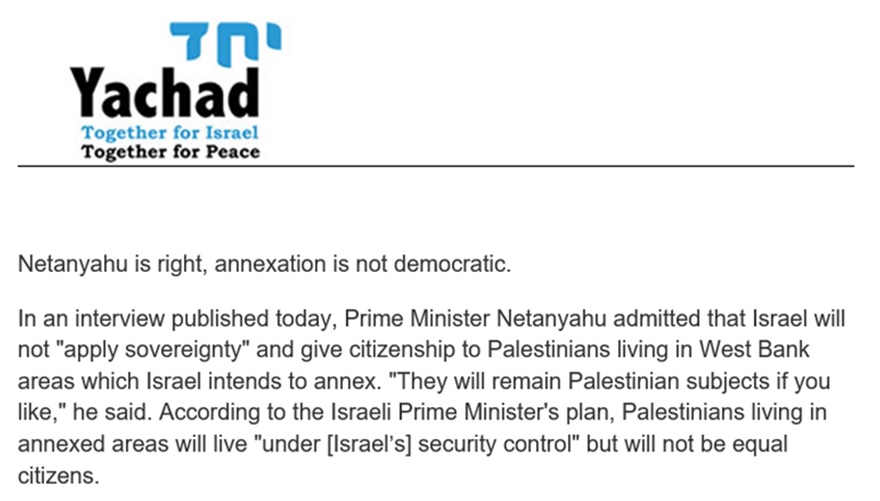
On 28 May 2020, Yachad’s Director sent a newsletter to the group’s list of contacts.  This is what she wrote, among other things:
Netanyahu is right, annexation is not democratic.
In an interview published today, Prime Minister Netanyahu admitted that Israel will not “apply sovereignty” and give citizenship to Palestinians living in West Bank areas which Israel intends to annex. “They will remain Palestinian subjects if you like,” he said. According to the Israeli Prime Minister’s plan, Palestinians living in annexed areas will live “under [Israel’s] security control” but will not be equal citizens.
Now, let’s go to the interview that Yachad refers to.  Here’s the question and Netanyahu’s response, which the newspaper even provides with the subtitle “A Palestinian enclave”:
Q: Nevertheless, several thousand Palestinians live in the Jordan Valley. Does that mean they will receive Israeli citizenship?
[Netanyahu]: “No. They will remain a Palestinian enclave. You’re not annexing Jericho. There’s a cluster or two. You don’t need to apply sovereignty over them, they will remain Palestinian subjects if you will. But security control also applies to these places.”
Clearly, Netanyahu talks about areas (such as the city of Jericho) that will not be annexed by Israel.  The US ‘Peace to Prosperity’ Plan describes such Palestinian enclaves – areas of Palestinian sovereignty connected to the envisaged State of Palestine by access roads.  Since they live in areas earmarked for the future State of Palestine, the inhabitants of these enclaves are Palestinian citizens, not Israeli citizens.  Conversely, there are also Israeli enclaves in the midst of the Palestinian state; these are connected to Israel through access roads and their inhabitants are citizens of Israel.  Here is the exact wording of the Plan:
The Palestinian population located in enclaves that remain inside contiguous Israeli territory but that are part of the State of Palestine shall become citizens of the State of Palestine and shall have the option to remain in place unless they choose otherwise. They will have access routes connecting them to the State of Palestine. They will be subject to Palestinian civilian administration, including zoning and planning, within the interior of such Palestinian enclaves. They will not be discriminated against and will have appropriate security protection. Such enclaves and access routes will be subject to Israeli security responsibility.
The Israeli population located in enclaves that remain inside contiguous Palestinian territory but that are part of the State of Israel shall have the option to remain in place unless they choose otherwise, and maintain their existing Israeli citizenship. They will have access routes connecting them to the State of Israel. They will be subject to Israeli civilian administration, including zoning and planning, within the interior of such Israeli enclaves. They will not be discriminated against and will have appropriate security protection. Such enclaves and access routes will be subject to Israeli security responsibility.
So let’s summarise: Netanyahu said (emphasis mine)
You’re not annexing Jericho. There’s a cluster or two. You don’t need to apply sovereignty over them, they will remain Palestinian subjects if you will.
Yachad says (emphasis mine)
Netanyahu admitted that Israel will not “apply sovereignty” and give citizenship to Palestinians living in West Bank areas which Israel intends to annex.
Netanyahu clearly talks about territory that Israel will not annex; Yachad says he referred to areas that Israel will annex.  This, without the shadow of a doubt, is twisting Netanyahu’s words.  It’s horribly misleading.  But, worse, I believe it is a deliberate misinterpretation, an attempt to deceive.  Here is why:
  1. The Yachad’s Newsletter does in fact include a link to the text of Netanyahu’s interview. But that link is placed at the bottom of the email, where most readers are likely to ignore it.  In addition, the link is to the Hebrew version of the interview.  But it is reasonable to assume that most of Yachad's audience (British Jews) typically do not read modern Hebrew – or not well enough to fully understand the meaning of what was said.  It would have been honest to place a link to the English translation of the interview (published in the same newspaper) in the actual paragraph.  For instance, by making the word 'interview' itself a link, as I did above, which would have allowed readers to easily access that interview and check for themselves.  
  2. Alterntively, Yachad could at least have quoted the short passage from Netanyahu’s interview, in English translation, just as I did above. Instead, they chose to (mis)‘interpret’ it, cutting and pasting small bits in a way that changed the meaning.  The question is – why?
  3. Yachad knows the situation in the West Bank – they’ve been organising ‘educational’ tours (read: indoctrination field trips) there for years. The city of Jericho and its hinterland are Area A – the part of the West Bank that, since the Oslo Accords, is under the complete control of the Palestinian Authority – with Israel allowed to intervene only in cases of severe security breaches.  Yachad knows very well that the ‘annexation’ refers to parts of Area C, the part of the West Bank where Israel was granted complete control.  I’ve heard the same Director of Yachad delivering a presentation on Oslo and Areas A, B and C.  Much as I’d like to, I cannot believe that she missed the reference to Jericho and its significance.
  4. Yachad are neither stupid nor newcomers to the intricacies of the US Peace Plan – they campaigned against it; they are familiar with Israeli politics and with the positions of the main personalities – certainly Netanyahu. They heard, not so long ago, Mark Regev, Israel’s Ambassador to London explaining that Israel will indeed offer citizenship to Palestinians inhabiting areas ‘annexed’ by Israel – just as she did when it ‘annexed’ the Golan Heights and East Jerusalem.  At the very least, that knowledge should have made Yachad circumspect in reading and ‘interpreting’ that part of Netanyahu’s interview.

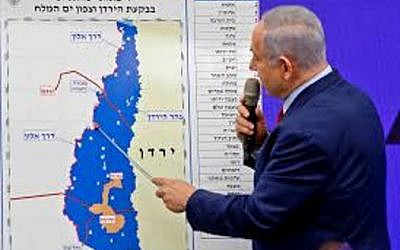
Netanyahu has previously explained the extent of his planned Jordan Valley ‘annexation’. The orange patch in the thicker part of the blue area is the Jericho area. This is part of Area A and is not included in the planned ‘annexation’. {Youtube screen capture}
Yachad may point to some Israeli journalists (notably Ha’aretz) who made the same dishonest claim.  But two liars don’t make a truth.  At least Ha’aretz published the original fragment from Netanyahu’s interview, allowing people to judge for themselves, to spot the spin.
Yachad’s Director now has a last-ditch opportunity to be a mensch: she can write to the group’s contacts, apologising – without reservations, without ‘hochmes’, without trying to squeeze further dishonest propaganda from what she will say is an honest mistake.  She should furthermore publish her apology in the Jewish News and Jewish Chronicle – the same newspapers the group often uses to convey their other messages.  She should apologise in situ for the equally misleading social media posts.
If she chooses not to do all that, then the verdict is inevitable.  This is not about ‘annexation’ or Israel – we can agree or disagree on that.  It’s about ethics; it’s about salvaging a remnant of credibility.
Intellectual dishonesty is always off-putting.  But it is never more appalling than when employed by the self-righteous, by those who seek to cover themselves in the noble mantle of morality.  Lies and deceit make shaky rungs on a ladder leading not to high moral ground – but to the depths of moral turpitude.

Note: a previous version of this article mistakenly stated that no link to the interview was provided in Yachad's email.  It was – though the link was to the text in Hebrew (a language most British Jews do not speak) and it was included in the 'Read more' section at the bottom of the message, where most people would probably ignore it, as I did initially.

Sunday, 10 May 2020

Taking the Mick out of Davis


If I were a rich man,
Yubby dibby dibby dibby dibby dibby dibby dum.
All day long I'd biddy biddy bum.
If I were a wealthy man.  […]
And it won't make one bit of difference if I answer right or wrong.
When you're rich, they think you really know!

An absolute giant of Yiddish literature, Sholem Aleichem populated his stories with all the colourful characters of the Eastern European shtetl.  And one of the most convincing is the ‘gvir’: the rich Jew; the parvenu, the village boss who mistakes subservience for respect and trades ‘charity’ for influence and power.

The Jewish shtetl is a thing of the (nostalgic) past; not so the gvir; that tragi-comic character, it seems, still struts around: among us, but not quite one of us.

*** 

Sir Mick Davis is a very rich man.  He made his money in mining (coal, metals, petroleum); but don’t picture him in a hard hat with black on his nose – I suspect that he mines primarily from the comfort of a well-upholstered, directorial armchair.  And I guess he’s put that money to good use: he is an important donor to the Conservative Party (Labour also likes money; but it doesn’t like Jews – let alone rich ones!)  Davis served as Treasurer and – until recently – Chief Executive of the Tory Party.

I know, I know… a miner called Davis… what a cliché!  But no: Sir Mick ‘the Miner’ isn’t Welsh – he’s Jewish.  So, naturally, he also took an interest in the affairs of British Jewry: in 2009, he became Chairman of the Jewish Leadership Council.  How, you’re asking?  Well… previously, the JLC had been led by an elected official: the President of the Board of Deputies of British Jews.  It looks like Mr. Davis took advantage of a change of guard at the helm of the Board to shoulder aside the new President.  Or (to use the far more delicate language employed by the Jewish Chronicle)
he grasped the reins of its [the JLC’s] executive.
The newspaper commented – perhaps with a hint of irony – that this
may not have been exactly a palace coup but it showed who was boss in town.
Didn't it just!  I should warn you here: irony plays a big role in this story; where are you, Sholem Aleichem, when we most need you?

Mr. Davis first courted controversy in 2010, when he opined (in English and in public) that Israel ‘could become’ an apartheid state.  Some may see quite a bit of irony in that: Mick Davis was born and lived his formative years in Apartheid South Africa.  And… I might be wrong here, but I’ve never seen his name listed among the many South-African Jews who actively fought that appalling regime; unless, that is, one considers immigrating from South Africa to the UK as a brave act of social protest.  If indeed young Mr. Davis omitted to valiantly combat the apartheid in his home country, it must’ve been just a matter of  perspective: it seems it’s easier to recognise (and, consequently, criticise) potential apartheids that ‘may occur’ thousands of miles away; it’s not always easy to spot an actual apartheid operating under one’s very nose.

Mr. Davis’s comments on Israel’s putative apartheid-hood so outraged many in the British Jewish community that a petition was written demanding his resignation from public community positions.  But it was quickly withdrawn, when Sir Mick threatened to let the whole weight of his… err… indignation bear – by threatening to deploy his heavy legal artillery against the poor... err... much less indignant petitioner!  Not, God forbid, that Mr. Davis believes that freedom of speech is for him, but not for others; no, it’s just that, apparently, the petition had ‘misrepresented his positions’…

More recently, Sir Mick has once again become the talk of the (virtual) shtetl: in the cover-page article of the (almost bankrupted, but fortunately freshly resuscitated) Jewish News, he accused “Israeli politics” of “violat[ing] values of the Diaspora”.

I find the article full of (unintended) irony.  So let me read it to you with a running commentary.
Says Sir Mick:
Israel remains surrounded by hostility but its emerging existential threats come from within.
Now, when he’s right – he’s right: the Jewish state is indeed surrounded by enemies: there’s for instance Iran (80 times larger than Israel in area, 9 times in population, 5 times in economic output), whose Holocaust-denying leaders call for Israel’s blood every day – and twice on Saturday.  Leaving aside its nuclear ambitions, Iran has a large, strong and well-equipped military, which is currently busy entrenching itself in Syria, as close as it dares to Israel’s borders.  Another of those borders precariously separates Israel from an Iranian ally: Hezbollah – and its 100,000+ rockets.  To the south, there’s Hamas and the Palestinian Islamic Jihad; i.e., tens of thousands of rockets and mortar rounds, some capable of reaching targets hundreds of miles away.  In Sinai (a territory 3 times larger than Israel, which the Jewish state once controlled but ceded in return for peace and security) lurks a very active branch of the Islamic State.  You know – those nice people who’ve recently beheaded, crucified and burned a broad swath of blood and tears through Syria and Iraq.  And that’s before one thinks of threats that currently seem – for whatever that’s worth in the Middle East – less imminent: such as a certain manic dictator with neo-Ottoman ambitions.

Yet Sir Mick has decreed that these are not really existential threats.  ‘The problem’, he seems to preach to those Israelis who face the rockets, the bullets and the knives, ‘the problem is not that they want to kill you.  No, let me tell you what the real problem is: it’s your own suicidal tendencies!’ 

Now, Mick Davis is certainly entitled to his opinion.  It would be good to understand, however, on what specialist knowledge it is based?  Because, although Costa Coffee has hosted many a debate on grand strategy, it doesn’t actually count as an accredited military academy.

But, as we know, people don’t actually need to have a clue what they’re talking about – they can still talk.  The problem, says Sir Mick, is Israel’s 
own dysfunctional political system.  
And why is that political system so bad?  First, he explains, there are
the hazards of proportional representation.
And I thought “proportional” was actually a positive thing… stupid me!  I thought that it meant that each citizen gets a vote that is worth exactly the same; that the makeup of the Parliament is a true reflection of the views of the electorate, warts and all.  That’s not what ‘first past the post’ delivers. In 2019, for instance, 1 in every 8 Brits (circa 12%) voted for the Liberal Democrats; but, because of the ‘first past the post’ system, that party only has 11 MPs – i.e. a mere 1.7% of the House of Commons.  

In a proportional system, with 12% of the votes they would have gotten, of course 12% of the seats in Parliament – that’s what “proportional” means.

Don’t get me wrong: one can argue about the advantages and disadvantages of either system – till one’s blue in the face; if one donates to the Tories, I suppose that ‘first past the post’ is wonderful – it results in more bang for the buck; if I were to ask Liberal Democrat supporters, they might feel differently.  But is the “proportional representation” any less democratic?

So what is Sir Mick’s beef with Israel’s “proportional representation”.  Well, he tells us:
the outcome is a government the public didn’t vote for, led by a prime minister seemingly driven by holding onto power and propped up by parties who had previously pledged on principle not to govern with him.
So, Mr. Davis doesn’t like the outcome of the elections.  I get that.  I just don’t think that’s a good enough reason to change the system.  No disrespect, Sir Mick!

But why is this new government one “the public didn’t vote for”?  It represents a broad coalition, from left (the Israeli Labour Party) to centre (Blue & White) to right (Likud).  The prime minister will be Benjamin Netanyahu (leader of the largest party, which received 29% of the votes), followed by Benny Gantz (whose party received 27% of the votes).

True, before the elections Gantz promised not to serve in a Netanyahu government.  You caught him there, Mr. Davis, Sir!  He’s a terrible, terrible man – the first politician ever to break a pre-election promise.  I’m sure nothing like that ever happened while you were Chief Executive of the Conservative Party.  (In Gantz’s defence, he may have followed bad examples: before elections, every US president in the past 25 years promised to move the US Embassy to Jerusalem.  It took a quarter of a century to find one that actually did – and I doubt you like him much.)

It is, I agree, terrible that Israel has such a “dysfunctional political system”.  It gets people frustrated.  So unlike UK’s wonderfully functional political system; the one that produced a pro-Remain Parliament despite a clear pro-Brexit referendum; plus 3 years of paralysis, a government begging for elections and an opposition courageously opposing them, etc. etc.

Where Sir Mick is right is that Israel will now have (for a while, at least) a Prime Minister who faces “corruption charges”.  Netanyahu stands accused of having traded favours in return for a ‘kinder treatment’ at the hands of a major news outlet.  British politicians would certainly never do anything like that!  Although there were things… I seem to remember quite a few MPs (including ministers and shadow ministers) dipping their hands rather dishonestly into the public purse…  But that’s a different thing altogether!

Oh, I do admire Sir Mick’s principled stance.  In fact, I herewith demand that Netanyahu’s sorry ass be put in prison – if found guilty by a court of law.  It’s just surprising for me to hear rumours that, in the past, Mr. Davis may have taken a less righteous position against alleged corruption by one of his own underlings.  Well, given those false rumours, I’m sure that Sir Mick cannot but agree with me that people (including the Chairman of the Jewish Leadership Council and the Prime Minister of Israel) are innocent, unless proven guilty.

It’s only halfway through his article that Mr. Davis comes to the issue that really awoke his ire: the planned annexation by Israel of parts of the West Bank – in accordance with the latest US ‘Peace to Prosperity’ plan.
When we talk of existential threats to Israel, then annexation is the genuine article.
That’s, of course, a valid opinion.  Unfortunately for Mr. Davis, it is just the opinion of an outsider.  Sir Mick is not Israeli; he is a British citizen, paying his taxes in the UK.  It is Israeli citizens (i.e., people who live in Israel, pay taxes in Israel, serve in the army in Israel and risk being bombed to smithereens in Israel) that are entitled to decide (as opposed to opine) what constitutes genuine existential threats to Israel.  And a clear majority of those Israeli citizens voted for parties that accepted the US proposal.

But it doesn’t look like Sir Mick is content with ‘just’ an outsider’s opinion:
The keep your wallets open and mouths shut model of Israel-Diaspora relations was viable when Diaspora Jewry saw in Israel’s political leadership an embodiment of its values rather than a violation of them.
The “wallets open” was understood – and not just by me – as a hint.  After all, as the Jewish News says, Sir Mick is not just any outsider; he is
[o]ne of Britain’s biggest philanthropists to Israel.
I just wonder if, when Mr. Davis decided to give whatever he gave “to Israel” (or, more likely, to whatever causes and organisations he finds useful in Israel), he informed people that those donations came with a clear caveat: ‘I pay – I get the say’.  ‘Coz, had he said so to me (I’m Israeli), I would’ve told him to keep his money.  I have no idea what Sir Mick’s experience is with donations to the Conservative Party; but Israel is a sovereign country.

Isn't 'philanthropy' something done without ulterior motives?


Apparently, however, some sovereign countries have duties to set up other sovereign countries.  How else am I to understand Sir Mick’s sententious determination that Israel has a
moral and strategic imperative to extricate itself from ruling over [the Palestinians].
Before I read Sir Mick’s wise words, I rather stupidly thought it’s the task of every nation that doesn’t yet have independence to “extricate” itself from its rulers.  Including by making the necessary concessions and compromises to achieve that goal.  As Jews – and Indians, and Pakistanis – did in 1947.  In Sir Mick’s perfect world, however, it is the sacred duty of Israel to   offer
a tangible alternative on this issue.
Well, a (or, rather, another) “tangible alternative” has just been offered by the US Administration.  It may not be an administration to Sir Mick’s liking; it may not be an “alternative” he likes, or that the Palestinians like.  But, surely, Mr. Davis hasn’t made his millions by walking away from deals, simply because the opening offer wasn’t to his liking.  While the US document unsurprisingly expresses a US ‘Vision’, it also leaves the door wide open for negotiations:
The peace agreement that will hopefully be negotiated on the basis of this Vision should be implemented through legally binding contracts and agreements (the “ISRAELI-PALESTINIAN PEACE AGREEMENT”).
In fact, the reputed architects of the ‘Vision’ have gone to great pains to make that clear.  Speaking about the Palestinian leadership in an interview he gave to an Egyptian media outlet, Jared Kushner said:
If there are things they want to change, if they don’t like where we drew the lines, they should come and tell us.
Were they able and willing to make peace, the Palestinian leaders could simply have said ‘We agree with the principle that there should be an independent Palestinian state alongside Israel.  Everything else – let’s negotiate.’

In the absence of such a response, Israel’s ‘duty’ of providing “a tangible alternative” becomes a duty to provide ‘a tangible alternative acceptable to the kind of leadership for whom no alternative was acceptable in the past 100 years’.  I am not as knowledgeable as Sir Mick – but I found no such ‘duty’ in the Torah.  Maybe it’s in the Statutes of Values of the Diaspora that he appears to own.

But the relationship with the Palestinians isn’t Sir Mick’s only imputation towards the Jewish state.  Israel, he intones
must radically improve social mobility within its own society.
And why does he think that Israel has such poor social mobility?  Because
for an OECD country, Israel’s gaps between rich and poor are extraordinary.
Some may view as ironic that a multi-multi-millionaire preaches about narrowing the “gaps between rich and poor”.  But beyond the irony, according to OECD data, Israel has a Gini Coefficient of 0.35.  UK’s is 0.36. Gini is a widely used measure of income inequality: 0 (zero) corresponds to perfect equality, 1 (one) to worst possible inequality – so the lower, the better.  Well, I’d like to think that Sir Mick applies more rigorous research and due diligence to his business dealings than he does to his pronouncements on social issues.  Otherwise, I’d say such sloppiness is… how should I put it… “extraordinary”!

Income Inequality in OECD countries.  Israel in red.  The UK is the 4th bar to the right of Israel.


Next, Sir Mick’s bounces from pseudo-economics back to pseudo-politics:
Israel advocates around the world, of which I am one, boast about the full citizenship rights of Israel’s Arab citizens and their role in Israeli life. However, the MKs those citizens elect are still considered governmentally trayf.
Firstly, on behalf of all my countrymen, I’d like to thank Sir Mick for his unparalleled advocacy.  It’s valiant defenders like him that make us feel so much safer!

However, the rest of the passage is a bit of a spin.  Those MKs are not considered “governmentally trayf” because they are Arabs (indeed, one of them happens to be Jewish); nor because they are elected by Arabs (there are Jews who vote for the ‘Arab List’ and there are Arabs who vote for the ‘Jewish’ parties);  no, the problem is not the ethnicity or religion of those MKs or of their supporters – but the political views that they represent.  It’s about Zionism vs. anti-Zionism, yes – but not just.  The Arab Joint List includes a communist party; a hyper-nationalist party; and an Islamist Party.  Given the record of those ideologies in the region and the world, mainstream Israeli politicians may perhaps be forgiven for not wanting such parties in the governing coalition.

But the issue is more fundamental than that.  In a parliamentary democracy, there is a right to vote, to elect their parliamentary representatives (and be elected as such); I wasn’t aware that there was a right to have one’s representatives included in the governing coalition – whatever their politics.  Are you making up democratic rules as you go along, Mr. Davis?

Apparently, Sir Mick’s list of Israel’s many violations of ‘values of the Diaspora’ also includes the fact that the Jewish state has failed to teach British Jews Hebrew:
How for example, can we nurture a thriving and mutual beneficial sense of shared peoplehood, when so many Diaspora Jews, particularly in the English-speaking world are unable to speak Hebrew, the language of their homeland?
That is indeed a problem – and I must thank Mr. Davis for pointing it out.  Too bad he pointed it out… in English; in a Diaspora Jewish English language newspaper!

And it’s not Israel’s only linguistic and cultural sin.  Mr. Davis also determines that:
Jewish Israelis need more and better education in Arabic and Arab culture. Arab Israelis need more and better education in Jewish culture and history.
Don’t you just looove one that always asks for “more and better” – but fails to even mention what has already been achieved?  To start with, most Israelis (or their parents or grandparents) hail from Arab lands – so Arab culture is hardly unfamiliar to them.  Arabic is part of the curriculum in most Israeli secular schools – at all levels.  True, it is not compulsory to study Arabic – it’s one of the optional languages students can choose to study (and many do).  In recent years, more teachers of Arabic are employed in Jewish schools – no doubt because Mr. Davis has determined that this is the way forward.  Most Arab Israeli parents understandably choose to give their kids an education in Arabic schools – but that education includes the study of Hebrew.

And actually, may I suggest that – before he idly shoots his mouth off again – Sir Mick takes the time and the trouble to watch the excellent Israeli series ‘Fauda’?  It is available on Netflix.  With English subtitles, Sir Mick; no worries!

Don’t get me wrong: Mr. Davis can actually have a say on how Israel looks like – and how she should look like in the future; once he comes to live there, of course.  I’m sure he has enough money to buy himself a decent flat in Sderot!

But, let’s face it – he is unlikely to make Aliyah.  In fact, he doesn’t even envisage such possibility.  He bashes Israel ‘as a Jew’ from the Diaspora.  Why?  A very charitable explanation would be ‘because he cares’.  It’s a very strange way to show it, but hey-ho…

Unfortunately, I am more inclined to believe an explanation that Sir Mick himself let slip at some point:
I think the government of Israel […] have to recognise that their actions directly impact me as a Jew living in London, the UK.  When they do good things it is good for me, when they do bad things, it's bad for me. And the impact on me is as significant as it is on Jews living in Israel.
There are no less than 4 rather emphatic me’s in that short peroration.  It would seem that Mick Davis does care deeply… about Mick Davis!

Well, Mr. Davis Sir, as an Israeli who served for 20 years in the IDF, I am sorry for all the inconvenience that we caused you!

Oh, and… for whatever it’s worth, this Jewish Israeli (of the Ashkenazi variety) loves the Arabic language and culture.  Take for instance this brilliant proverb, which applies so well to you and your hatchet-job of an article:
الكلاب تنبح والقافلة تسير
It means: ‘The dogs bark, but the caravan moves on’.  So long, Sir Mick!

 
;